
Quick answer
Psychological safety is the shared belief that it's safe to speak up at work — to ask a question, raise a concern, admit a mistake or offer a half-formed idea — without fear of being punished or humiliated. The term was defined by Harvard professor Amy Edmondson. It is the strongest single predictor of team performance, and it is built through everyday behaviour rather than announced as a value on the wall.
Key takeaways
- Psychological safety is the shared belief that it's safe to take interpersonal risks on a team.
- Amy Edmondson defined it, and Google's Project Aristotle found it to be the strongest predictor of team performance — ahead of talent, experience or seniority.
- It is a team-level climate, distinct from one-to-one trust, and it does not mean lower standards or being agreeable.
- It is built through leader behaviour, and it has to be felt to take hold — explaining it from a slide rarely changes anything.
What psychological safety actually means
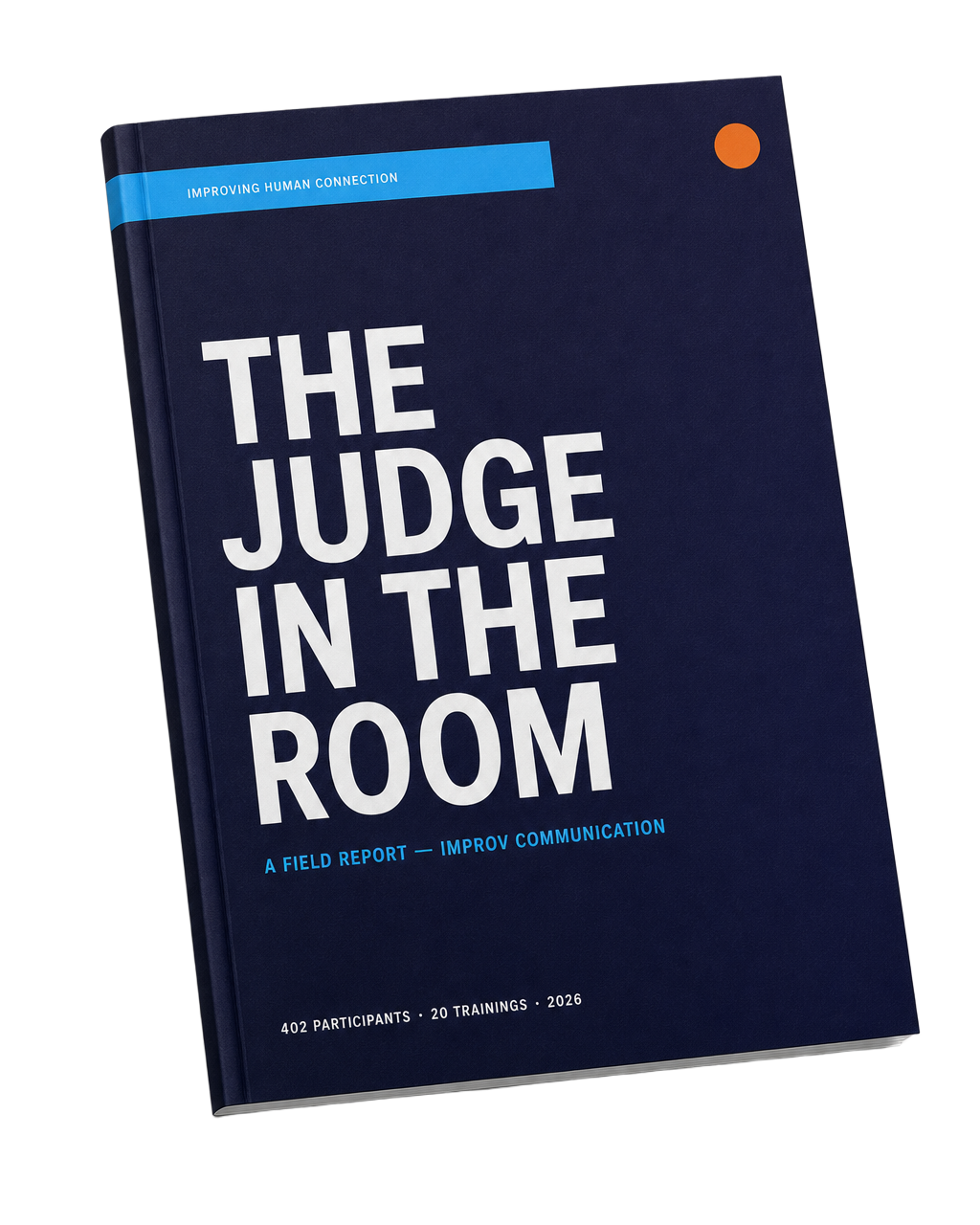
Free field report
The Judge in the Room — what 402 people told us about psychological safety.
Psychological safety is the shared sense, on a team, that you can take an interpersonal risk and be met with respect rather than punishment. The risks are ordinary and constant: asking the question that might sound naive, admitting you got something wrong, disagreeing with the senior person in the room, or offering an idea before it's fully formed.
Amy Edmondson, a professor at Harvard Business School, gave the concept its modern definition through her research on hospital teams in the 1990s. She noticed something counter-intuitive: the best-performing teams appeared to report more errors, not fewer. The better teams weren't making more mistakes. They felt safe enough to talk about the ones they made, which meant they learned faster and caught problems earlier. The willingness to be honest about what's going wrong turned out to be a feature of high performance, not a sign of weakness.
That is the heart of it. Psychological safety is what lets a team's real information reach the surface — the doubts, the questions, the early warnings and the unpolished ideas — instead of staying locked in people's heads where they help no one.
Three things psychological safety is often confused with
The phrase is used loosely, and three misconceptions get in the way of building it.
It's a team climate, not one-to-one trust. Trust is about how much you rely on a particular person. Psychological safety is a property of the group — the shared expectation of how people here respond when someone speaks up. You can trust a colleague deeply and still hold back in a meeting where the wider climate feels unsafe.
It's about candour, not comfort. A psychologically safe team is one where hard things get said, not one where everyone is kept comfortable. Safety is what makes it possible to give difficult feedback, challenge a decision and name a problem early. Mistaking it for niceness produces the opposite of what it's for.
It raises the standard rather than lowering it. The worry leaders raise most often is that safety means letting people off the hook. The evidence points the other way. Edmondson's own model pairs psychological safety with high standards: when both are high, a team reaches what she calls the learning zone — people are stretched and free to be honest about how it's going. Safety without standards is comfortable and complacent; standards without safety produce anxiety and silence. The two work together.
Why psychological safety matters
For years this could be dismissed as a soft idea. The evidence has closed that conversation.
When Google set out to understand why some of its teams outperformed others, it studied 180 teams over two years in a project called Aristotle. The expectation was that the strongest teams would have the most talented people and the deepest experience. They didn't. The single strongest predictor of team performance was psychological safety — whether people felt safe to take interpersonal risks. It mattered more than who was in the room.
The reason is practical. Most of what an organisation needs to know already exists inside it — the engineer who senses the timeline is wrong, the new joiner who spots a gap, the manager with a doubt about the strategy. On a team where it's safe to speak, that information surfaces in time to act on it. On a team where it isn't, it stays silent, and the organisation pays the cost without ever seeing the bill. Research by James Detert and Amy Edmondson found that 85% of professionals had at least one occasion when they felt unable to raise a concern with their boss, even though they believed it mattered.
A 2024 global study by BCG reached the same conclusion from another angle, finding psychological safety to be the strongest predictor of team performance and a significant buffer against burnout and attrition. In a period where most of the value comes from how quickly people adapt, a workforce that holds back is expensive, week after week.
The four stages of psychological safety
One useful way to think about how psychological safety grows is Timothy R. Clark's model of four stages. People first need to feel safe to belong (inclusion safety), then safe to learn and ask questions (learner safety), then safe to contribute their work (contributor safety), and finally safe to challenge the status quo (challenger safety). Most teams manage the first two and stall at the last — challenger safety, the freedom to question how things are done, is the hardest to reach and the most valuable when innovation is the goal.
How psychological safety is built
Psychological safety is built through behaviour, and most of the behaviour that matters is the leader's. A few moves do most of the work.
Leaders go first with their own fallibility — saying "I got this wrong" or "I don't know, what am I missing?" — which lowers the cost of honesty for everyone watching. They reward the person who raises the inconvenient concern rather than the easy good news, because how a leader responds in that moment teaches the room far more than any policy. They separate generating ideas from judging them, so people offer the rough thought before it's edited away. And they meet a half-formed idea with "Yes, and" rather than a correction, signalling that contribution is welcome before it's perfect.
What undoes all of this is the small reaction in the high-stakes moment — the flicker of irritation at bad news, the quick correction, the "we've already been through this". People don't calibrate their honesty to what leaders say. They calibrate it to what leaders do.
How psychological safety is measured
Psychological safety can be measured. Amy Edmondson developed a seven-item survey that asks people to rate statements about their team — whether it's safe to take a risk, whether mistakes are held against you, whether it's easy to ask others for help. The scores give a clear read on where a team sits and, repeated over time, show whether it's moving. Her research has since been built into The Fearless Organization Scan, the official measurement tool, which produces a Psychological Safety Index across four domains and benchmarks a team against a global dataset. IMPROV facilitators are certified practitioners of the Scan, so we measure a team properly before designing the work. Beyond any survey, the behavioural signals are visible to anyone watching closely: who speaks in meetings, how a mistake is met, whether the quiet people contribute.
Why psychological safety has to be felt, not taught
Most leaders, once they see the evidence, reach for the obvious fix. They tell people the door is always open. They add "psychological safety" to the values. They ask, at the end of the meeting, whether anyone has concerns. It rarely changes anything, because safety isn't a policy people read — it's an experience people have, again and again, until they believe it.
This is the part a slide can't deliver. A team can know the definition perfectly and still hold back, because the body learns safety through what actually happens in the room, not through what it's told. It's the reason our work is experiential. We put teams through situations where they feel the difference — between a room that judges and a room that supports — and practise the behaviours until they hold up when the pressure is real. Everyone talks about psychological safety. The work is making people feel it.
Free field report
The Judge in the Room
What 402 people told us about psychological safety — and what you can do with it on a Monday morning. Five findings, seven practices, participants’ own words.
FAQ
Frequently asked questions
- What is psychological safety?
- Psychological safety is the shared belief that it's safe to speak up on a team — to ask questions, raise concerns, admit mistakes and offer ideas — without fear of being punished or humiliated. It is the strongest predictor of team performance.
- Who came up with psychological safety?
- The modern concept was defined by Amy Edmondson, a professor at Harvard Business School, through her research on teams in the 1990s. Google's Project Aristotle later confirmed its importance, and Timothy R. Clark added the four-stages model.
- Why is psychological safety important at work?
- Because it lets a team's real information — doubts, questions, early warnings and unfinished ideas — reach the surface in time to act on it. Research consistently links it to better performance, faster learning, more innovation and lower attrition.
- Is psychological safety the same as trust?
- No. Trust is about how much you rely on a particular person; psychological safety is a team-level climate — the shared expectation of how people respond when someone speaks up. You can trust a colleague and still feel unsafe in the wider group.
- Does psychological safety mean lower standards?
- No. It works best paired with high standards. When both are high, a team reaches what Edmondson calls the learning zone — people are stretched and free to be honest about how it's going. Safety replaces the fear that stops people contributing, not the standard they're held to.
- How do you build psychological safety?
- Through leader behaviour: modelling your own fallibility, rewarding people who raise difficult things, separating idea-generation from judgement, and responding well to half-formed ideas. Because it's felt rather than understood, experiential practice tends to build it faster than classroom teaching.
Keep reading
Related from IMPROV
- How do you build psychological safety in a team?Explore →
- How do you measure psychological safety?Explore →
- Psychological safety vs trust: what's the difference?Explore →
- The four stages of psychological safetyExplore →
- How leaders accidentally destroy psychological safetyExplore →
- Psychological Safety TrainingExplore →
Curious?
Is your team losing ideas to silence?
That's exactly what we help leaders see and shift. No pitch — just a proper conversation about your team.