Quick answer
Psychological safety can be measured. The original instrument is Amy Edmondson's seven-item survey, which asks people to rate how safe it feels to make a mistake, raise a problem, take a risk and ask for help on their team. Edmondson's work has since been built into The Fearless Organization Scan — the official measurement tool, which produces a Psychological Safety Index across four domains and benchmarks a team against a global database. Behavioural signals matter too: who speaks in meetings, and how mistakes are met.
Key takeaways
- Psychological safety is measurable, starting with Amy Edmondson's validated seven-item survey.
- The Fearless Organization Scan is the official tool built on Edmondson's research — it produces a Psychological Safety Index across four domains and benchmarks against a global dataset.
- Numbers tell you where a team sits; behavioural signals and repeat measurement tell you whether it's moving.
- IMPROV facilitators are certified Fearless Organization Scan practitioners, so measurement can be the baseline for a programme rather than a one-off snapshot.
Yes, psychological safety can be measured
Free field report
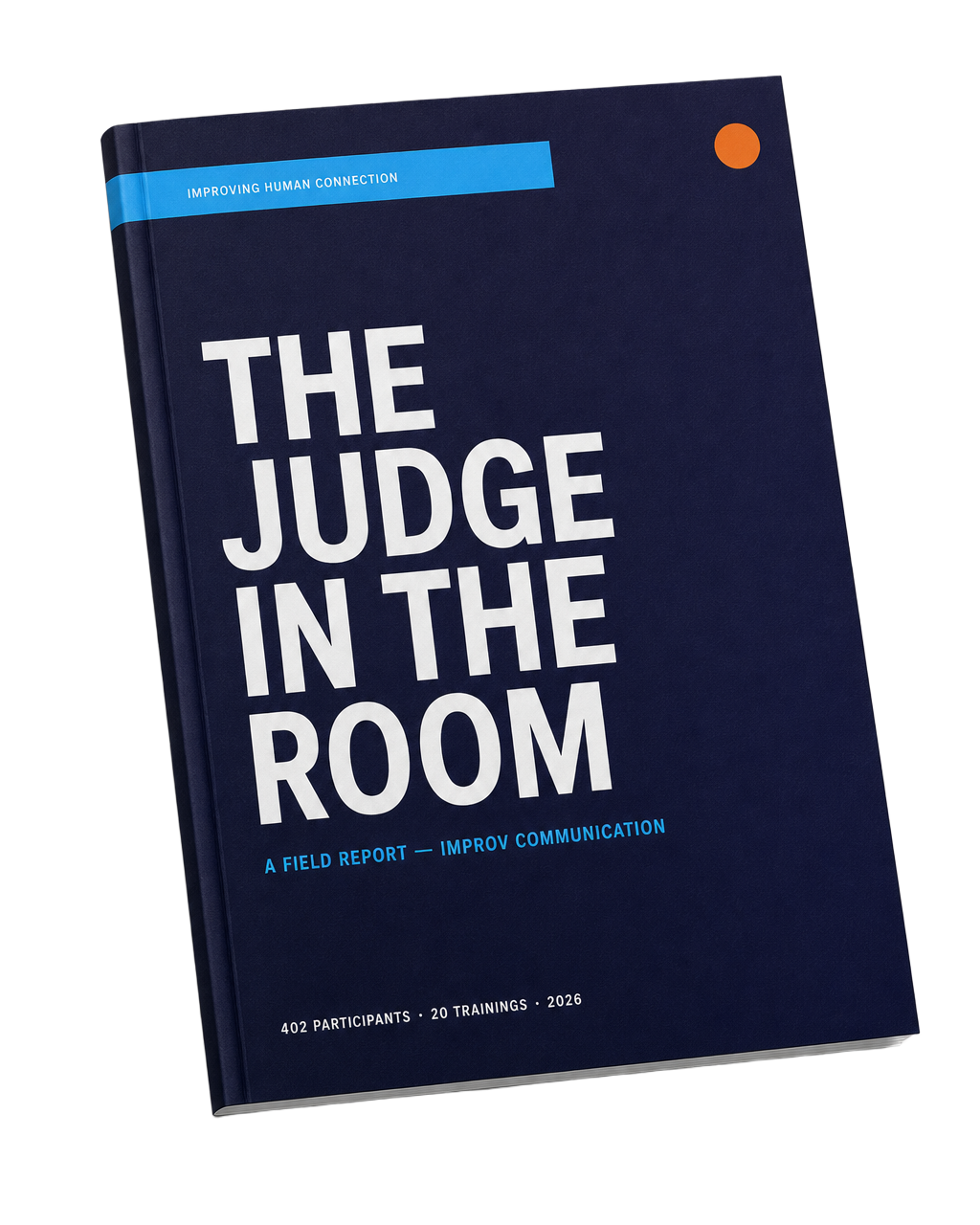
The Judge in the Room — what 402 people told us about psychological safety.
Because psychological safety is a felt thing, leaders often assume it can't be measured. It can. The concept has been studied rigorously for twenty-five years, and the instruments are well validated. You can put a number on where a team sits today, and — more usefully — track whether it's moving over time.
Edmondson's seven questions
The original measure comes from Amy Edmondson's 1999 research. It asks people to rate seven statements about their team on a scale from strongly disagree to strongly agree. Paraphrased, they cover:
- Whether a mistake made on this team tends to be held against you
- Whether people are able to raise problems and tough issues
- Whether the team accepts people who are different, rather than rejecting them
- Whether it feels safe to take a risk
- Whether it's easy to ask other people on the team for help
- Whether colleagues would deliberately undermine your efforts
- Whether your unique skills and contributions are valued and used
Three of the items are worded negatively on purpose, so that agreeing isn't always the "good" answer — it stops people sailing through on autopilot. Averaged across a team, the responses give a clear read on the climate, and they're the foundation every later tool builds on.
The Fearless Organization Scan — the official measure
Edmondson's research has since been built into a dedicated assessment, The Fearless Organization Scan, which translates her work into a Psychological Safety Index. Rather than a single score, it measures a team across four domains:
- Open conversation — whether people feel safe to speak up and raise concerns
- Attitude to risk and failure — how openly the team shares mistakes and learns from them
- Willingness to help — how readily people support one another
- Inclusion and diversity — whether differences are accepted, and people aren't rejected for being different
Breaking the score into four domains is what makes it useful: two teams can have the same overall level for very different reasons, and the domains show you exactly where to work. The Scan also benchmarks a team against a large global dataset, so a result reads as "high or low compared with everyone else", not just an abstract number.
We use it directly. IMPROV facilitators are certified practitioners of The Fearless Organization Scan, which means we can measure a team properly, interpret the four domains with them, and build the training around what the data actually shows — rather than guessing at where the gaps are.
What the survey can't see — and the body can
A survey is a snapshot of perception. It's worth reading alongside the behavioural signals that are visible to anyone watching a team closely. Who speaks in meetings, and who never does. How a mistake is met — with curiosity or with a search for blame. Whether the quiet people contribute, or whether the same three voices fill the room. Whether bad news travels up quickly or arrives late. These observations and the survey tell the same story from two angles, and together they're more honest than either alone.
Measure twice: before and after
A single measurement tells you where you stand. The real value comes from measuring twice — before an intervention and again after — so you can see whether anything actually moved. Psychological safety is a behaviour that builds over weeks, so a sensible rhythm is to scan at the start, run the work, and re-scan after the follow-up window. That before-and-after view turns "we think it helped" into evidence.
A few pitfalls to avoid
Measurement goes wrong in predictable ways. Survey people without genuine anonymity and they'll tell you what's safe to say, not what's true — which, on a topic about safety, defeats the point. Measure once and never again, and you have a number with no direction. And treat a low score as a verdict on individuals rather than a feature of the climate, and you'll teach people never to answer truthfully again. The score is information about the system, not a report card on the people in it.
From number to change
A score is a starting point. On its own, a measurement changes nothing — what changes a team is the behaviour that follows it. This is why we treat the Scan as the opening move of a programme: measure the four domains, show the team where they stand against the benchmark, then do the experiential work that shifts the behaviours, and measure again to see what held. The number tells you where to aim. The practice is what moves it.
Free field report
The Judge in the Room
What 402 people told us about psychological safety — and what you can do with it on a Monday morning. Five findings, seven practices, participants’ own words.
FAQ
Frequently asked questions
- Can psychological safety really be measured?
- Yes. Amy Edmondson's validated seven-item survey has measured it since 1999, and The Fearless Organization Scan built on her research turns it into a Psychological Safety Index across four domains, benchmarked against a global dataset.
- What is The Fearless Organization Scan?
- It is the official psychological-safety measurement tool, based on Amy Edmondson's research. It measures a team across four domains — open conversation, attitude to risk and failure, willingness to help, and inclusion and diversity — and benchmarks the result against a large global database. IMPROV facilitators are certified practitioners.
- What are Amy Edmondson's seven questions?
- Seven statements people rate about their team — covering whether mistakes are held against you, whether it's safe to raise problems and take risks, whether it's easy to ask for help, whether differences are accepted, and whether your contribution is valued. Three are worded negatively on purpose.
- How often should you measure psychological safety?
- At least twice — before an intervention and after the follow-up window — so you can see whether it moved. Many teams then re-measure periodically to keep the climate visible.
- What's a good psychological safety score?
- It's most meaningful relative to a benchmark rather than in the abstract, which is why the Scan compares a team against industry, country and global data. The pattern across the four domains matters more than any single number.
Keep reading
Related from IMPROV
Curious?
Is your team losing ideas to silence?
That's exactly what we help leaders see and shift. No pitch — just a proper conversation about your team.