
Quick answer
Psychological safety is built through behaviour, not policy — and most of the behaviour that matters is the leader's. The moves that do the work are simple: go first by admitting your own mistakes, reward the person who raises a difficult thing, separate generating ideas from judging them, and meet a half-formed idea with "Yes, and" rather than a correction. You can't announce safety into being. People learn it from what leaders do in the high-stakes moment.
Key takeaways
- Psychological safety is built through repeated behaviour, not a policy or a value on the wall.
- Most of the behaviour that matters is the leader's — people calibrate their honesty to what leaders do.
- Four moves carry most of the load: go first, reward the messenger, separate creating from judging, and build on half-formed ideas.
- It's a behavioural skill, so it builds faster through practice than through being explained.
You can't announce your way to psychological safety
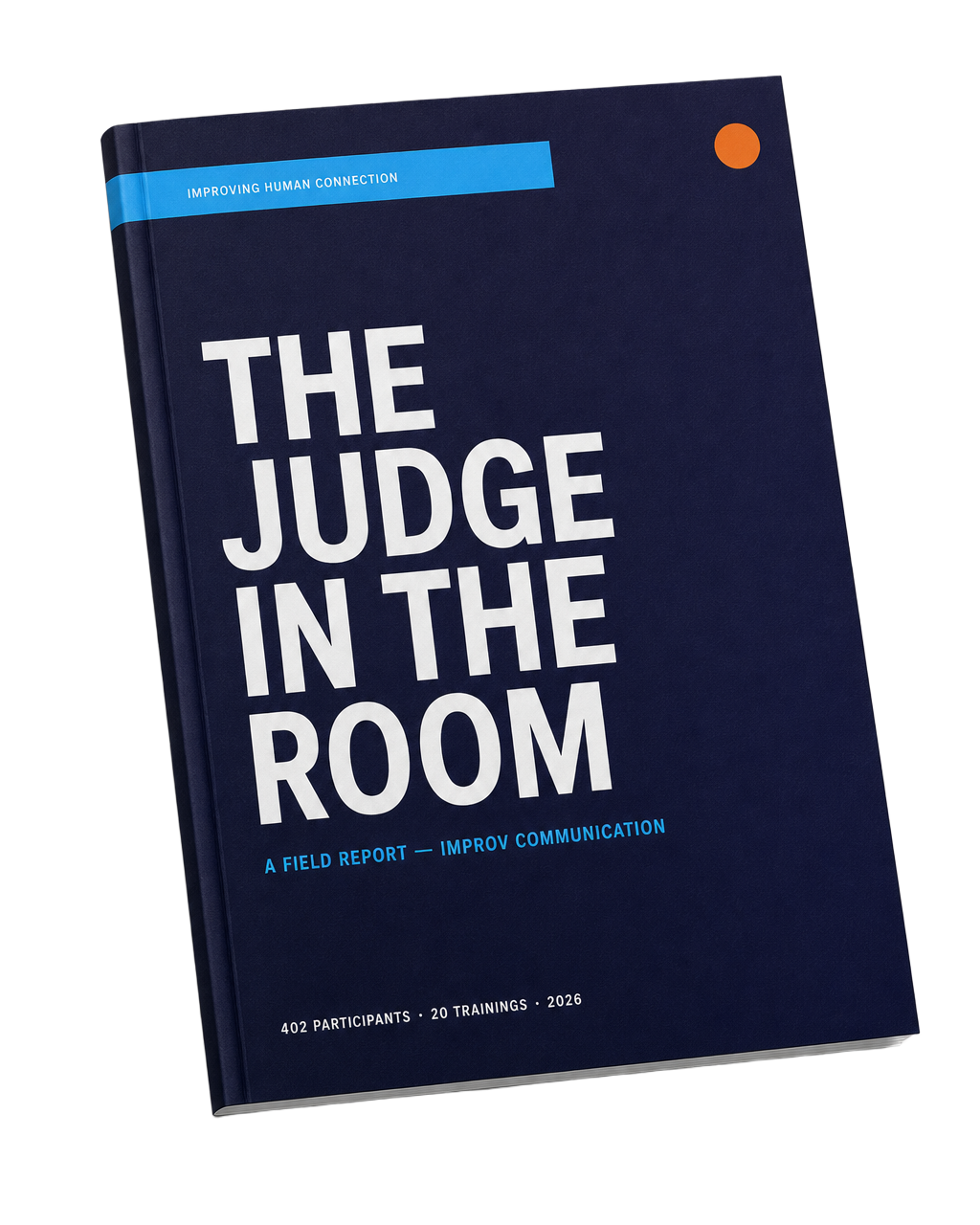
Free field report
The Judge in the Room — what 402 people told us about psychological safety.
Most leaders, once they're sold on the idea, reach for the obvious fix. They tell people the door is always open. They add "psychological safety" to the team values. They ask, at the end of a meeting, whether anyone has concerns. And very little changes.
The reason is that people don't calibrate their honesty to what leaders say. They calibrate it to what leaders do — especially in the small, high-stakes moments. The first time someone raises a real concern and is met with a flicker of irritation or a quick correction, the whole room recalculates. The door may be open. The lesson is to stay out of it.
Safety isn't a policy you publish. It's an experience people have, again and again, until they believe it. Which means building it is a matter of behaviour, repeated, until the team trusts the pattern.
The leader sets the temperature
In any team, the most-watched person is the one with the most power. People read the leader constantly for cues about what's safe — what gets rewarded, what gets punished, what gets a sigh. That makes the leader's behaviour the single biggest lever on the climate. The good news is that this is learnable. A few moves carry most of the weight.
Go first with your own fallibility
The fastest way to make it safe for others to be uncertain is to be uncertain yourself, out loud. When a leader says "I got this wrong" or "I don't know — what am I missing?", they lower the cost of honesty for everyone watching. It signals that being unfinished is allowed here, even at the top. Teams match the candour they see above them, so a leader who hides every doubt teaches everyone else to do the same.
Reward the messenger, especially when it stings
The moment that defines a team is the inconvenient one — the warning nobody wanted, the dissent, the question that exposes a gap. How a leader responds in that moment teaches the room far more than any policy. Thank the person who raised it, even when — perhaps especially when — you'd rather not have heard it. Punish it once, even with a tone, and you've taught everyone to bring you good news only.
Separate creating from judging
Most teams kill their best ideas by evaluating them the instant they're spoken. Generating ideas and judging them are different jobs, and doing both at once means people only ever offer the safe, finished thought. Make space to gather ideas before anyone critiques them — name which mode the room is in — so the rough, unformed contributions get a chance to grow before the red pen comes out.
Meet the half-formed idea with "Yes, and"
When someone offers a rough thought, the instinct to correct or improve it shuts the next person down. Building on it instead — taking what's useful and adding to it — signals that contribution is welcome before it's perfect. It's a small habit with a large effect on how freely a team thinks, and it's why "Yes, And" sits at the centre of how we work.
What quietly undoes it
Most damage to psychological safety isn't dramatic. It's the small reaction in the charged moment: the interruption, the eyes flicking to a phone when someone tentative starts to speak, the "we've already been through this", the idea claimed by someone more senior. None of it feels like a big deal to the leader. To the person who took the risk, it's the data that decides whether they speak up next time. Watch your own first reactions — the half-second before you reply is where safety is made or lost.
Where to start on Monday
You don't need a programme to begin. Pick one meeting this week and try three things: open by naming something you got wrong recently, ask a real question and let the silence sit until someone fills it, and when the first rough idea arrives, build on it out loud instead of assessing it. Then watch who speaks who normally doesn't. That's the signal the climate is shifting.
Why this builds faster by doing than by telling
Every behaviour above is simple to understand and hard to do under pressure, when you're busy, triggered, or hearing something you'd rather not. Knowing what psychological safety requires and being able to hold it in a tense moment are different things — the second is a skill, and skills are built by practising them, not by reading about them.
That's the thinking behind our work. We put teams and leaders through situations where they feel the difference between a room that judges and a room that supports, and rehearse these behaviours under mild, safe pressure until they hold up when the pressure is real. Everyone can learn the four moves in ten minutes. Living them when it counts is the part worth practising.
Free field report
The Judge in the Room
What 402 people told us about psychological safety — and what you can do with it on a Monday morning. Five findings, seven practices, participants’ own words.
FAQ
Frequently asked questions
- How long does it take to build psychological safety?
- The first shifts can happen in a single session, as people feel the difference. Lasting change takes weeks of reinforced behaviour — the research on behaviour change points to motivation, manager reinforcement and follow-up over roughly a month or more.
- Whose job is it to build psychological safety?
- Everyone contributes, and the leader carries the most weight, because people read the most-powerful person in the room for cues about what's safe. Leader behaviour sets the climate.
- Can you build psychological safety in a remote team?
- Yes. The behaviours are the same — going first, rewarding candour, building on ideas — and they need more deliberate attention online, where silence and disengagement are harder to read.
- What's the single most important first step?
- Go first with your own fallibility. A leader admitting a mistake or a "I don't know" lowers the cost of honesty for everyone else faster than any other move.
- How do you rebuild psychological safety once it's damaged?
- Slowly, and through consistency. Name that you want more candour, then prove it by responding well the next several times someone takes a risk. One good response won't undo a pattern; a run of them will.
Keep reading
Related from IMPROV
Curious?
Is your team losing ideas to silence?
That's exactly what we help leaders see and shift. No pitch — just a proper conversation about your team.