
Quick answer
The four stages of psychological safety are a model developed by Timothy R. Clark describing how safety grows on a team. People first need to feel safe to belong (inclusion safety), then safe to learn and ask questions (learner safety), then safe to contribute their work (contributor safety), and finally safe to challenge the way things are done (challenger safety). Most teams reach the first three and stall at the fourth — and challenger safety is the one that matters most for innovation.
Key takeaways
- The four-stages model is Timothy R. Clark's framework, building on Amy Edmondson's concept of psychological safety.
- The stages are inclusion safety, learner safety, contributor safety and challenger safety, and people move through them in order.
- Each stage unlocks a different behaviour: belonging, learning, contributing and finally challenging.
- Most teams stall before challenger safety — the freedom to question the status quo, and the most valuable stage for innovation.
A map for how safety grows
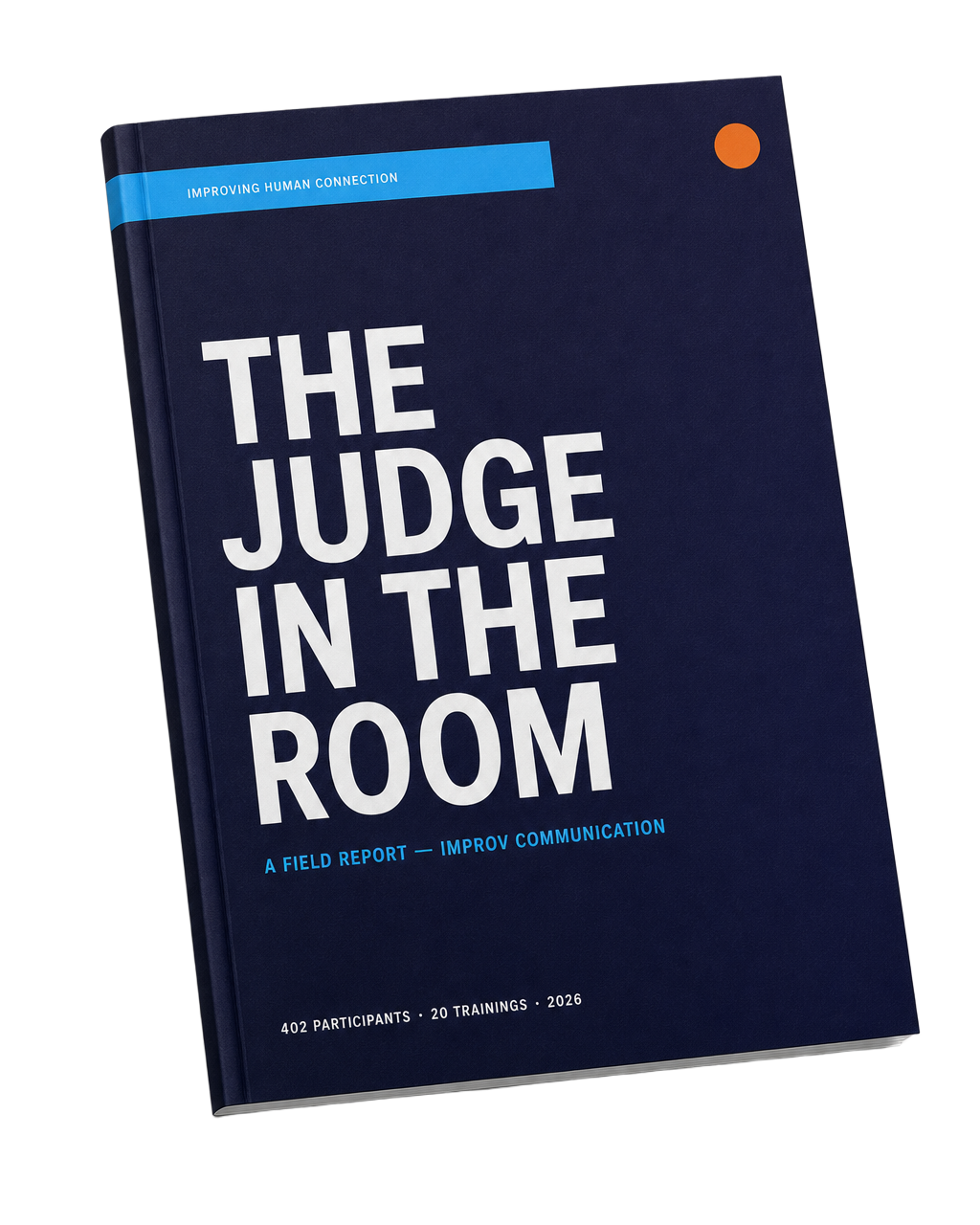
Free field report
The Judge in the Room — what 402 people told us about psychological safety.
Amy Edmondson defined what psychological safety is and showed why it predicts team performance. Timothy R. Clark, in his book The 4 Stages of Psychological Safety, added a useful complement: a map of how it develops, stage by stage. People don't arrive at full candour all at once. They grow into it, and the four stages describe that path — each one unlocking a behaviour the stage before it makes possible.
Stage 1 — Inclusion safety
The first need is to belong. Inclusion safety is the feeling that you're accepted for who you are, that you can be present and be yourself without being excluded or made to feel lesser. It's the foundation: until people feel they belong, nothing else is available to them. On a team with inclusion safety, a new joiner, a quieter personality or someone from a different background feels part of the group rather than on the edge of it.
Stage 2 — Learner safety
Once people belong, they need to feel safe to learn — to ask the question, admit they don't know something, try, and get it wrong without being punished for it. Learner safety is what lets people grow. Where it's missing, people hide their gaps, pretend to understand, and never ask the question that would have saved a week. Where it's present, "I don't get this — can you explain?" is an ordinary thing to say.
Stage 3 — Contributor safety
Next comes the freedom to contribute — to use your skills and make a real difference, with the autonomy to do meaningful work. Contributor safety is the sense that your input is wanted and your judgement is trusted. People who feel it bring their full ability to the team rather than holding it in reserve. Without it, capable people do the minimum and keep their best thinking to themselves.
Stage 4 — Challenger safety
The final stage is the hardest and the most valuable. Challenger safety is the freedom to question the way things are done — to challenge the status quo, push back on a decision, and suggest a better way, even to someone more senior, without fear of damage to your standing. This is where genuine innovation lives, because every improvement starts as someone saying "I think we could do this differently."
Where most teams stall
Most teams manage the first three stages and stop short of the fourth. People feel they belong, can learn and can contribute — and still won't challenge a leader's decision or name the thing everyone is quietly thinking. That gap is where organisations lose their best ideas and their early warnings. Challenger safety asks the most of a leader, because it means being questioned, and it returns the most, because it's the stage where teams improve themselves.
How this relates to Edmondson's work
The four stages and Edmondson's research are complementary rather than competing. Edmondson defined the concept and gave us the way to measure it; Clark gave us a developmental sequence for building it. In practice they fit together: you can use a measurement like The Fearless Organization Scan to see where a team stands, and think in terms of the four stages to understand which behaviour to work on next — most often, helping a team that already contributes well take the step into challenging.
How a team moves up the stages
Progress comes from the leader lowering the cost of each successive risk. You build inclusion by making everyone fully part of the group, learner safety by treating questions and mistakes as normal, contributor safety by giving people real autonomy, and challenger safety by actively inviting dissent and responding well when it comes — thanking the person who pushes back rather than defending against them. Each stage is a behaviour the team practises until it holds, which is why the most reliable way to climb the stages is to experience them, together, in a setting where taking the next risk is safe.
Free field report
The Judge in the Room
What 402 people told us about psychological safety — and what you can do with it on a Monday morning. Five findings, seven practices, participants’ own words.
FAQ
Frequently asked questions
- Who created the four stages of psychological safety?
- Timothy R. Clark, in his book The 4 Stages of Psychological Safety. The model builds on Amy Edmondson's original concept of psychological safety.
- What are the four stages?
- Inclusion safety (safe to belong), learner safety (safe to learn and ask questions), contributor safety (safe to use your skills and contribute), and challenger safety (safe to question the status quo).
- How is this different from Amy Edmondson's definition?
- Edmondson defined what psychological safety is and how to measure it. Clark's four stages describe how it develops over time. They're complementary — one is the concept and measure, the other is a developmental map.
- Which stage is hardest to reach?
- Challenger safety, the freedom to question how things are done. Most teams reach the first three and stall here, even though it's the stage that matters most for innovation.
Keep reading
Related from IMPROV
Curious?
Is your team losing ideas to silence?
That's exactly what we help leaders see and shift. No pitch — just a proper conversation about your team.