Quick answer
Applied Improv is a leadership and team-development methodology that takes the core skills of improvisation — active listening, building on others' ideas, thinking on your feet, and recovering from mistakes — and uses them to build communication, collaboration and psychological safety in organisations. It is experiential and hands-on, and at IMPROV it is anchored in five guiding principles.
Key takeaways
- Applied Improv is a leadership and team-development methodology built on the core skills of improvisation: listening, building on ideas, adapting, and recovering from mistakes.
- It is experiential — participants practise the behaviours rather than hear about them, which is why the learning transfers back to work.
- At IMPROV it rests on five guiding principles: Yes And, Do Not Judge Yourself, Do Not Judge Others, Embrace Failure, and Make Each Other Look Good.
- Sessions are structured group exercises with a facilitated debrief — no audience, no performance, no scripts.
- Organisations use it to build psychological safety, communication, leadership presence and the ability to adapt under pressure.
Ask ten leaders what they remember from their last leadership training and most will mention the lunch. Slides fade. Experiences stay. Applied Improv exists because of that difference.
What does Applied Improv actually mean?
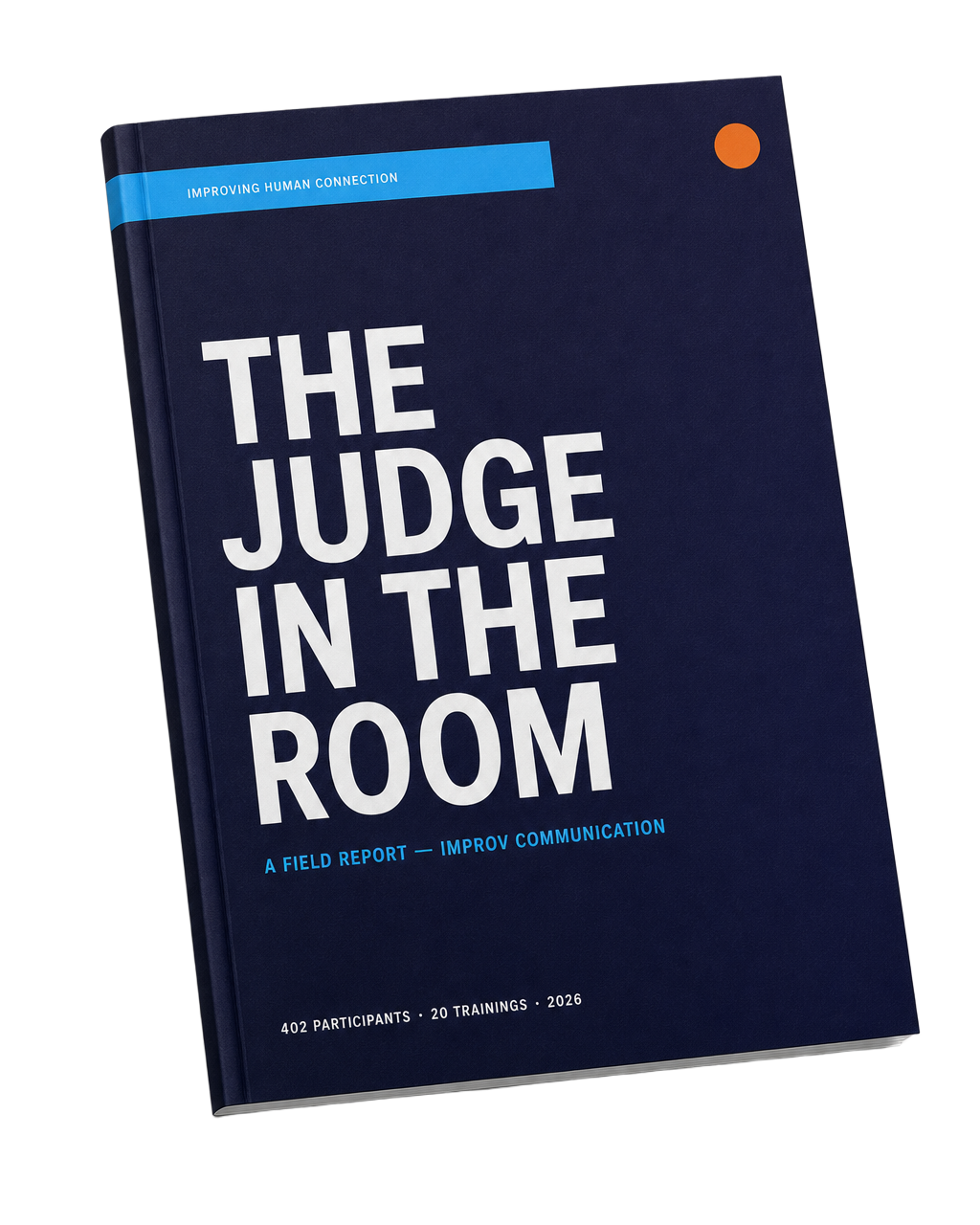
Free field report
The Judge in the Room — what 402 people told us about psychological safety.
Applied Improv takes the core skills of improvisation — listening fully, accepting and building on other people's ideas, adapting when the plan changes, and recovering quickly from mistakes — and applies them to leadership and organisational development. The word "applied" matters. These skills are practised in structured exercises designed for workplaces, guided by a facilitator, with a debrief that connects every exercise back to the job.
The skills themselves are ordinary human capacities. Anyone can listen. Anyone can build on a colleague's idea rather than defend their own. Anyone can admit a mistake and move on. What most organisations lack is a place to practise these behaviours deliberately, at low stakes, until they hold up under pressure. Applied Improv provides that place.
What skills does Applied Improv build?
Four sit at the centre.
Active listening. Most people listen just long enough to prepare their reply. The exercises make that impossible — you can only respond well if you have taken in what was actually said. We have written a full deep listening playbook on what this looks like in practice.
Building on ideas. The habit of accepting a colleague's offer and adding to it — Yes, And — is the engine of collaboration. Teams that build on each other move faster and produce better ideas than teams where every suggestion meets a "yes, but".
Thinking on your feet. Plans change, clients surprise you, the question you prepared for never comes. Practising response under mild, friendly pressure builds the calm adaptability leaders need when the stakes are real.
Recovering from mistakes. How quickly a team recovers from failure matters more than how rarely it fails. The exercises create dozens of small, safe failures per session, so people learn what recovery feels like. We explore this further in the three types of failure.
Alongside these four, sessions train emotional intelligence — self-awareness, self-regulation and empathy, the capacities Daniel Goleman identified in 1995. Goleman's central claim was that these are learned capabilities rather than fixed traits, and the evidence supports him. We have written about why emotional intelligence is a learnable skill.
What are the 5 Guiding Principles?
At IMPROV Communication, everything we deliver rests on our own five guiding principles framework:
Yes, And — accept what your colleague offers and build on it.
Do Not Judge Yourself — the inner critic slows your thinking and silences your best contributions.
Do Not Judge Others — judgement, whether expressed or merely feared, shuts people down.
Embrace Failure — treat mistakes as information and recover fast.
Make Each Other Look Good — shift attention from protecting yourself to supporting the people around you.
Each principle is simple to say and demanding to live. Together they describe how teams behave when people speak up, share half-formed ideas and catch problems early — the condition Amy Edmondson named psychological safety: "a shared belief held by members of a team that the team is safe for interpersonal risk-taking".
What is Applied Improv used for?
Organisations bring Applied Improv in for different reasons, and the same underlying skills serve all of them. Leadership programmes use it to build presence, listening and composure under pressure. Teams use it to improve collaboration and to create the psychological safety that lets people contribute fully — and because safety is built through repeated, lived behaviour, the experiential approach is one of the fastest routes there (here is how teams build it). Innovation work uses it to help people share rough ideas earlier and judge them later. And organisations in the middle of change use it to build comfort with uncertainty, because improvising well is precisely the skill of working without a complete script.
Does the learning actually stick?
This is the right question to ask of any training. The research field that studies it — transfer of training — has been clear since Baldwin and Ford's landmark 1988 review: knowing about a skill rarely changes what people do. Transfer depends on how the training is designed, who the participants are, and whether the new behaviour gets practised and reinforced back at work.
Experiential learning is built for transfer. Participants rehearse the actual behaviour — listening, building, recovering — rather than memorising a model of it. The practice happens under mild pressure, which is the condition the behaviour must survive in real work. And the debrief makes the connection explicit, so each person leaves knowing exactly where the skill applies on Monday morning.
Compare that with the standard classroom format. A presenter explains a framework, heads nod, and within weeks most of it is gone — anyone who has sat through a slide-heavy training day knows the feeling. Information transfer has its place. Behaviour change asks for something more physical.
What does an Applied Improv session look like?
Most sessions run in pairs and small groups, through short, structured exercises that build on each other. The early exercises are deliberately easy — everyone succeeds, the room warms up, people laugh. From there the exercises gently raise the demand: listen more closely, build faster, recover from a miss in front of the group. There is no audience, no script and no performance, and nobody is asked to be funny. It is colleagues practising with colleagues.
The exercise is half the work. The debrief is the other half. After each one, the facilitator asks the questions that turn an experience into a usable insight: What did you notice? Where does this pattern show up in your work? What would change if you did this in your next meeting? That conversation is where the learning lands.
Why does it have to be felt rather than taught?
Everyone talks about psychological safety, collaboration and trust. Reading about them changes very little. When a person experiences — in their own body — what it feels like to have a colleague build on their half-formed idea, or to fail in front of the group and watch nothing bad happen, something shifts. The concept becomes a memory, and memories travel back to work in a way bullet points never do.
That is the view behind everything we do at IMPROV: less PowerPoint, more doing. If you are curious what this could look like for your team, our Improv Training page describes the formats we deliver, from a single energising session to a full leadership programme. Or simply get in touch — a short conversation will tell you more than any article can.
Free field report
The Judge in the Room
What 402 people told us about psychological safety — and what you can do with it on a Monday morning. Five findings, seven practices, participants’ own words.
Curious?
Is your team losing ideas to silence?
That's exactly what we help leaders see and shift. No pitch — just a proper conversation about your team.