
Emotional Intelligence
Why emotional intelligence is a learnable skill — and why improv training builds it fast
Quick answer
Emotional intelligence is a set of skills you can build, not a fixed trait you're born with. Meta-analyses of emotional-intelligence training show a moderate, positive and lasting improvement, with longer, experiential, multi-method programmes working best. That last finding is why Applied Improv is one of the most efficient ways to build it: improv trains the exact skills emotional intelligence is made of — reading others, staying composed under pressure, responding well in the moment — through repeated, real-time practice rather than theory.
Key takeaways
- Emotional intelligence is learnable. Reviews of EI training consistently find it improves with practice.
- The strongest results come from experiential programmes that run over time and use several methods — exactly the shape of good improv training.
- Knowing about emotional intelligence and being good at it are different things. It's a performance skill, built through reps under real conditions.
- Applied Improv trains the core EI skills directly: attunement, self-regulation, expression and social awareness, all in real time.
- Gains last when they're reinforced, which is why structured follow-up matters as much as the training day.
"You've either got it or you don't" — and why that's wrong
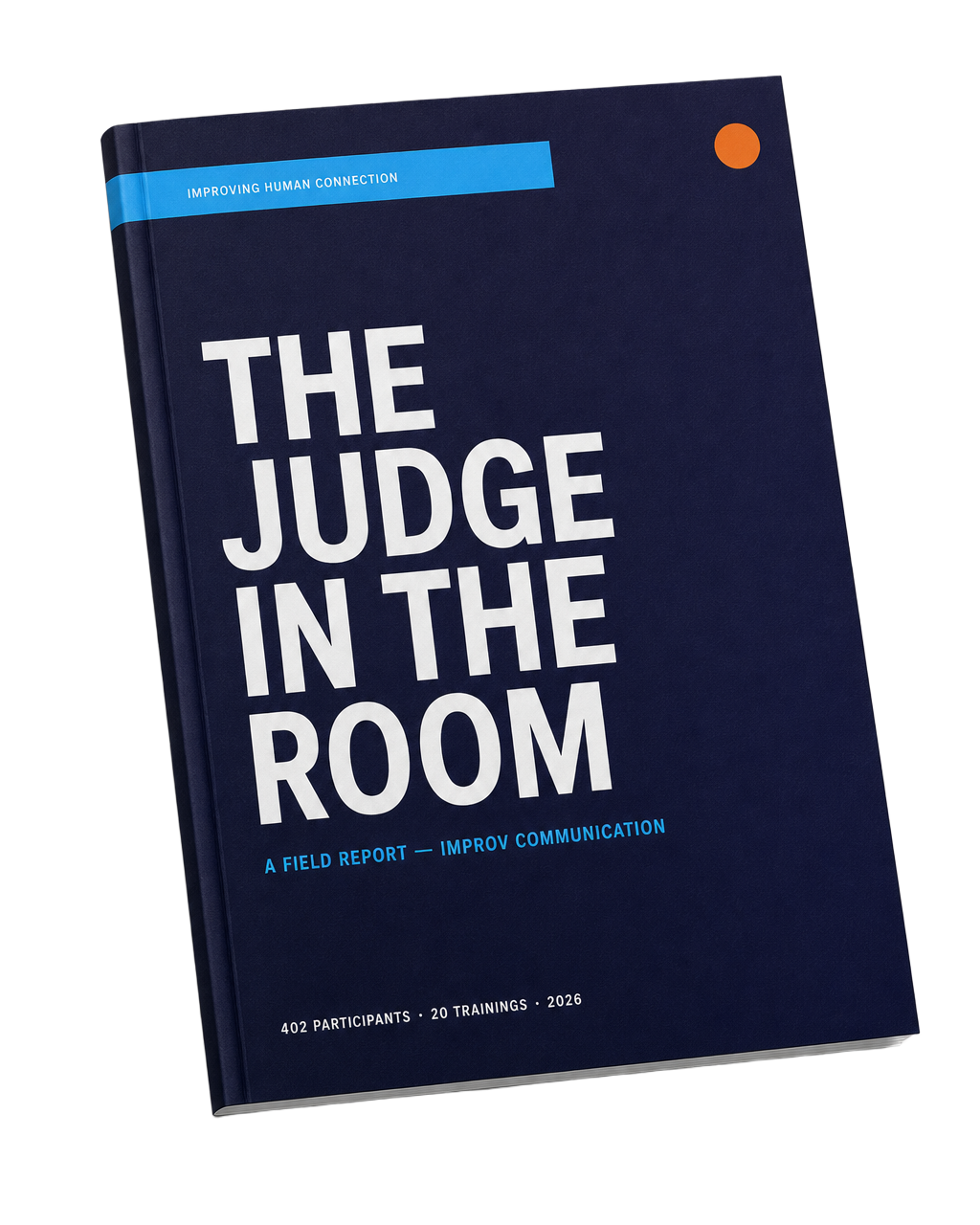
Free field report
The Judge in the Room — what 402 people told us about psychological safety.
Emotional intelligence still carries a quiet assumption: that some people are naturals and the rest are out of luck. The warm, perceptive leader was simply born that way, and you can't teach what they have.
Daniel Goleman, who put emotional intelligence on the map for business, was clear that this is mistaken. The competencies behind it — self-awareness, self-regulation, empathy, social skill — are learned, not fixed. They behave like any other capability: weak in some people, strong in others, and improvable in everyone willing to work at them. The brain supports this. It keeps adapting throughout adult life, which means the patterns of reaction we think of as "just how I am" can be rewired with practice.
This matters for any leader deciding where to invest. If emotional intelligence were innate, development would be a waste of money. It isn't, and the evidence says so plainly.
The evidence: emotional intelligence improves with training
This has been tested properly. A 2018 meta-analysis by Hodzic and colleagues, pooling many separate studies, found that emotional-intelligence training produces a moderate, positive effect — people's EI measurably rises after it. A 2024 systematic review of emotional-competency training in the workplace reached the same conclusion: the skills improve, and the effect is real rather than a feel-good illusion.
Two details in that research matter for how you choose a programme. First, the strongest results come from training that runs over time and uses several methods, rather than a single lecture. Second, the gains last when they're reinforced — emotional skills, like physical ones, fade without ongoing practice. A one-off talk moves the needle very little. A structured, experiential programme with follow-up moves it a great deal.
Hold those two findings in mind, because they point directly at why one kind of training outperforms the rest.
Why knowing about EI doesn't make you good at it
Most development falls into the same trap. You can read every book on emotional intelligence, learn Goleman's framework and Brackett's RULER model, and still snap at a colleague the moment you feel cornered. Understanding is not the same as doing.
Emotional intelligence is a performance skill, closer to playing an instrument than to passing an exam. The test of it comes in the half-second when you're triggered, tired or challenged — exactly when conscious knowledge tends to desert you. What carries you then is what you've practised until it became automatic, built by doing it over and over in conditions close enough to the real thing that the learning transfers. A book can't give you that. Reps can.
That is the gap a slide deck can't close, and it's the gap experiential training is built for.
Why improv training is one of the most efficient ways to build it
Applied Improv looks, from the outside, like a long way from a leadership competency. Up close, it's one of the most direct workouts for emotional intelligence there is — because every skill EI is made of, improv demands in real time.
It trains attunement. Improv only works if you read your partner closely — their tone, energy, the offer underneath their words — and respond to what's actually there. That's empathy and social awareness, practised continuously rather than discussed.
It trains self-regulation under pressure. Standing in an unscripted scene puts you in a mild, controlled version of the stress that hijacks people at work. You feel the urge to grab control, to judge yourself, to retreat — and you practise staying present anyway. Our principle "Do Not Judge Yourself" is self-regulation by another name. Repeated under light pressure, it builds the habit that holds under heavy pressure.
It trains expression and reading the room. You practise saying what's needed, in the moment, and adjusting when it doesn't land. That's the Expressing skill in Brackett's RULER model, rehearsed live.
It trains social skill directly. "Make each other look good" — supporting the people around you so the whole thing works — is the core of every exercise. It's also the core of how strong teams operate.
It uses safe failure as the teacher. "Embrace Failure" means missteps become material, not shame. People try, miss, recover and try again, dozens of times in an afternoon. That volume of low-stakes reps is what rewires a reaction, and it's hard to get any other way.
Notice how closely this matches what the research says works best: experiential, repeated, multi-method practice over time. Improv compresses a great many emotional reps into a short window, and it engages the body and the nervous system rather than the intellect alone — which is precisely where emotional intelligence lives. You leave having practised the skills, not having heard about them.
What this looks like, and what makes it stick
A leader who has done this work notices the flash of defensiveness before it speaks, reads the quiet person in the meeting, and responds rather than reacts when the pressure rises. Those are small moments, and they decide a great deal.
The research carries one more instruction worth heeding: gains last when they're reinforced. This is why we never treat a training day as the finish line. Every engagement is built around it — activation before, the experiential work itself, and structured follow-up afterwards — so the new behaviours survive past the point where most training quietly fades. Emotional intelligence paired with intelligence, what we call EPIQ, is what separates the leaders people choose to follow from the ones they simply report to. And both halves of that can be built.
Everyone talks about emotional intelligence as though you either have it or you don't. The evidence is kinder than that. It's a skill, it responds to practice, and the fastest way to build it is to practise it — which is exactly what we do, in the room.
Free field report
The Judge in the Room
What 402 people told us about psychological safety — and what you can do with it on a Monday morning. Five findings, seven practices, participants’ own words.
FAQ
Frequently asked questions
- Is emotional intelligence learnable, or are you born with it?
- It's learnable. While people start from different points, the competencies behind emotional intelligence — self-awareness, self-regulation, empathy and social skill — are learned and improvable. Meta-analyses of EI training show a moderate, positive effect, confirming the skills can be built.
- What does the research say about emotional intelligence training?
- A 2018 meta-analysis by Hodzic and colleagues, and a 2024 systematic review of workplace emotional-competency training, both found that training produces a real, moderate improvement in emotional intelligence. The strongest results come from experiential programmes that run over time and use multiple methods, and the gains last when they're reinforced.
- Why doesn't reading about emotional intelligence make you better at it?
- Because emotional intelligence is a performance skill, tested in the heat of the moment when conscious knowledge tends to desert you. It's built through repeated practice under realistic conditions, not through understanding a framework.
- How does improv training build emotional intelligence?
- Applied Improv trains the exact skills emotional intelligence is made of — reading others, regulating yourself under pressure, expressing clearly, and supporting the people around you — through repeated, real-time practice with safe failure and immediate feedback. This experiential, multi-method approach matches what research finds works best.
- How long does it take to improve emotional intelligence?
- Improvement begins quickly with experiential practice, and lasting change depends on reinforcement over time. A single session raises awareness; a structured programme with follow-up builds habits that hold under pressure.
Keep reading
Related from IMPROV
Curious?
Is your team losing ideas to silence?
That's exactly what we help leaders see and shift. No pitch — just a proper conversation about your team.