
Quick answer
"Yes, and" is the first principle of improvisation and one of the most practical tools a team has for innovation. It means accepting what a colleague offers and building on it, rather than blocking it with "Yes, but". The shift sounds small. Its effect on how freely a team thinks is large: ideas grow instead of dying in the first ten seconds, and people keep contributing because it stays safe to. Pixar built a version of it — they call it "plussing" — into how they make films.
Key takeaways
- "Yes, and" means accept the offer, then add to it. "Yes, but" accepts in word and rejects in substance.
- The word "and" carries no judgement. "But" quietly deletes everything that came before it, and teams feel the difference at once.
- Innovation depends on ideas surviving long enough to be built on. Most are killed in the first reaction, before anyone has heard them out.
- Pixar's "plussing" rule: you may only critique an idea if you also add something that makes it better.
- Keeping idea-generation separate from judgement is how teams stop killing their best thinking too early.
- It's a learnable habit, and under real pressure it's harder than it sounds.
Two words that quietly decide whether a team innovates
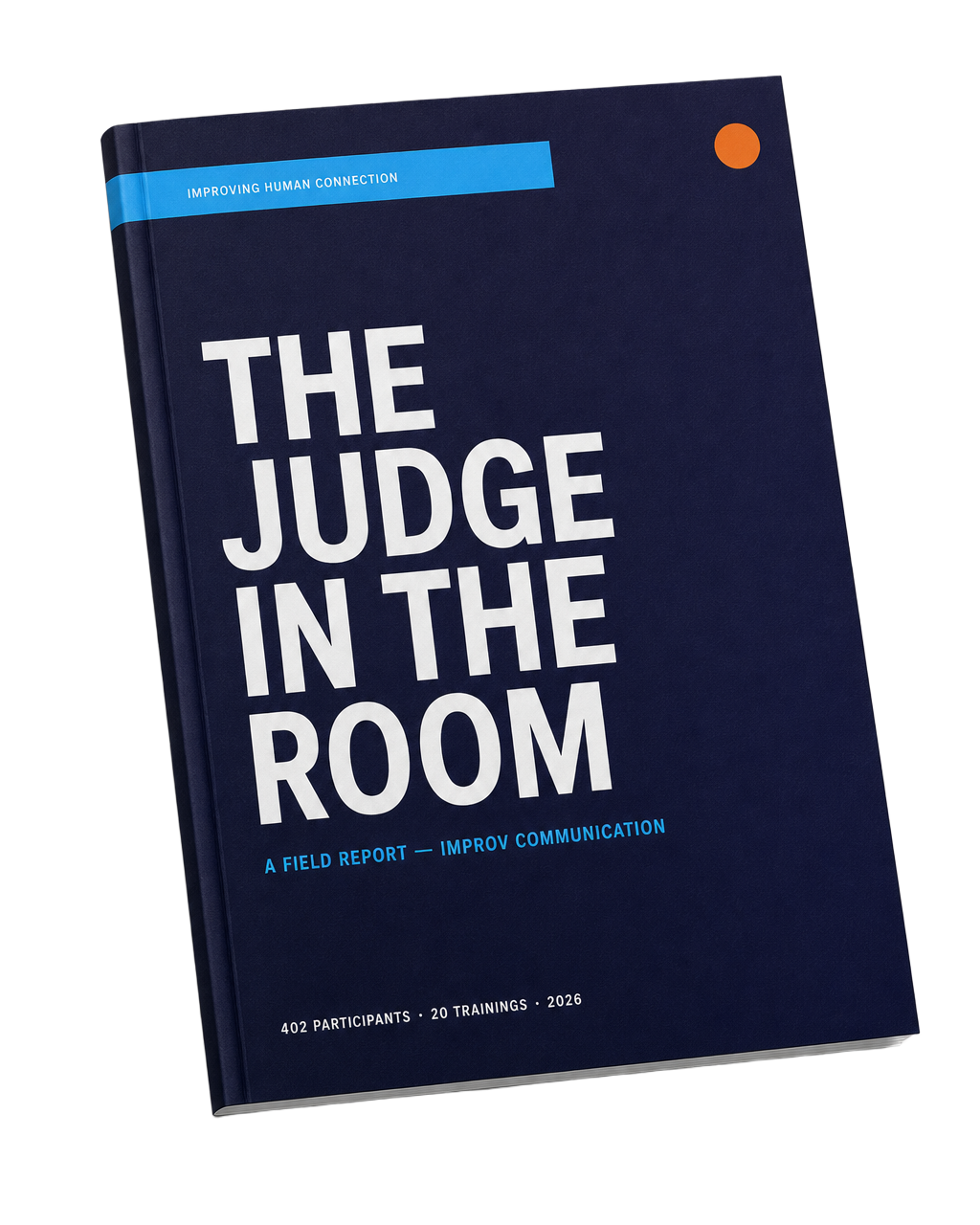
Free field report
The Judge in the Room — what 402 people told us about psychological safety.
Sit in on almost any meeting where ideas are on the table, and you'll hear the same small word doing a lot of damage. Someone offers a thought, and the reply begins: "Yes, but…"
It feels reasonable. Polite, even. The word "yes" suggests agreement, so no one notices what the "but" does next. And what it does is delete everything in front of it. "Yes, but we tried that in 2022." "Yes, but the budget won't stretch." "Yes, but legal will never sign it off." The idea is gone before it has had a chance to become anything.
Do that a few times in a room and people stop offering. Not consciously. They simply learn that a half-formed idea will be met with a reason it can't work, and they keep the next one to themselves. The meeting goes quiet, and everyone agrees it was a sensible discussion. The cost — the ideas that were never spoken — never shows up anywhere you can see it.
This is where improvisation has something useful to teach leaders. On a stage with no script, a scene only works if people build on each other. So improvisers live by a simple rule, and it turns out to be one of the most practical tools a team has for thinking together.
What "Yes, and" actually means
"Yes, and" is the first of the five guiding principles we work from, and it's often misunderstood as forced positivity — agreeing with everything, never pushing back. That's not it.
The "yes" means you accept what your colleague has offered as real and worth working with, instead of blocking it. The "and" means you add something — your perspective, a concern, a way to make it stronger. You're building on the idea rather than competing with it. You can disagree inside a "Yes, and". You can raise the budget problem. The difference is that you do it while keeping the idea alive, so the conversation moves forward instead of stopping dead.
Compare the two replies. "Yes, but the budget won't stretch" closes the door. "Yes, and given the budget, what if we ran it as a pilot in one region first?" keeps it open and makes it better. Same concern. Completely different outcome for the room. One version trains people to stop talking. The other trains them to keep thinking.
It comes down to a quirk of language. The word "and" adds. The word "but" subtracts. Whatever sat before the "but" is quietly cancelled, and the speaker hears it, even when the tone was kind. This is exactly why we removed "but" from how we write and speak at IMPROV — it's a small discipline that changes how people experience being heard.
Why "Yes, but" feels so reasonable
If "Yes, but" is this costly, why is it everywhere? Because it feels like rigour.
Most leaders were promoted, in part, for being sharp — for spotting the flaw, the risk, the reason something won't work. That instinct is valuable, and it's exactly what makes "Yes, but" so automatic. The flaw is easier to see than the possibility, and naming it feels like adding value. In the moment, critiquing an idea looks more intelligent than extending one.
The problem is timing, not judgement. Judgement matters enormously — and there is a right moment for it. When it arrives in the first ten seconds, before an idea has been built out, it doesn't sharpen the thinking. It ends it. The team never finds out what the rough idea might have become, because no one was allowed to develop it past its first, clumsy form. And good ideas almost always start clumsy.
There's solid ground under this. Amy Edmondson's research at Harvard shows that teams learn and perform best when it's safe to take interpersonal risks — to float the unfinished thought without fear of how it lands. Google's Project Aristotle, after studying 180 teams, found psychological safety to be the strongest single predictor of team performance. "Yes, and" is one of the most direct ways to build that safety in real time, one reply at a time.
Pixar's version: plussing
The clearest proof that this works at the highest level comes from Pixar, a company whose entire business is producing original ideas on a deadline.
Pixar uses a practice it calls "plussing", built directly on the improviser's "Yes, and". The rule is simple and strict: in a feedback session, you may only critique an idea if you also add a constructive suggestion that improves it. You can't merely shoot a sketch down. You have to build on what's already good and propel it forward. As Pixar's own people put it, "and" opens up possibilities, where "but" shuts them down.
What's striking is that plussing is more demanding than ordinary critique, not softer. It's easy to say why something won't work. It's harder, and far more useful, to say "here's what's strong about this, and here's how we make it stronger." Pixar built that discipline into its culture because it produces better films. The same discipline produces better strategies, better products and better decisions in any organisation willing to practise it.
Separate the creating from the judging
Underneath "Yes, and" sits a principle we return to constantly: the creative phase and the editorial phase are different jobs, and most teams ruin both by doing them at once.
The creative phase is divergent. Its job is to generate — to get ideas out, including the strange and unfinished ones, without weighing them yet. The editorial phase is convergent. Its job is to choose, refine and stress-test. Both are essential. They simply can't happen in the same breath, because the moment you start judging, people stop generating. You end up with a handful of safe, pre-edited ideas and none of the bold ones, which were killed before they could be spoken.
"Yes, and" protects the creative phase. It buys an idea enough room to grow before anyone reaches for the red pen. The editing still happens — and it happens later, deliberately, once there's something worth editing. Teams that learn to hold these two phases apart are astonished at how much more their own people had to offer all along.
What this looks like on Monday morning
None of this requires a culture programme to start. A few changes in how you run a room shift the dynamic quickly.
Notice your own first reaction. When someone offers an idea, catch the "Yes, but" before it leaves your mouth, and turn it into "Yes, and". You can still raise the concern. Raise it as an addition, not a verdict.
Name the phase you're in. At the start of a discussion, say whether you're generating ideas or choosing between them. When people know judgement is coming later, they contribute more freely now.
Borrow Pixar's rule for a meeting. For one session, make it the norm that no idea gets criticised without a suggestion attached. It feels unnatural for ten minutes, and then the quality of the conversation changes.
Watch what happens to the quiet people. The real test of "Yes, and" isn't the confident voices. It's whether the person who usually says nothing starts to speak. When they do, you're hearing thinking the organisation has been missing.
These habits are simple to describe and harder to live, especially under pressure, when the instinct to judge fast is strongest. That's why we don't teach "Yes, and" from a slide. We put teams through the experience of it — building something together, feeling an idea grow under "Yes, and" and collapse under "Yes, but" — until the habit holds when the stakes are real.
Everyone talks about innovation. Most of the ideas an organisation needs are already in the building. "Yes, and" is how you let them survive long enough to be heard.
Free field report
The Judge in the Room
What 402 people told us about psychological safety — and what you can do with it on a Monday morning. Five findings, seven practices, participants’ own words.
FAQ
Frequently asked questions
- What does "Yes, and" mean in improvisation?
- "Yes, and" is the first principle of improvisation. The "yes" means you accept what someone offers instead of blocking it; the "and" means you build on it by adding something of your own. It keeps a scene — or a conversation — moving forward rather than stalling.
- How does "Yes, and" help with innovation at work?
- Innovation depends on ideas surviving long enough to be developed. "Yes, and" keeps an idea alive and builds on it, so people keep contributing and the team's best thinking actually surfaces. "Yes, but" tends to kill ideas in the first reaction, before they've been heard out.
- What is the difference between "Yes, and" and "Yes, but"?
- "Yes, and" adds to an idea and keeps it open. "Yes, but" accepts in word while rejecting in substance — the word "but" quietly cancels everything before it. You can still disagree inside a "Yes, and"; you simply do it while keeping the idea alive.
- What is Pixar's plussing technique?
- Plussing is Pixar's feedback practice, based on the improviser's "Yes, and". The rule is that you may only critique an idea if you also add a constructive suggestion that improves it. It produces sharper, more useful feedback than simply pointing out flaws.
- Can you disagree while using "Yes, and"?
- Yes. "Yes, and" is about timing and framing, not blind agreement. You can raise a budget problem, a risk or a different view — you frame it as an addition that moves the idea forward, rather than a verdict that ends it.
Keep reading
Related from IMPROV
Curious?
Is your team losing ideas to silence?
That's exactly what we help leaders see and shift. No pitch — just a proper conversation about your team.