
Quick answer
Make it safe by changing how the meeting runs. Invite each person by name, ask questions rather than broadcasting answers, share airtime evenly, and respond warmly to the first risky comment. People judge the room by what happens after someone speaks, so the leader's reaction in that moment sets the tone.
Key takeaways
- Silence in meetings is usually a rational calculation: people weigh what happened last time before they risk speaking.
- Google's Project Aristotle found the safest teams share airtime evenly and stay tuned in to one another.
- Most of the work is in the setup — frame the work openly, invite people by name, and structure the meeting so airtime is shared.
- The first risky comment is a test the whole room is watching; how the leader responds sets the tone.
- Safe-meeting behaviours are skills, and they strengthen when leaders practise them under real pressure.
Most teams have more good thinking in the room than ever makes it onto the table. The gap between the two usually shows up in meetings — in the concern nobody voiced, the idea that stayed in someone's notebook, the "I don't quite follow" that went unsaid. Making meetings safe to speak up in is one of the most practical things a leader can do, and most of it comes down to how the meeting is run.
Why do people go quiet in meetings?
Free field report
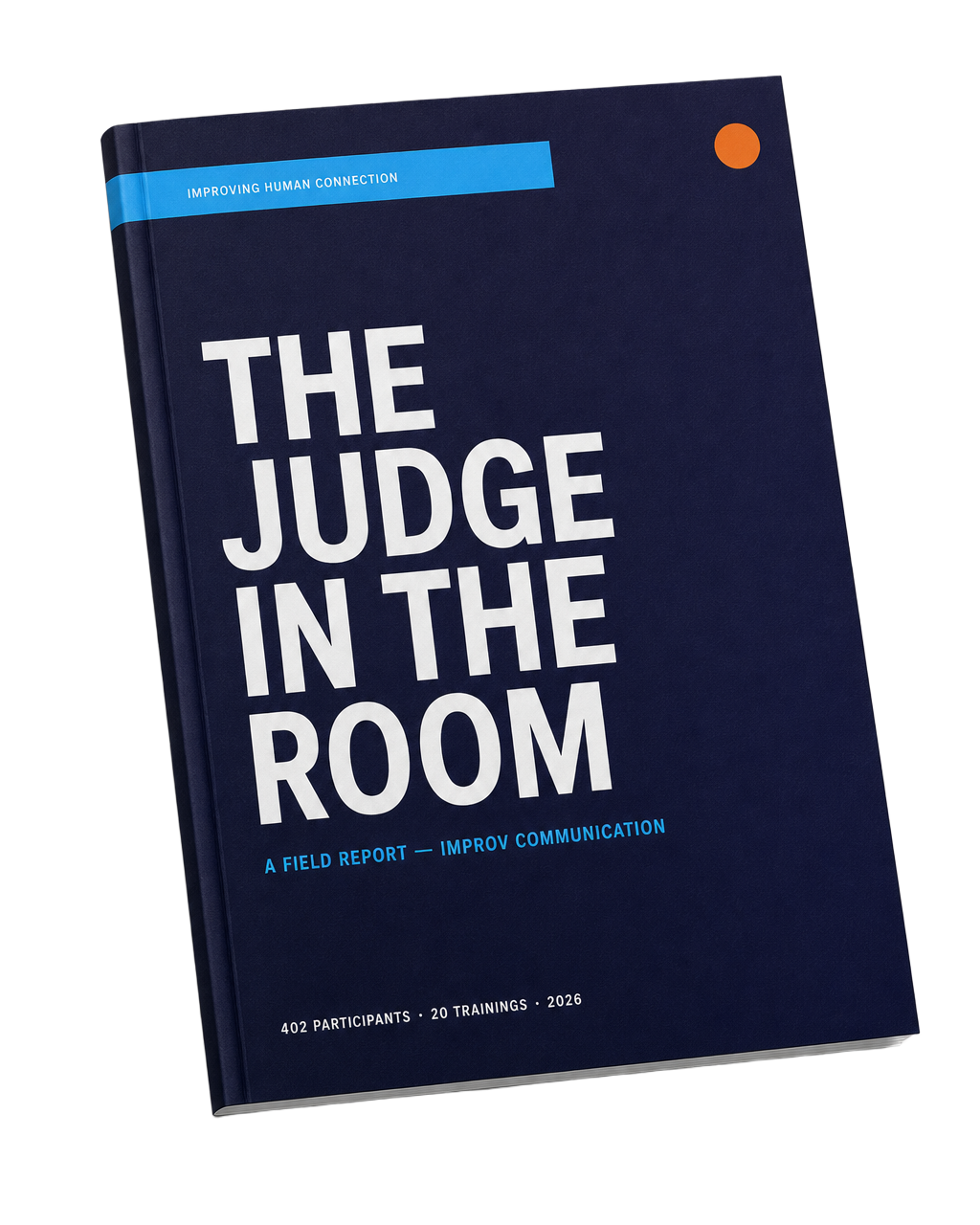
The Judge in the Room — what 402 people told us about psychological safety.
Most silence in a meeting is a calculation. Before anyone offers a half-formed idea, questions the plan, or admits they are lost, they run a quick read of the room: what happened the last time someone did this? If the honest answer is "they got talked over, corrected, or quietly remembered for it", the safer move is to stay quiet. The idea stays in the person's head, and the meeting carries on a little poorer for it.
That calculation is fast and mostly unconscious. Amy Edmondson, the Harvard professor whose research defined psychological safety, describes it as the shared belief that a group is safe for interpersonal risk-taking — that you can ask a question, flag a concern, or disagree without fear of embarrassment or reprisal. In a meeting, that belief is tested in real time. Every raised hand is a small risk, and people take it only when the expected cost feels low enough.
The cost is set largely by the leader, often without them noticing. A flash of irritation at bad news, a fast correction of someone's rough idea, a glance at the clock while a junior colleague is mid-sentence — each one teaches the room a little more about whether speaking up is worth it. Over time, the room learns. That quiet learning is why the fear of speaking up shuts down more ideas than any failure ever does.
What does the research say about meetings specifically?
Google's Project Aristotle studied 180 teams to work out what separated the effective ones from the rest. Psychological safety came out as the single strongest predictor of performance. Two of the norms sitting underneath it are directly about how meetings run.
The first the researchers called equality in the distribution of conversational turn-taking. In the strongest teams, everyone spoke roughly the same amount over the course of a meeting — no single voice dominated, and no one was left out. The second was social sensitivity: members stayed tuned in to how others were feeling, picking up the small signals that tell you someone has something to say and is holding it back.
Put plainly, safe meetings are ones where airtime is shared and people pay attention to each other. Both are things a leader can shape by design, which is what makes them so useful. You can read the fuller story in our piece on what Project Aristotle taught us about teams.
How do you set up a meeting so it is safe to speak?
A lot of the work happens before anyone opens their mouth. Edmondson points to three leader moves, and each one has a practical meeting version.
Frame the work openly. Open by naming what you do not yet know and what you need from the room. When a leader says "I have a rough plan and I am sure there are holes in it — help me find them", the group hears that disagreement is welcome here. Framing turns the meeting from a performance into a shared piece of thinking.
Invite participation by name. General questions like "any thoughts?" tend to land in silence, or get answered by the same two confident voices. Directed, warm invitations work far better: "Sara, you have run this process before — where do you see the risk?" People contribute when they feel wanted in the conversation, rather than merely permitted to join it.
Share the airtime on purpose. Simple structures do more than good intentions ever will. A quick round where each person speaks in turn, a couple of minutes of silent writing before open discussion so quieter thinkers arrive with something formed, or the leader deliberately speaking last so the room is not anchored to the most senior view — each of these evens out the turn-taking that Project Aristotle found mattered so much.
What should a leader do the moment someone takes a risk?
This is where meetings are won or lost. Edmondson's third move is to respond productively, and the first risky comment in any meeting is a test the whole room is watching.
When someone raises a concern or floats an odd idea, the reflex for many leaders is to correct it, defend the plan, or move briskly on. Each of those reactions teaches the room to stop offering. The alternative costs almost nothing: thank the person for raising it, get curious about it, and build on whatever is usable even when the idea is only half-right. "That is a useful challenge — say more" does more for a meeting culture than any written policy.
The habit underneath this is one IMPROV works with constantly: accepting what someone offers and adding to it, rather than blocking it. When people trust that their contribution will be received and built on, they offer more of it. When they expect it to be knocked down, they keep it to themselves. Much of it comes down to how well a leader listens, which is why we treat listening as a leadership skill in its own right.
How do you know it is working?
The signals are quiet ones. Dissent starts to surface in the room rather than in the corridor afterwards. Quieter people speak without being drawn out. Bad news arrives early, while there is still time to act on it. Someone says "I do not understand" in front of the group, and nothing bad happens to them.
If your meetings are still marked by long silences, the same three voices, and a suspicious absence of disagreement, those are worth reading as signals rather than as a sign of a well-run room. They are among the clearest signs a team lacks psychological safety, and they tend to be fixable once a leader starts changing how the meeting runs.
Why practice matters more than intention
Every leader reading this could nod along and change nothing on Monday. Knowing to invite people in by name is a long way from doing it smoothly when the meeting is running late and the pressure is on. The behaviours that make a meeting safe — framing the work, inviting people in, sharing airtime, receiving a challenge well — are skills, and skills grow by doing them, feeling what happens, and adjusting.
That is the ground IMPROV's psychological safety trainings work on. Our facilitators put leaders and teams into live situations where speaking up, building on each other, and handling the unexpected are practised in the room until they become natural — so the behaviours hold up when it is a real meeting and a real risk. If you would like to explore what that could look like for your team, we would be glad to talk it through.
Free field report
The Judge in the Room
What 402 people told us about psychological safety — and what you can do with it on a Monday morning. Five findings, seven practices, participants’ own words.
Curious?
Is your team losing ideas to silence?
That's exactly what we help leaders see and shift. No pitch — just a proper conversation about your team.