
Quick answer
Signs of low psychological safety are quiet ones: smooth, silent meetings; bad news that reaches you late; a few voices dominating while others stay silent; mistakes that get hidden or blamed; questions that go unasked; candour that only happens in the corridor; and new joiners going quiet fast. None look like a crisis. Each one shows people have decided speaking up costs too much.
Key takeaways
- Low psychological safety looks calm from the front — quiet meetings and fast agreement are often suppression rather than health.
- Watch how bad news travels: when problems reach you late or softened, people are protecting themselves rather than the work.
- 85% of employees have at some point withheld a concern from their manager because speaking up felt too risky (Edmondson and Detert).
- The clearest tell is corridor candour — the real conversation happening everywhere except the room where decisions are made.
- Silence is feedback about the climate, not a verdict on the people; it shifts through what a team repeatedly experiences when someone takes a small risk.
Low psychological safety rarely announces itself. There is no row, no resignation letter, no obvious crisis. Instead there is a slow quietening — fewer questions, smoother meetings, less disagreement. To a busy leader, a calm team can look like a healthy one. Often it is the opposite. The calm is the sound of people deciding it is safer to say nothing.
That is what makes low psychological safety so costly. The research bears this out: in work by Amy Edmondson and James Detert, 85% of employees said they had at some point withheld a concern from their manager because raising it felt too risky. The problems do not disappear when people stop voicing them. They simply go underground, where no one can act on them.
Here are seven signs that the people around you have quietly concluded that speaking up costs more than staying silent.
Sign 1: Meetings are smooth and quiet
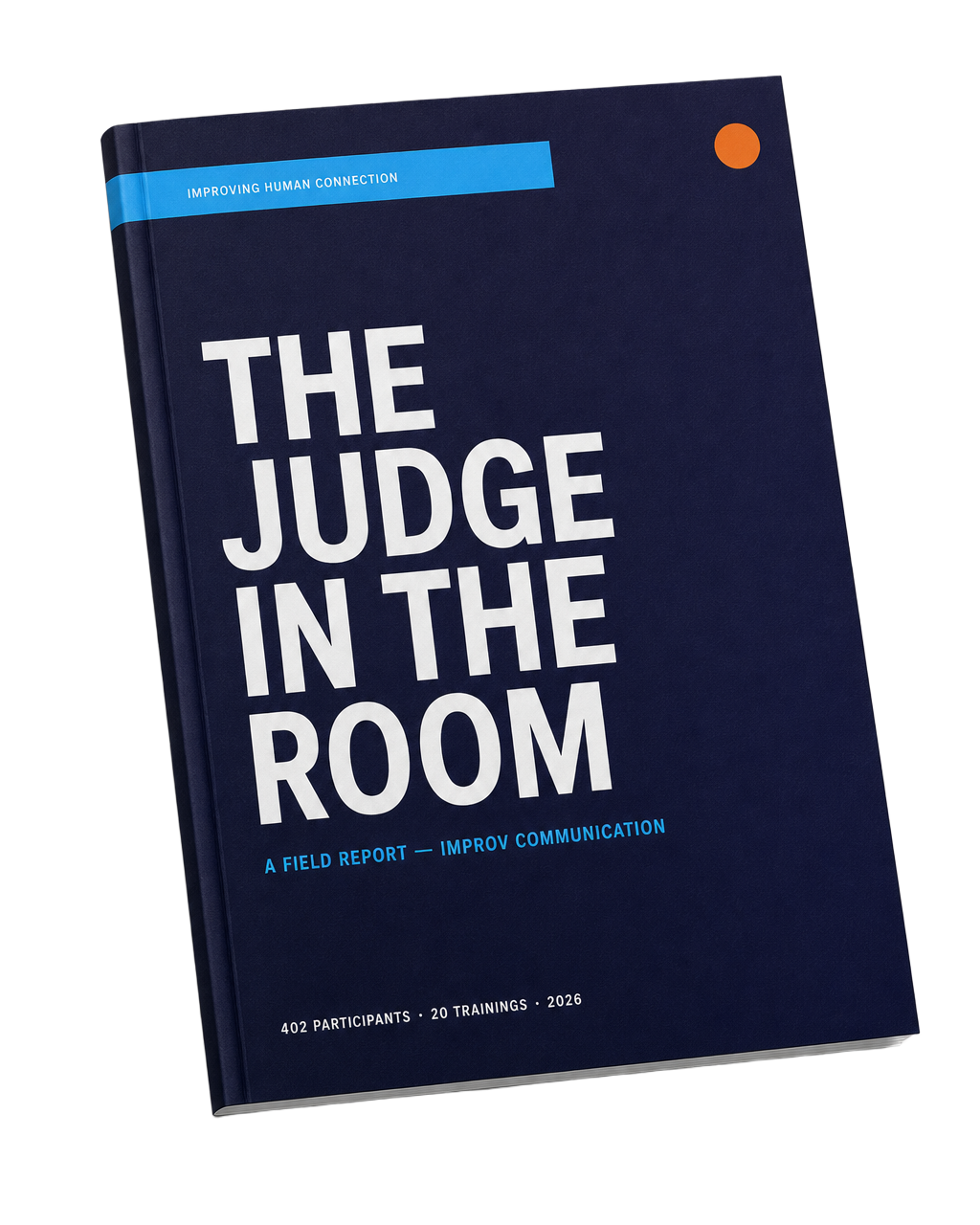
Free field report
The Judge in the Room — what 402 people told us about psychological safety.
A discussion ends and everyone nods. No one pushes back, no one asks the awkward question, the decision lands without friction. It feels efficient. On a team with low psychological safety, that smoothness is a warning sign. Real work involves disagreement, half-formed ideas and honest uncertainty. When all of that has vanished from the room, it usually means people have stopped offering what they actually think.
Sign 2: Bad news reaches you late, or not at all
Watch how problems travel. On a healthy team, a missed deadline or an emerging risk reaches the leader early, while there is still time to respond. Where safety is low, bad news moves slowly. It gets softened at each handover, delayed in the hope it resolves itself, or held back entirely. By the time it reaches you, the moment to act has often passed. Edmondson's own early research showed this vividly: the hospital nursing teams that reported more errors were not the worse teams — they were the better ones, willing to surface mistakes so they could be fixed. The teams reporting fewer errors were often hiding them.
Sign 3: The same few voices do all the talking
Listen to who speaks. In many meetings, a small group carries almost every conversation while others contribute little beyond agreement. Sometimes that reflects seniority or personality. Just as often it signals that most people have weighed up the cost of speaking and chosen to hold back. The quiet ones often have plenty to contribute. They have simply learned that their input is unlikely to be welcomed, so they conserve it.
Sign 4: Mistakes get hidden or pinned on someone
How a team handles error tells you almost everything. Where safety is high, a mistake becomes information — something to examine and learn from. Where it is low, the first instinct is to conceal it or find someone to blame. People spend their energy protecting themselves rather than improving the work. If errors only ever come to light by accident, and the conversation that follows is about fault rather than cause, your team has learned that honesty is dangerous.
Sign 5: The real conversation happens in the corridor
The meeting ends, and the actual discussion begins — in the hallway, the side-channel, the message thread that excludes the decision-maker. This is one of the clearest signs of all. People have plenty to say; they have simply decided the formal room is the wrong place to say it. When the candour all happens in private, the team is spending real effort working around a lack of safety instead of using that energy on the work itself.
Sign 6: No one admits they are lost
A new system, an unfamiliar acronym, a brief that does not quite make sense — and not a single question. On a safe team, someone says "I don't follow, can you explain that again?" and the rest of the room is quietly grateful. Where safety is low, admitting confusion feels like admitting weakness, so people nod along and work it out alone later, often getting it wrong. The absence of questions is rarely a sign that everyone understood.
Sign 7: New and junior members go quiet fast
Newcomers arrive with fresh eyes and the most permission to ask "why do you do it this way?" Notice how long that lasts. On a healthy team, new and junior people keep questioning and contributing well past their first weeks. Where safety is low, they read the room quickly, see what happens to people who speak up, and adjust. Within a month or two they have gone as quiet as everyone else. When your newest people stop asking questions, they are telling you what they have learned about the place.
Why is low psychological safety so easy to miss?
Because every one of these signs looks, on the surface, like something benign. Quiet meetings look like agreement. Late bad news looks like things going well. Silence looks like consensus. As Edmondson puts it, the absence of voiced problems is not evidence that there are none — it is often evidence that people have stopped reporting them. A leader reading the room from the front can easily mistake suppression for harmony, which is precisely why so many teams operate with far less safety than their leaders believe.
What should you do if you recognise these signs?
Start by treating the signs as feedback about the climate rather than about the people. Silence is a rational response to a setting where speaking up has felt costly, so the question worth sitting with is what you and the team have taught each other about talking — and what would need to change for that to feel different. From there, the work is behavioural: how you respond the next time someone brings you an unwelcome fact, whether you invite the quiet voices in, whether you treat a mistake as information or as a failing. If you want a sharper read before you act, our guide on how to measure psychological safety sets out Edmondson's seven-item survey and the behavioural signals that go beyond it.
It is worth being honest about one thing: people will not feel safe because you tell them they are safe. Safety is something a team comes to believe through repeated experience of what actually happens when they take a small risk in front of each other. That is why we build it in the room rather than on a slide. In our psychological safety training, teams practise the moments that usually shut people down — the half-formed idea, the dissenting view, the admission of not knowing — and feel for themselves what changes when those moments are met well. The signs above tell you where a team stands today. What people live together is what moves them somewhere better.
If several of these signs feel familiar, that is useful knowledge rather than a verdict. It means there is real performance sitting just under the surface, waiting for the conditions that let it out.
Free field report
The Judge in the Room
What 402 people told us about psychological safety — and what you can do with it on a Monday morning. Five findings, seven practices, participants’ own words.
Curious?
Is your team losing ideas to silence?
That's exactly what we help leaders see and shift. No pitch — just a proper conversation about your team.