
Psychological Safety
Why the fear of speaking up kills more ideas than failure ever will
Quick answer
Most organisations lose more ideas to silence than to failure. People stay quiet for a simple reason: the half-second risk of looking foolish, junior or difficult outweighs the uncertain reward of speaking. Research by James Detert and Amy Edmondson found that 85% of professionals had at least one occasion when they felt unable to raise a concern with their boss. The fix is to build the psychological safety that makes speaking up the low-risk, obvious choice. That's a leadership job.
Key takeaways
- The expensive failures in most organisations are invisible: the idea, the warning and the question that were never voiced.
- Silence is usually a fast, rational calculation about risk and reward, not a confidence problem — and under threat, the brain defaults to caution.
- Google's Project Aristotle found psychological safety to be the single strongest predictor of team performance, ahead of talent, experience or seniority.
- You cannot instruct people into candour. Safety is built through how leaders respond in the moments that matter.
- The shift is learnable, and it shows up in behaviour: who speaks first, how a mistake is met, and whether a half-formed idea is welcomed or corrected.
The failures you can see, and the ones you can't
Free field report
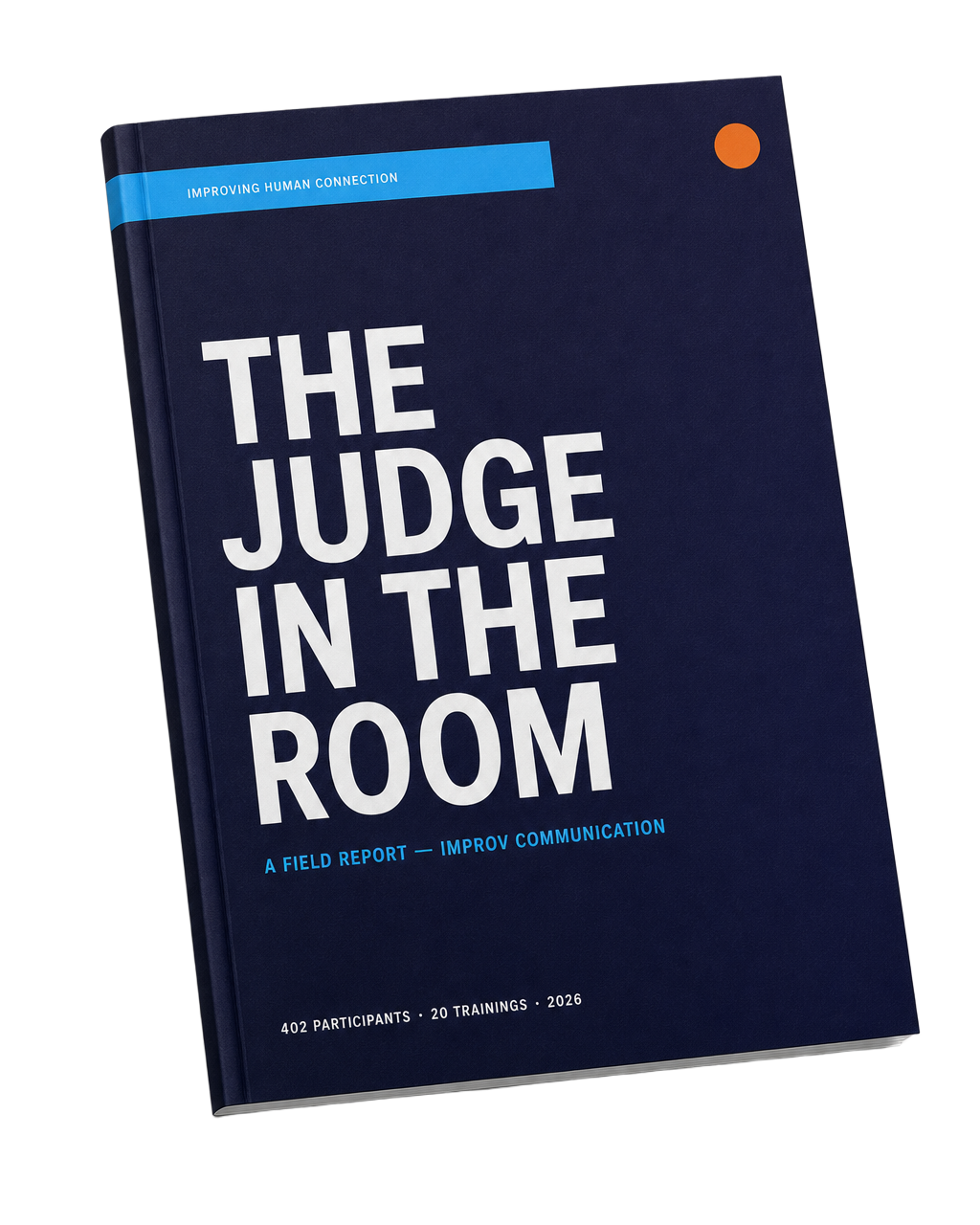
The Judge in the Room — what 402 people told us about psychological safety.
Every leader can name the failures that hurt: the launch that missed, the hire that didn't work, the project that ran over. They're painful, and they're visible. You can learn from them.
The failures that cost the most are the ones you never see. The engineer who suspected the timeline was wrong and said nothing in the meeting. The new joiner who spotted a gap in the plan and decided it wasn't her place. The senior manager who had doubts about the acquisition and kept them to himself, because everyone else seemed sure.
None of those show up in a post-mortem. They simply never happen, and the organisation pays for them without ever knowing the bill arrived. This is why the fear of speaking up is more expensive than failure itself. A failure, at least, teaches you something. Silence teaches you nothing, and it keeps teaching you nothing, quietly, for years.
Why capable people stay quiet
Read from the outside, silence looks like a lack of ideas or nerve. Usually it's neither. Most of the time, people are running fast, sensible maths.
Speaking up carries an immediate, certain risk: you might look uninformed, you might irritate someone senior, you might be wrong in front of people whose opinion of you matters. The reward is delayed and uncertain: maybe the idea lands, maybe it changes nothing. Faced with a certain risk and an uncertain reward, the safe move is to say nothing. So people say nothing.
There's biology underneath this. When we sense social threat — the risk of being judged, excluded or diminished — the brain's amygdala responds much as it would to physical danger. It narrows our thinking and pulls us toward self-protection. In that state, the part of the brain we need for creative, generous contribution goes quiet. People aren't choosing to disengage. Their nervous system is choosing for them.
The scale of this is easy to underestimate. In research by James Detert and Amy Edmondson, 85% of professionals reported at least one occasion when they felt unable to raise a concern with their boss, even though they believed it was important. Not a fringe minority. The overwhelming majority, holding back something that mattered.
What silence actually costs
For a decade, psychological safety could be dismissed as a soft idea. The evidence has closed that conversation.
When Google set out to understand what made some teams outperform others, it studied 180 teams over two years in a project called Aristotle. The expectation was that the best teams would have the most talented people, the deepest experience, the most impressive credentials. They didn't. The single strongest predictor of team performance was psychological safety — whether people felt safe to take interpersonal risks, ask questions and admit mistakes. It mattered more than who was in the room.
Amy Edmondson's research at Harvard points the same way: teams where people feel safe to speak up consistently learn faster and perform better than teams where people self-censor. A 2024 global study by BCG found psychological safety to be the strongest predictor of team performance and a significant buffer against burnout and attrition.
Put plainly: the organisations that hear their own best thinking outperform the ones that don't. And in a period where most of the value comes from how quickly people adapt, the cost of a workforce that holds back compounds week after week.
Why "just be more open" doesn't work
Most leaders, once they see this, reach for the obvious fix. They tell people the door is always open. They say "there are no stupid questions". They ask, at the end of the meeting, whether anyone has any concerns.
It rarely changes anything, and the reason is simple. People don't calibrate their honesty to what leaders say. They calibrate it to what leaders do — especially in the small, high-stakes moments. The first time someone raises a real concern and is met with a flicker of irritation, a correction, or a "we've already been through this", the whole room recalculates. The door may be open. The lesson is to stay out of it.
Safety is an experience people have, again and again, until they believe it — not a policy you can announce. Which means it can't be taught from a slide. It has to be felt.
What leaders actually do to make it safe
The good news is that this is behaviour, and behaviour is learnable. A few moves matter more than any statement of values.
Go first. The fastest way to make it safe for others to be uncertain is to be uncertain yourself, out loud. When a leader says "I got this wrong" or "I don't know — what am I missing?", they lower the cost of honesty for everyone watching. People match the candour they see at the top.
Reward the messenger, especially when it stings. The moment that defines a team is the inconvenient warning, the dissent, the question that exposes a gap — the awkward contribution rather than the easy one. How you respond to it teaches the room far more than any policy. Thank the person who raised it, even when — perhaps especially when — you'd rather not have heard it.
Separate creating from judging. Most teams kill ideas in the cradle by evaluating them the instant they're spoken. Generation and judgement are different jobs, and doing both at once means people only ever offer the safe, finished thought. Make space to gather ideas before anyone critiques them.
Meet the half-formed idea with "Yes, and". When someone offers a rough, unpolished thought, the instinct to correct or improve it shuts the next person down. Building on it instead — taking what's useful and adding to it — signals that contribution is welcome before it's perfect. It's a small habit with a large effect on how freely a team thinks.
None of this is complicated. It is also hard to do under pressure, when the amygdala is making its case for caution in your own head too. That's why we don't teach psychological safety from theory. We put leaders and teams through experiences where they feel the difference — between a room that judges and a room that supports — and practise the behaviours until they hold up when it counts.
Everyone talks about psychological safety. The work is making people feel it. Do that, and the ideas you've been losing to silence start showing up in the room, where they can finally do some good.
Free field report
The Judge in the Room
What 402 people told us about psychological safety — and what you can do with it on a Monday morning. Five findings, seven practices, participants’ own words.
FAQ
Frequently asked questions
- What is psychological safety?
- Psychological safety is the shared belief that it's safe to speak up, ask questions, take risks and admit mistakes without being punished or humiliated. The term was coined by Harvard Business School professor Amy Edmondson, whose research shows it is the strongest predictor of team learning and performance.
- Why do employees stay silent at work?
- Because speaking up carries an immediate, certain social risk — looking foolish, annoying someone senior, being wrong in public — while the reward is delayed and uncertain. Under perceived threat, the brain defaults to self-protection. Research by Detert and Edmondson found 85% of professionals had withheld a concern from their boss out of fear.
- How is the fear of speaking up different from the fear of failure?
- Failure is visible and teaches you something. The fear of speaking up produces invisible losses — the ideas, warnings and questions that are never voiced — so the organisation pays the cost without ever seeing it or learning from it.
- Can psychological safety actually be improved?
- Yes. It's built through behaviour, not policy: leaders modelling their own uncertainty, rewarding people who raise difficult things, separating idea-generation from judgement, and building on half-formed ideas rather than correcting them. Because it has to be felt rather than understood, experiential training tends to shift it faster than classroom teaching.
- Does psychological safety mean lowering standards?
- No. It means it's safe to be honest, not that anything goes. High-performing teams pair high safety with high standards — people feel free to challenge, question and admit mistakes precisely so the work gets better.
Keep reading
Related from IMPROV
Curious?
Is your team losing ideas to silence?
That's exactly what we help leaders see and shift. No pitch — just a proper conversation about your team.