
Quick answer
Leadership is, to a large degree, the work of managing emotion — your own and the team's. Emotional intelligence is the skill underneath a leader's presence, the trust they earn, and the quality of the decisions they make when the pressure is on. It shapes how a whole team feels, and how it performs.
Key takeaways
- Leadership is largely emotional work: setting the tone, staying steady, and helping people think clearly under pressure.
- In Goleman, Boyatzis and McKee's Primal Leadership, a leader's mood is contagious and shapes the emotional climate of the whole team.
- Each of Goleman's five components — self-awareness, self-regulation, motivation, empathy and social skill — shows up in a specific leadership behaviour.
- Emotional intelligence tends to matter more as people rise, because senior roles are mostly about people, not tasks.
- EQ is learnable at every level, including in experienced senior leaders, when it is practised rather than only read about.
Ask people to describe the best leader they have worked for, and they rarely start with intellect. They talk about how that person made them feel. Steady when things went wrong. Fair under pressure. Someone who listened, who could be disagreed with, who seemed to know what the room needed before anyone said it. That description is a portrait of emotional intelligence at work.
The idea has strong research behind it. Daniel Goleman's writing on leadership, and the book Primal Leadership, written with Richard Boyatzis and Annie McKee, made the case that the emotional task of a leader is the original and most important one. Everything else a leader does — strategy, decisions, direction — travels through people, and people respond to how they are led emotionally long before they weigh the logic of what they are told.
Why is leadership mostly emotional work?
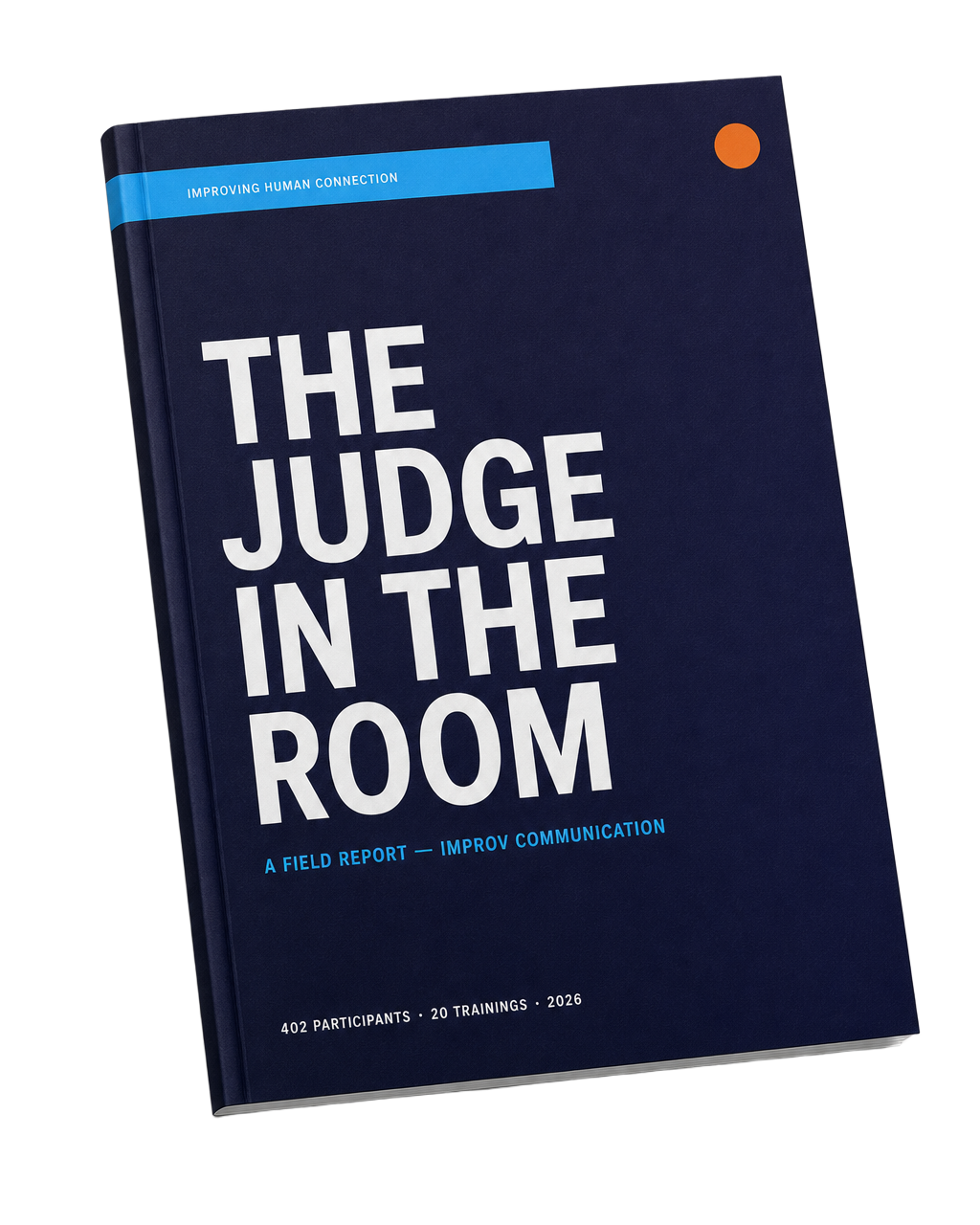
Free field report
The Judge in the Room — what 402 people told us about psychological safety.
A day in a leadership role is mostly a sequence of emotionally charged moments. Delivering feedback someone would rather not hear. Holding a team together when a target slips. Making a call with incomplete information while everyone watches how calm you stay. Deciding whether to speak first in a tense meeting or to wait. None of these are technical problems. They are questions of judgement, timing and emotion.
This is why emotional intelligence tends to matter more as people rise. Early in a career, results come mostly from individual skill. Higher up, results come almost entirely through others — through how well a leader can align, motivate and steady a group of people who each have their own pressures. The higher the role, the larger the share of the job that is emotional, and the more a shortfall in EQ costs.
How does each part of emotional intelligence show up in a leader?
Goleman's model breaks emotional intelligence into five components. Each one maps onto a recognisable leadership behaviour.
Self-awareness is the leader who knows their own patterns — what winds them up, how they come across on a hard day, when their confidence tips into not listening. That awareness is the starting point, because a leader who cannot read their own state has no chance of managing it in front of others.
Self-regulation is composure that holds when it is tested — the space a leader keeps between feeling frustration and acting on it. A regulated leader can receive bad news without the room bracing for their reaction, which is what keeps information flowing towards them instead of away.
Motivation, in Goleman's sense, is the inner drive to pursue goals for their own sake, with energy and persistence. In a leader it reads as optimism that survives setbacks — the quality that helps a team keep going when the easy thing would be to deflate.
Empathy is the ability to sense what other people are feeling and to factor it in. For a leader it is the skill behind reading a quiet room, noticing the person who has gone silent, and understanding how a decision will land before announcing it. Empathy gives a leader accurate information about the people they are responsible for.
Social skill is all of the above put to work in relationships — building trust, handling disagreement well, moving a group towards a shared aim. It is the visible layer, and it rests on the four that sit underneath it.
You can go deeper on each of these in our guide to the five components of emotional intelligence.
What does it mean that a leader sets the emotional climate?
One of the sharpest findings in Primal Leadership is that a leader's emotional state is contagious. Moods spread through a team, and the leader's mood spreads furthest, because everyone is watching the person in charge for cues about how worried, safe or hopeful they should be. The research the authors draw on suggests a leader's actions account for a large share of how people experience the climate of their organisation.
That places a real responsibility on anyone who leads. The tone you bring into a room becomes, to a degree, the tone of the room. A leader who walks in tense and short with people teaches the team to go quiet and self-protect. A leader who stays warm and composed under pressure gives the team permission to think clearly and speak up. Goleman calls the second kind resonant leadership — the leader who moves people towards positive emotion and, through it, towards better performance.
This is where emotional intelligence connects to psychological safety. A leader's steadiness is what makes it feel safe to admit a mistake, raise a concern or offer a half-formed idea. Take that steadiness away and the ideas stay unsaid — which is the most expensive silence a team can carry.
Does emotional intelligence matter more than intelligence for leaders?
Both matter, and they are not in competition. A leader needs the analytical horsepower to understand the work and the emotional intelligence to lead people through it. Intelligence sets the floor; emotional intelligence tends to decide how far someone goes once they are past it. We look at this trade-off in full in EQ vs IQ: which matters more for leadership.
At IMPROV we describe the pairing as EPIQ — emotional intelligence and intelligence working together. Bright decisions still fail when a leader cannot bring people with them, and warm intentions still fail without the clarity to act on them. The strongest leaders hold both.
Can experienced leaders actually develop their EQ?
Yes — and this is the part that changes how the skill should be developed. Emotional intelligence is learnable at any level, including for senior leaders with decades behind them. What shifts with experience is the method. A leader of twenty years rarely needs another model explained. They grow through honest feedback, moments of reflection, and repeated practice in realistic situations where they can try a steadier response and feel the difference it makes.
This is the ground our work sits on. IMPROV's emotional intelligence and leadership trainings put people into live situations — real conversations, real pressure, real feedback — so the skill is built in the body and the moment, not only understood on a page. A leader can read about staying composed when challenged; the change comes from doing it, noticing what happens, and doing it again. Practice is what turns emotional intelligence from an idea a leader agrees with into a behaviour a team can feel.
If you are thinking about how to build these skills across your leaders, our Emotional Intelligence Training and Leadership Training are designed to do exactly that. You are also welcome to book an exploration call and talk it through with us.
Free field report
The Judge in the Room
What 402 people told us about psychological safety — and what you can do with it on a Monday morning. Five findings, seven practices, participants’ own words.
Curious?
Is your team losing ideas to silence?
That's exactly what we help leaders see and shift. No pitch — just a proper conversation about your team.