
Quick answer
Both matter, and they do different jobs. IQ and technical skill get you through the door — they are the baseline for any senior role. EQ, your emotional intelligence, decides how far you go once you are there. For leadership, it predicts effectiveness more reliably than IQ alone, and the strongest teams pair the two.
Key takeaways
- IQ and technical skill are threshold capabilities — they get you into a senior role, and they rarely separate the good leaders from the great ones.
- Goleman's research across 188 companies found emotional intelligence roughly twice as important as IQ and technical skill for strong performance at every level.
- The higher you rise, the more EQ matters — at the top, close to 90% of what distinguishes outstanding leaders is emotional, not cognitive.
- You can hold a high IQ and a low EQ; the two are largely independent, and EQ is the one you can keep developing.
- The strongest teams pair sharp thinking with emotional skill — what we at IMPROV call EPIQ (EQ and IQ working together).
What is the difference between EQ and IQ?
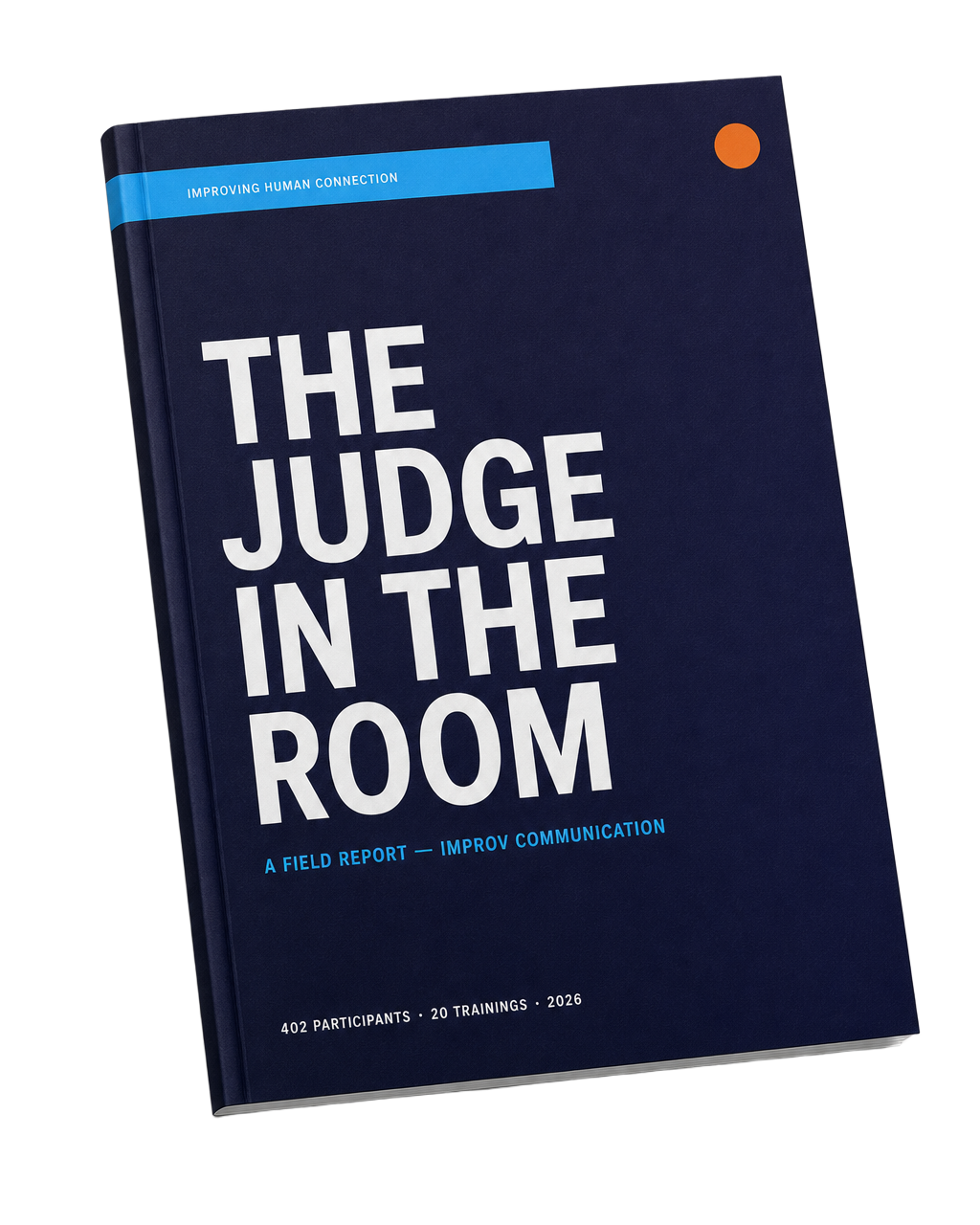
Free field report
The Judge in the Room — what 402 people told us about psychological safety.
IQ measures cognitive ability — reasoning, memory, problem-solving, the kind of horsepower that shows up in analysis and technical work. It is fairly stable across adult life. EQ, emotional intelligence, is a different capacity: recognising and understanding emotions, your own and other people's, and using that awareness to think clearly, connect, and act well under pressure. The term was introduced by psychologists Peter Salovey and John Mayer and brought to a wide audience by Daniel Goleman.
The simplest way to hold the two apart: IQ is how well you process information. EQ is how well you read and manage the human side of a situation — including yourself. One helps you solve the problem on the page. The other helps you work with the people in the room while you do it.
What does the research say about EQ vs IQ for leadership?
When Daniel Goleman studied competency models from 188 large companies — among them British Airways and Credit Suisse — he found something striking. Emotional intelligence competencies appeared about twice as often as cognitive ability and technical skill in the profiles that separated star performers from average ones. When he calculated the ratio of these ingredients for strong performance, EQ proved roughly twice as important as IQ and technical skill across jobs at every level. Goleman set this out in his 1998 Harvard Business Review article, "What Makes a Leader?".
Goleman's phrase for IQ and technical skill is "threshold capabilities" — the entry-level requirements for a senior role. They get you considered. Once everyone in the room clears that bar, they stop being what sets people apart. What differentiates the leaders people actually follow tends to sit on the emotional side.
A caution worth keeping: these figures come largely from one body of research, and the field has debated how to measure emotional intelligence ever since. The direction of the finding is well supported and widely replicated. The exact percentages are best read as a strong signal rather than a precise law.
Why does EQ matter more the higher you rise?
The pattern Goleman found grows more pronounced with seniority. At the top of an organisation, close to 90% of what distinguished outstanding leaders from average ones was emotional, not cognitive.
It makes sense when you picture the work. A junior specialist is largely paid for technical output. A senior leader is paid for something else entirely: setting direction, holding steadiness when things wobble, making decisions with incomplete information, and shaping how a whole team feels and behaves. Almost all of that is emotional work. The leader is, in effect, the emotional climate of the team — Goleman's later work on Primal Leadership makes exactly this point. Read the room badly, lose your composure under pressure, miss what your people are carrying, and the technical brilliance behind it counts for little.
This is why so many technically gifted people stall at a certain level. The skill that got them promoted is no longer the skill the job needs.
Can you have a high IQ and a low EQ?
Yes — they are largely independent. Plenty of sharp, analytically gifted people struggle to read a room, sit with disagreement, or stay composed when challenged. The combination is common enough to be a recognisable type: the person whose thinking everyone respects and whose meetings everyone dreads.
Here is the part that matters most for any leader reading this. IQ is fairly fixed by adulthood. Emotional intelligence is learnable at any age. It behaves like a skill — it grows with practice and feedback, and it fades without them. So the gap between a leader's raw intelligence and their effect on people stays open to change. In fact, it is the most coachable gap there is. We have written more on why emotional intelligence is a learnable skill.
Which should you hire and develop for?
For most senior roles, screen for the threshold and hire for the difference. Cognitive ability and technical competence matter — you want people who can clearly do the job. Once a shortlist clears that bar, the questions that predict who will actually lead well are emotional ones. How do they handle being wrong? Can they hear a hard truth without punishing the person who said it? Do people leave conversations with them feeling steadier or smaller?
For development, the logic is even clearer. You can rarely move someone's IQ. You can reliably grow their emotional intelligence, and the return on that — in trust, in decisions, in how a team performs under pressure — is large. Which is why the most useful question is rarely "EQ or IQ?". It is "how do we build the EQ to match the IQ we already have?".
EPIQ: pairing sharp thinking with emotional skill
The framing of EQ "versus" IQ can mislead. The leaders and teams that perform best run both at once — clear thinking and emotional skill, working together. We call this EPIQ: emotional intelligence and cognitive intelligence side by side, so that good thinking actually lands with the people it is meant to serve. Sharp analysis that nobody can hear changes nothing.
Reading about emotional intelligence is the easy part. Building it is where it gets interesting, because emotional skill is a performance skill — it grows through reps and feedback, the way any skill does. That is what our Emotional Intelligence training is built around: leaders practising the moments that matter — staying composed when challenged, listening past their first reaction, making others feel safe enough to speak — until the steadier response becomes the natural one. The same thread runs through our Leadership Training, where the human side of leading is the work itself.
If you are weighing how to grow the human side of your leaders to match their obvious capability, we would be glad to talk it through and help you find the right starting point.
Free field report
The Judge in the Room
What 402 people told us about psychological safety — and what you can do with it on a Monday morning. Five findings, seven practices, participants’ own words.
Curious?
Is your team losing ideas to silence?
That's exactly what we help leaders see and shift. No pitch — just a proper conversation about your team.