
Quick answer
High emotional intelligence shows up as self-awareness, steadiness under pressure, real listening and the ability to read a room and respond well. Low emotional intelligence shows up as blame, defensiveness, poor listening and reactions that outsize the moment. The signs are behavioural, which means they can be observed — and, with practice, changed.
Key takeaways
- Emotional intelligence is visible in behaviour — how someone handles pressure, feedback and disagreement tells you more than any self-description.
- The clearest sign of high EQ is self-awareness: knowing what you feel, why, and how it lands on others.
- People with high EQ regulate their reactions, listen to understand, and read the emotional temperature of a room.
- Low EQ tends to show up as defensiveness, blame, poor listening and reactions that outsize the moment.
- These are learnable behaviours, so the signs of low EQ describe a starting point, not a fixed trait.
Why are the signs of emotional intelligence easier to see than to describe?
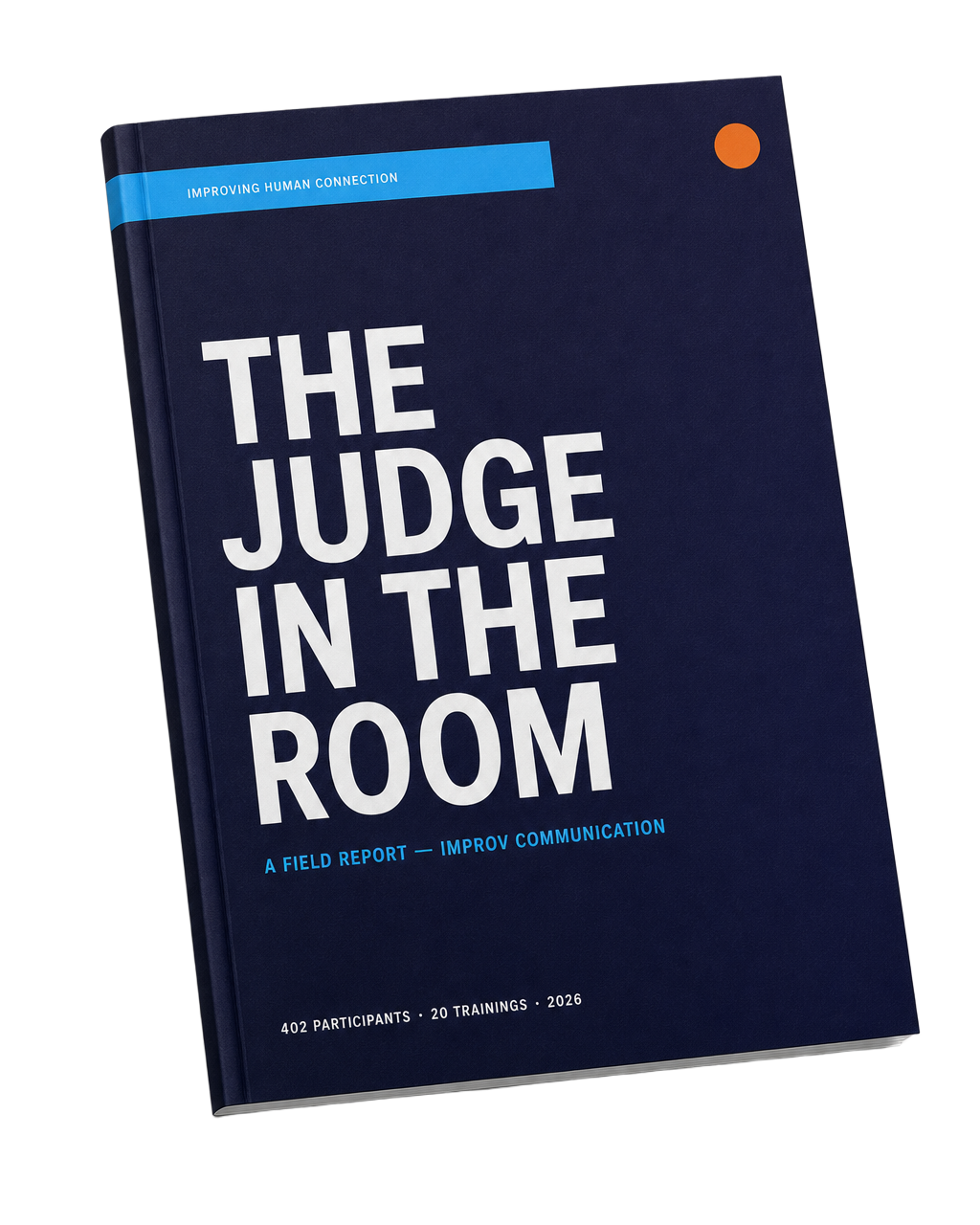
Free field report
The Judge in the Room — what 402 people told us about psychological safety.
Emotional intelligence lives in behaviour. You notice it in the small moments — how a colleague takes hard feedback, how a manager holds a tense meeting, how someone responds when a plan falls apart at four o'clock on a Friday. None of that appears on a CV, and most people cannot describe their own EQ accurately, so the honest read comes from watching what people do when emotion is in the room.
That is also why the signs are useful. Daniel Goleman's model breaks emotional intelligence into five parts — self-awareness, self-regulation, motivation, empathy and social skill — and each one leaves a visible trace. Once you know what those traces look like, you can spot high and low EQ in others, and, more usefully, in yourself.
What are the signs of high emotional intelligence?
People with high emotional intelligence tend to share a set of habits. A few of the clearest:
- They know what they are feeling, in the moment. Self-awareness is the foundation of the whole thing. They can name the emotion — irritation, worry, disappointment — while it is happening, which gives them a choice about what to do next.
- They stay steady under pressure. When the stakes rise, their reaction stays roughly the size of the problem. They feel the heat and still think clearly.
- They listen to understand. They ask a second question before offering their answer. People leave conversations with them feeling heard.
- They read the room. They pick up the unspoken — who has gone quiet, where the energy dropped, what the mood in a meeting actually is — and adjust.
- They take feedback without collapsing or attacking. Criticism lands as information rather than threat. They can say "tell me more" and mean it.
- They own their part. When something goes wrong, they look at their own contribution first. Accountability comes before blame.
- They handle disagreement without making it personal. They can hold a firm position and a warm relationship at the same time.
Notice that none of these is about being calm all the time or agreeable all the time. High EQ includes feeling things strongly. The skill is in what happens next.
What are the signs of low emotional intelligence?
Low emotional intelligence shows up as the mirror image — the same situations handled in ways that cost trust:
- Reactions that outsize the moment. A small setback triggers a large response, and the people nearby start managing the mood rather than the work.
- Defensiveness when challenged. Feedback is met with justification, counter-attack or a quick change of subject.
- Blame that travels outward. When things go wrong, the cause is always someone else, the process, or the circumstances.
- Poor listening. They interrupt, finish sentences, or wait visibly for their turn to talk.
- Missing the emotional temperature. They push on with the agenda while half the room has gone silent, and seem surprised when people disengage.
- Struggling to name feelings. Everything is "fine" or "stressed", with little language in between — which makes emotions harder to manage, for reasons the neuroscience explains below.
- Difficulty with repair. After a rupture, they move on as though nothing happened, and the unspoken tension stays in the room.
A fair word of caution: everyone does some of these on a bad day. One defensive moment is human. A consistent pattern across weeks and situations is the real signal.
Why does naming emotions matter so much?
One sign runs deeper than it looks: the ability to put feelings into precise words. In a 2007 UCLA study, Matthew Lieberman and colleagues scanned people's brains while they labelled the emotions on faces. Naming the feeling lowered activity in the amygdala, the brain's alarm system, and gave the prefrontal cortex — the part that reasons and plans — more room to work. Psychiatrist Dan Siegel later gave the effect its memorable name: "name it to tame it".
When a person can tell the difference between disappointed and betrayed, or anxious and overwhelmed, they are regulating their own nervous system in real time. Emotional vocabulary is one of the quiet engines of high EQ, which is why it sits at the centre of Marc Brackett's RULER model.
Can the signs of low emotional intelligence change?
Yes — and this is the part worth holding onto. Goleman himself described the five components as learned capabilities rather than fixed traits. Emotional intelligence grows with practice, the way any behavioural skill does. Someone who blames outward today can learn to pause and ask what their own part was. Someone who dominates conversations can learn to leave space.
The signs, then, describe a current pattern and a starting point. They tell you where the reps need to go: more self-awareness, steadier regulation, closer listening. Reading about those moves helps a little. Practising them, with feedback, in situations that carry real emotional charge, is what makes them stick.
Where do these habits actually get built?
That last point is where our work sits. Reading a list of signs is easy; changing how you show up when a meeting turns tense is hard, because it happens faster than thought. IMPROV's Emotional Intelligence Training puts people in live situations where they practise self-awareness, regulation and reading the room in the moment — so the habits are built through repetition, with support, rather than left as good intentions. It is how behavioural change actually holds.
If you would like to explore what that could look like for your team, our Emotional Intelligence Training is a good place to start, or book an exploration call and we can think it through together.
Free field report
The Judge in the Room
What 402 people told us about psychological safety — and what you can do with it on a Monday morning. Five findings, seven practices, participants’ own words.
Curious?
Is your team losing ideas to silence?
That's exactly what we help leaders see and shift. No pitch — just a proper conversation about your team.