
Quick answer
Emotional intelligence is learnable. You improve it by building self-awareness, naming your emotions accurately, pausing before you react, and practising empathy in real conversations. Progress comes from repetition — small reps, done often, in the moments that matter. A 2018 meta-analysis found that structured emotional intelligence training produces a moderate, lasting effect.
Key takeaways
- Emotional intelligence is learnable — it grows with deliberate, repeated practice.
- Start with self-awareness — you can only manage what you first notice.
- Name it to tame it: labelling an emotion lowers amygdala activity and helps you think clearly (Lieberman).
- Use the meta-moment — pause and ask what your best self would do (Brackett's RULER).
- Empathy grows through real conversations and deep listening, done on purpose.
- Practice beats theory: EQ is a performance skill, built by using it in real situations.
Can you really improve your emotional intelligence?
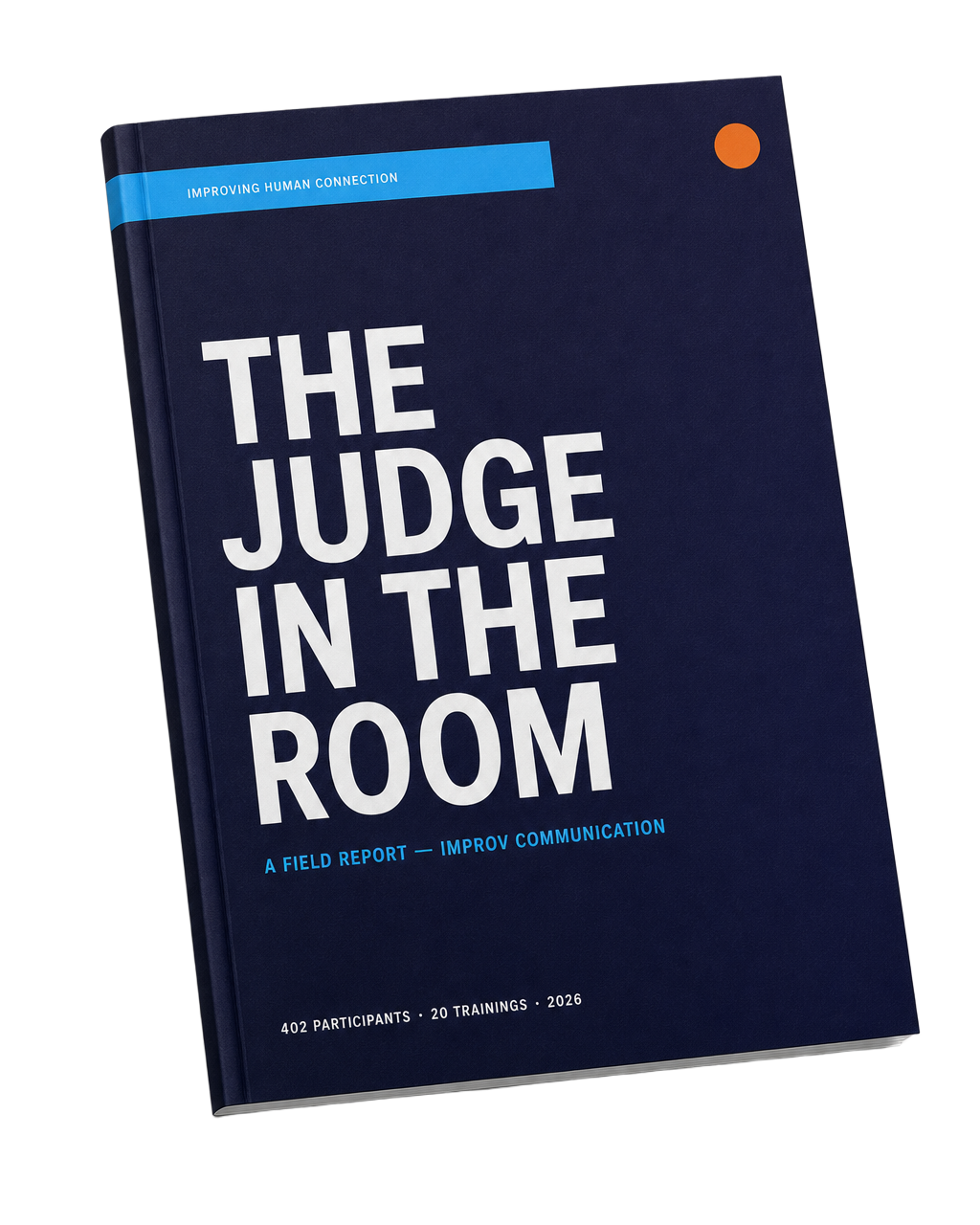
Free field report
The Judge in the Room — what 402 people told us about psychological safety.
Yes. For a long time people treated emotional intelligence as something you either had or you didn't — a fixed part of your temperament. The evidence points the other way. In 2018, Sabina Hodzic and colleagues published a meta-analysis in Emotion Review pulling together 24 studies on emotional intelligence training. Across them, structured training produced a moderate improvement that held up when people were measured again weeks later. Emotional intelligence behaves like any other capability: it responds to deliberate practice.
That matters because the alternative — assuming your EQ is set — quietly stops people from trying. Once you treat it as a skill, the question changes from "am I an emotional person?" to "which specific habit do I want to build next?"
We have written more on the science of this in why emotional intelligence is a learnable skill. Here, the focus is practical: how you actually build it.
Where do you start? Build self-awareness first
Self-awareness sits underneath everything else. You can only manage a reaction you have noticed, and you can only read a room if you can first read yourself. Daniel Goleman put self-awareness at the base of his model for exactly this reason — it is the component the others depend on.
Building it is less mysterious than it sounds. A few habits that work:
- Check in before meetings. Take ten seconds to ask what you are actually feeling — rushed, defensive, curious, flat. Naming it changes how you show up.
- Notice your body. A tight jaw, a quicker heartbeat, a held breath — these usually arrive before the thought does. They are early data.
- Ask for one piece of feedback. Self-perception has blind spots. A trusted colleague can tell you how you land in a way you cannot see from the inside.
None of this takes extra time in your day. It takes attention, repeated often enough to become a habit.
How do you get better at managing your reactions?
This is where emotional intelligence earns its keep — in the gap between a trigger and your response. Two well-evidenced practices help.
The first is affect labelling, popularised by psychiatrist Dan Siegel as "name it to tame it". When you put a feeling into words — "I'm frustrated", "I'm anxious about this" — something measurable happens in the brain. UCLA neuroscientist Matthew Lieberman showed with fMRI that naming an emotion lowers activity in the amygdala, the brain's alarm system, and brings the more reasoned prefrontal cortex back online. The feeling stays. Its grip loosens enough for you to think.
The second is the meta-moment, a practice from Marc Brackett's RULER framework at the Yale Center for Emotional Intelligence. When you feel yourself about to react, you pause and ask two questions: how have I handled situations like this before, and what would my best self do right now? That short pause is often the whole difference between a reaction you regret and a response you are proud of. You can read more in our piece on the RULER model.
Both practices share a logic: you cannot stop emotions arriving, and you can shape what you do next. That skill grows every time you use it.
How do you build empathy and social skill?
Empathy is the ability to sense what another person is feeling and to let that shape how you respond. It grows through real contact with other people, done with intent.
The most reliable way in is listening — properly, not while forming your reply. Give someone your full attention, ask a question that shows you have understood, and resist the urge to fix or reroute. Most people rarely feel truly heard at work, so the effect of doing this well is larger than you would expect.
Social skill — the outward end of emotional intelligence — builds on the same foundation. When you can read your own state and another person's, conversations that used to feel risky become manageable: giving hard feedback, disagreeing without damage, staying warm when the pressure rises. These are things you get better at by doing them, with enough safety to get them wrong along the way.
Why does practice beat theory?
You can read every book on emotional intelligence and still freeze in the moment that counts. Knowing about self-regulation and being able to self-regulate when your heart rate is up are different things.
The reason is simple. Emotional intelligence fires under pressure, and pressure is not something you can reason your way through in the moment. Like any performance skill, it is built through repetition, in conditions close enough to the real thing that the practice carries over.
This is why our approach to developing emotional intelligence is experiential. We put people in situations where they have to use these skills — reading a room in real time, responding to something they did not plan for, staying present when it would be easier to retreat. The learning happens in the doing, and the reps are what make it hold when it matters.
If you would like to build these skills in your team rather than talk about them, our Emotional Intelligence Training is designed to do exactly that. And if you are weighing up where to start, a short exploration call is the easiest first step.
Free field report
The Judge in the Room
What 402 people told us about psychological safety — and what you can do with it on a Monday morning. Five findings, seven practices, participants’ own words.
Curious?
Is your team losing ideas to silence?
That's exactly what we help leaders see and shift. No pitch — just a proper conversation about your team.