
Quick answer
Emotional intelligence (EQ) is the ability to recognise, understand and manage emotions — both your own and other people's — and to use that awareness to think clearly, connect with others and act well under pressure. The term was introduced by Peter Salovey and John Mayer in 1990 and popularised by Daniel Goleman. It is learnable, and for leadership it matters more than IQ alone.
Key takeaways
- Emotional intelligence is the ability to recognise, understand and manage emotions in yourself and in others, and to use that information to guide how you think and act.
- The term was coined by psychologists Peter Salovey and John Mayer in 1990, then brought to a wide audience by Daniel Goleman's 1995 book Emotional Intelligence.
- Goleman's model, developed with Richard Boyatzis, organises emotional intelligence into four domains: self-awareness, self-management, social awareness and relationship management.
- Goleman's research at nearly 200 large companies found that high emotional intelligence is what distinguishes outstanding leaders — IQ and technical skill get you in the door.
- Emotional intelligence is a learnable skill, and it grows through practice and feedback rather than through reading about it.
Most of what goes wrong at work is emotional before it is technical. A decision made in frustration. Feedback that lands as an attack. A good idea held back because the room felt unsafe. Emotional intelligence is the skill of noticing these moments — in yourself and in others — and handling them well. This guide covers where the idea comes from, what it involves, why it matters for leadership, and how you build it.
Where does the term come from?
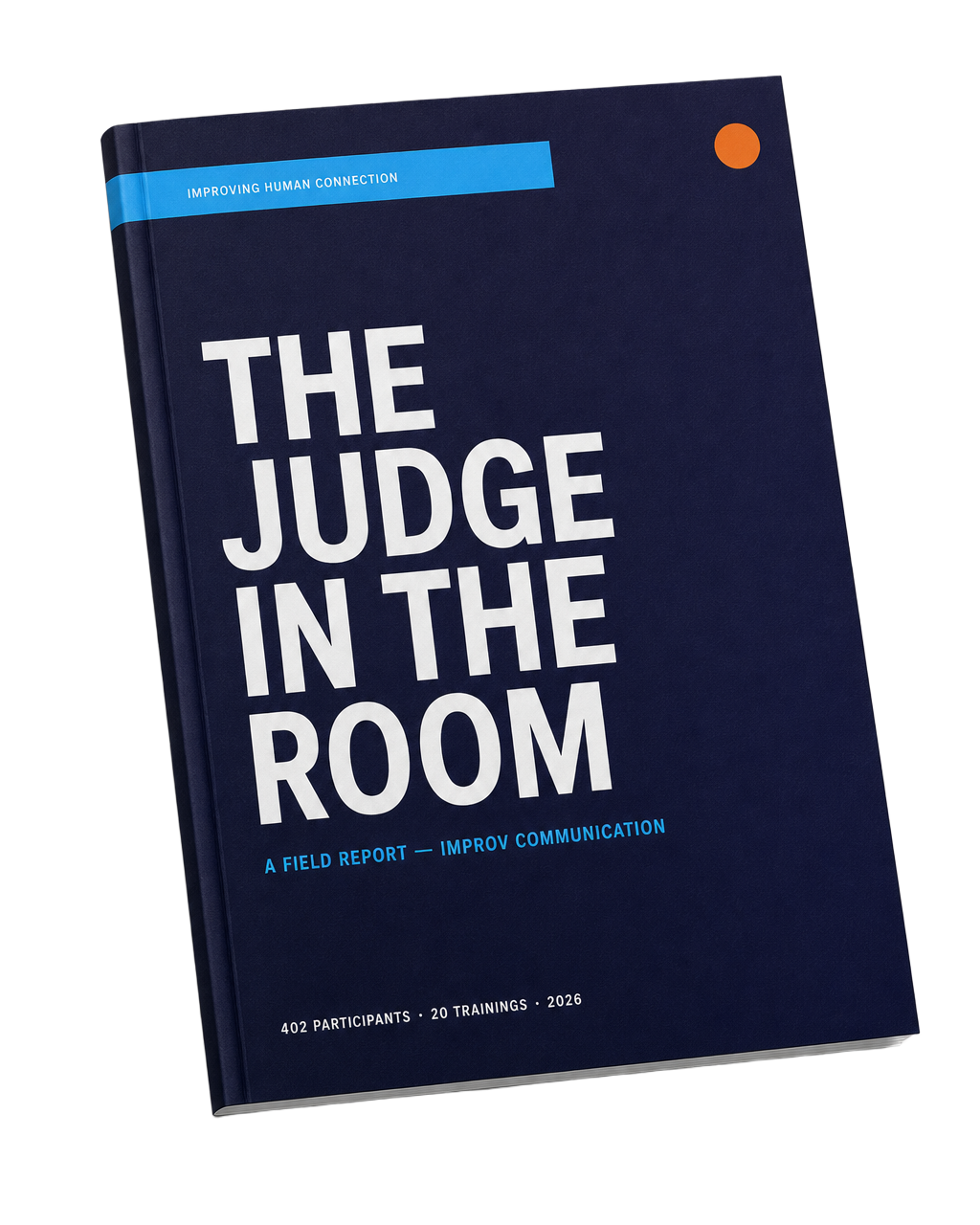
Free field report
The Judge in the Room — what 402 people told us about psychological safety.
In 1990, two psychologists — Peter Salovey of Yale and John Mayer of the University of New Hampshire — published a paper in the journal Imagination, Cognition and Personality that gave the idea its name. They defined emotional intelligence as a set of skills for appraising and expressing emotion accurately, regulating emotion in yourself and others, and using feelings to guide thinking and action.
Five years later, psychologist and science journalist Daniel Goleman published Emotional Intelligence (1995), and the idea travelled from academic journals into boardrooms. Goleman's argument was simple: how we handle ourselves and our relationships matters at least as much as raw cognitive ability — and often more.
Since then the field has deepened. Marc Brackett, founding director of the Yale Center for Emotional Intelligence, developed the RULER model — five concrete skills for recognising, understanding, labelling, expressing and regulating emotion. The research base has grown alongside it.
What does emotional intelligence involve?
Goleman's model, refined with his colleague Richard Boyatzis, organises emotional intelligence into four domains. Each one is observable in daily working life:
Self-awareness — knowing what you are feeling as you feel it, and understanding how those feelings shape your judgement. The leader who notices their own irritation rising in a meeting, before it leaks into their tone, is practising self-awareness.
Self-management — handling your reactions rather than being handled by them. Pausing before replying to the email that annoyed you. Staying steady when the project slips. Keeping your drive alive when things get hard.
Social awareness — reading what others are feeling and taking it into account. Empathy sits at the heart of this domain: the difference between hearing what someone said and understanding what they meant.
Relationship management — putting all of the above to work in relationships: building rapport, handling conflict, giving feedback that lands, moving a group towards a shared goal.
Goleman's original 1995 model described five components — self-awareness, self-regulation, motivation, empathy and social skill. He and Boyatzis later consolidated these into the four domains above, with twelve specific competencies nested beneath them.
None of these are personality traits you either have or lack. They are capacities, and capacities respond to practice.
Why does emotional intelligence matter at work?
In his 1998 Harvard Business Review article "What Makes a Leader?", Goleman reported on research at nearly 200 large, global companies. The pattern was consistent: truly effective leaders were distinguished by high emotional intelligence. Analytical skill and technical knowledge mattered — as entry requirements. What separated outstanding leaders from competent ones sat in the emotional domain.
There is a neurological reason for this. Under pressure, the brain's threat response — driven by the amygdala — narrows thinking and pushes people towards defence: fight, flight or freeze. A leader who cannot regulate their own response spreads that state through the team. A leader who can stay steady creates the conditions in which others think clearly too. This is one reason emotional intelligence sits underneath psychological safety: people speak up when the emotional climate tells them it is safe to do so, and leaders set that climate moment by moment.
The effect compounds with seniority. The more senior the role, the less the job is about technical work and the more it is about people — reading them, steadying them, bringing them along. EQ scales. Technical skill plateaus.
Is EQ more important than IQ?
Both matter, and they do different jobs. IQ and technical expertise are threshold capabilities: they get you into the role and let you understand the work. Emotional intelligence determines what you do with that ability when other people are involved — which, in leadership, is nearly all of the time.
So the question is less "which one?" and more "do you have both working together?" We call that pairing EPIQ — emotional intelligence plus IQ. The sharpest analysis in the room achieves nothing if it is delivered in a way no one can hear, and the warmest leader still needs sound judgement. The strongest teams pair the two deliberately.
Can emotional intelligence be learned?
Yes — and this may be the most important thing about it. Unlike IQ, which stays fairly stable through adult life, emotional intelligence responds to deliberate practice. Research on emotional intelligence trainings shows measurable, lasting improvement. We have written about why emotional intelligence is a learnable skill in more depth.
What the research also shows is how it is learned: through experience and repetition, with feedback. You can read every book on empathy and remain a poor listener. The skill builds the same way fitness does — through reps.
How do you start building it?
A few places to begin, each tied to a domain of the model:
Start by naming what you feel. Several times a day, pause and put a precise word to your emotional state — pressured, hopeful, irritated, flat. Precision matters: "stressed" hides more than it reveals. Naming an emotion is the first step to regulating it.
Notice your reactions under pressure. When something triggers you, take one breath before responding. That small gap is where self-management lives.
Listen to understand rather than to reply. In your next three conversations, set yourself one rule: ask a follow-up question before offering your own view.
Ask for feedback on how you land. Self-awareness has a blind spot — yourself. Other people can see what you cannot.
These practices look modest. Done consistently, they change how you show up — and people notice.
Where does practice come in?
Reading about emotional intelligence builds knowledge. Practising it builds the skill. That gap — between knowing and doing — is where most development effort stalls, and it is the gap our work is designed to close. In our Emotional Intelligence trainings, participants practise the real behaviours — naming emotions, listening fully, staying steady when the unexpected arrives — in live situations with other people, guided by our facilitators. The learning happens in the body as much as the head, which is why it holds.
If you are curious what that looks like for your team, get in touch — we are happy to talk it through.
Free field report
The Judge in the Room
What 402 people told us about psychological safety — and what you can do with it on a Monday morning. Five findings, seven practices, participants’ own words.
Curious?
Is your team losing ideas to silence?
That's exactly what we help leaders see and shift. No pitch — just a proper conversation about your team.