
Quick answer
Applied improv builds psychological safety by giving a team a low-stakes place to practise the behaviours safety depends on: speaking up early, building on each other's ideas, and recovering from mistakes without blame. Amy Edmondson's research describes safety as a shared belief formed through experience, which is why practising it moves a team faster than hearing about it.
Key takeaways
- Psychological safety is a shared belief about what happens when you take an interpersonal risk — beliefs update through experience, so teams need evidence about themselves.
- Edmondson's 1999 study of 51 work teams found psychological safety predicted learning behaviour, and learning behaviour explained the link between safety and performance.
- Three of IMPROV's five guiding principles do most of the work: Embrace Failure, Do Not Judge Others, and Make Each Other Look Good.
- Applied improv puts mistakes in front of a team early and cheaply, so the group builds a track record of recovering well together.
- Senior teams often gain the most, because the habits that protect status are exactly what suppress speaking up lower down.
Most teams have already heard the concept. Someone has shared the Google study, a leader has said the words "speak up" in an all-hands, and everyone nods. Then the next meeting runs exactly as the last one did, with the same three people talking and the same quiet person holding the thing that mattered.
That gap is the whole problem. And it explains why practising the behaviours tends to move a team further than explaining them.
Why does psychological safety have to be practised?
Free field report
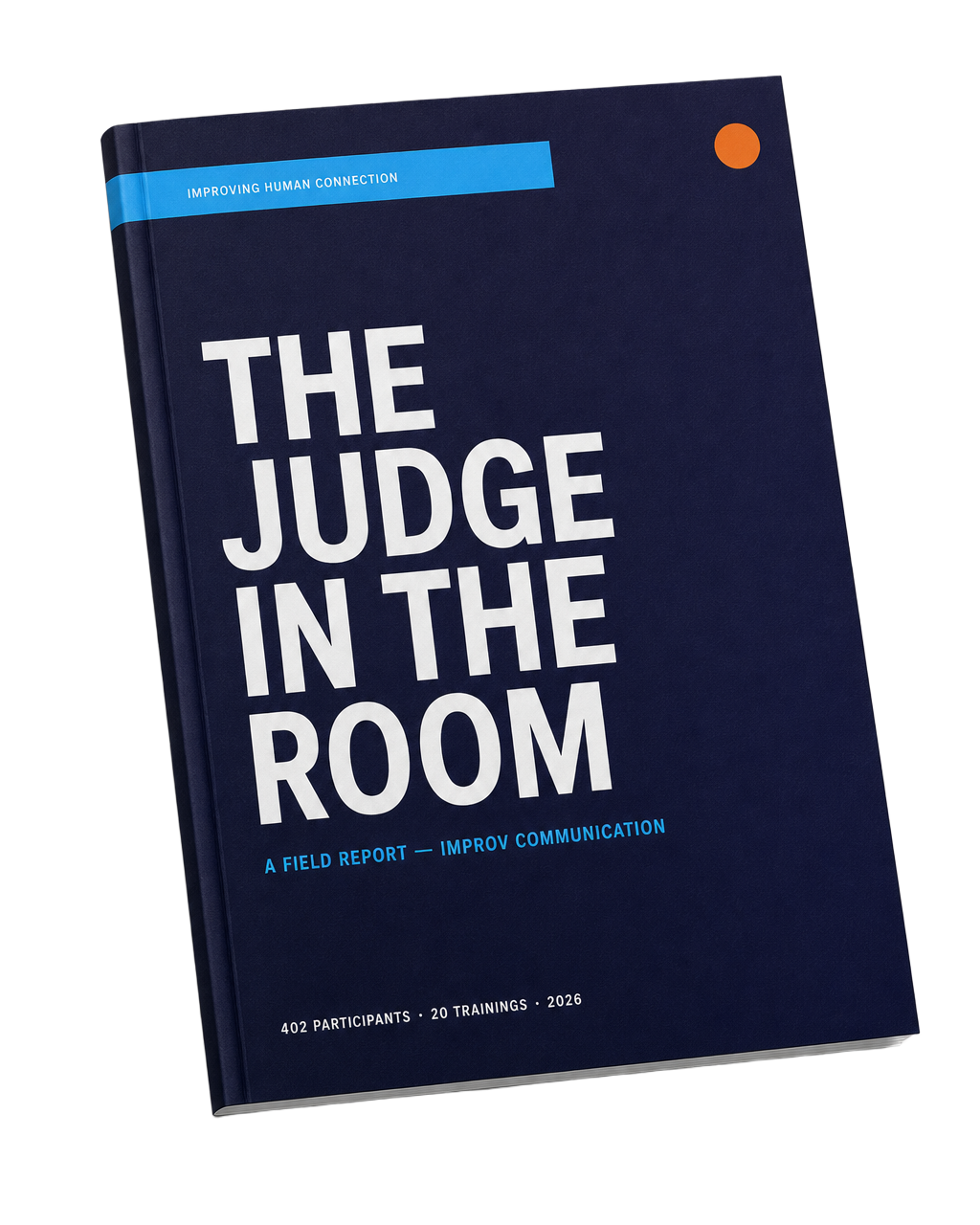
The Judge in the Room — what 402 people told us about psychological safety.
Amy Edmondson defined team psychological safety in her 1999 paper in Administrative Science Quarterly as a shared belief held by members of a team that the team is safe for interpersonal risk-taking. The word doing the work there is belief.
A belief forms from what people have lived through together. Each time someone floats a half-formed idea and the room treats it well, the belief grows. Each time someone admits an error and watches it get used against them, the belief shrinks. Everyone in the team is running this calculation constantly, mostly without noticing.
Edmondson's study of 51 work teams in a manufacturing company found that psychological safety was associated with learning behaviour — asking questions, seeking feedback, discussing errors, experimenting — and that learning behaviour explained the link between safety and team performance. The paper was named an Outstanding Publication in Organizational Behavior by the Academy of Management in 2000, and it remains the anchor for the field.
Here is what follows from the word belief. Information updates what a team knows. Experience updates what a team expects. Safety lives in the expectations, so a team needs fresh evidence about itself for anything to shift.
Which improv principles build psychological safety?
IMPROV's work rests on five guiding principles: Yes And, Do Not Judge Yourself, Do Not Judge Others, Embrace Failure, and Make Each Other Look Good. Three of them carry most of the weight on safety.
Embrace Failure
Applied improv puts mistakes in front of a team early, cheaply, and in the open. Someone loses the thread of an exercise. Someone gives an answer that lands nowhere. It happens within the first ten minutes, and it happens to everyone, including the most senior person present.
What matters is what the group does next. In a well-facilitated session, the group keeps going and the mistake becomes ordinary. Do that thirty times in an afternoon and the team has built a small track record of recovering together. That track record is what people draw on months later when the mistake is real and expensive.
Failure also comes in kinds, and treating them as one thing is where a lot of teams get stuck — we've written separately about the three types of failure and why only some deserve a conversation about blame.
Do Not Judge Others
The fear that stops people speaking up is rarely fear of being wrong. It is fear of how they will look. Edmondson's own framing is about confidence that the team will not embarrass, reject or punish someone for speaking up.
Improv exercises make judgement expensive in a way people can feel. If your job in the exercise is to take whatever your colleague offers and do something useful with it, you have no room to sit back and rate it. Suspend the judging reflex for two hours and something shows up: how much of your usual listening was spent preparing a verdict. That noticing tends to survive the session, and it's the same muscle behind deep listening as a leadership skill.
Make Each Other Look Good
This principle inverts the default. In most meeting cultures, the quiet incentive is to look good yourself. When the group's shared job becomes making the person next to you look good, contributions stop being auditions. Ideas get built rather than defended.
That's also the connective tissue to Yes, And — the habit of adding to a colleague's idea before testing it. A team that does this reliably has removed one of the biggest costs of speaking up, which is the risk that your idea gets picked apart before it has taken shape.
Why does a session move faster than a conversation about safety?
Because of the density of the practice. In an hour of applied improv, a team generates dozens of small moments where someone takes a risk and the group responds. Each one is a data point. The belief moves because the evidence moved.
A talk about psychological safety produces zero such moments. Everyone leaves agreeing with the idea and holding exactly the same expectations they walked in with — which is the same reason most training fades within a month while practised skills stay.
There's a second reason, and it's about who goes first. Safety spreads downwards. When the team watches their own director drop a thread, name it, laugh, and carry on, permission has been granted in a way no policy achieves. The exercise creates that moment without anyone having to be brave in a real situation with real stakes.
Does this work with senior leadership teams?
Senior teams often gain the most, and they're usually the most sceptical going in. That scepticism is worth taking seriously rather than arguing with.
The habits that make someone effective at a senior level — arriving with a considered position, projecting composure, avoiding visible errors — are the same habits that teach an organisation to hide things. A leadership team that practises recovering out loud changes what the two layers beneath them believe is allowed. And they do it faster than any communications campaign will.
The exercises are calibrated for this. No performance, no audience, no one asked to be funny. Small structured tasks with a clear point, run at a pace that leaves no time for the polished answer, followed by an honest conversation about what people noticed in themselves.
Where this fits
We build our trainings around a simple observation: teams believe what they've experienced together. So we spend the time in the room producing experiences worth believing — small risks, quick recoveries, colleagues backing each other — and then we make the connection explicit, so people leave with language for what they've just done and something specific to try on Monday.
If you're working on psychological safety and the concept has already landed while the behaviour hasn't, that's the gap our Psychological Safety Training is built for. You can also start with what psychological safety actually is, or read more on how applied improv works as a leadership methodology.
Free field report
The Judge in the Room
What 402 people told us about psychological safety — and what you can do with it on a Monday morning. Five findings, seven practices, participants’ own words.
Curious?
Is your team losing ideas to silence?
That's exactly what we help leaders see and shift. No pitch — just a proper conversation about your team.