
Quick answer
Applied improv develops the human side of leadership — presence, listening, adapting under pressure, and making it safe for others to speak — by having leaders practise those behaviours rather than learn about them. It works because leadership is a set of habits, and habits change through repetition, feedback and doing, not information alone.
Key takeaways
- Leadership shows up as behaviour under pressure — presence, listening and composure are habits, and habits change through practice.
- Applied improv trains five leadership capabilities directly: presence, active listening, thinking on your feet, emotional regulation, and creating safety for others.
- Practising a behaviour in a low-stakes setting transfers to real meetings far better than hearing it described.
- It suits senior leaders especially, because the skills it builds are the ones that get harder as responsibility grows.
- At IMPROV, these capabilities map onto the EPIC Leadership model — Empathy, Purpose, Inspiration, Connection.
Why a leadership course rarely changes how someone leads
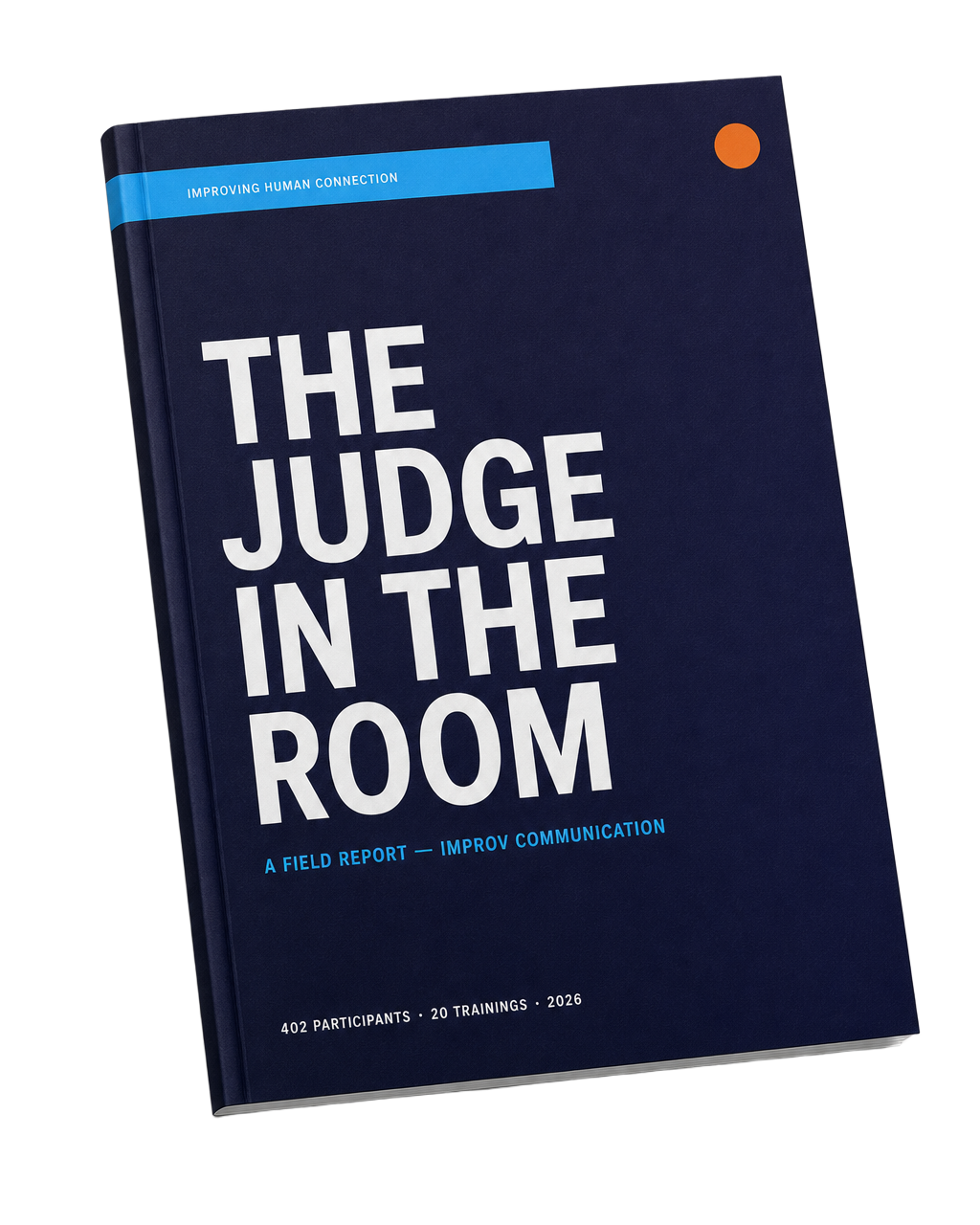
Free field report
The Judge in the Room — what 402 people told us about psychological safety.
Most leadership development hands people information. A model for feedback. A framework for difficult conversations. A description of what good listening looks like. People leave able to explain the behaviour, and a month later they lead much the way they always did.
The reason is simple. Leadership shows up in what you do, usually under pressure and often when you are tired or caught off guard. Knowing what good listening looks like does little in the moment a colleague challenges your plan in front of the team. What carries you through that moment is a habit, and habits form through repetition rather than explanation.
This is the gap applied improv is built to close. It is a leadership and team-development methodology built on the core skills of improvisation — listening closely, building on what others offer, thinking on your feet, and recovering quickly from mistakes. Whed practicing applied improv, leaders practise those skills in the room until they become available under real pressure.
What leadership skills does applied improv build?
Five capabilities come up again and again, and each one is hard to develop by reading about it.
Presence. The ability to be fully in the conversation in front of you, rather than half-listening while you prepare your reply. Applied improv work forces real attention, because you cannot build on what someone said if you were not listening to them in the first place.
Active listening. Most leaders listen to respond. Applied improv trains listening to understand — taking in the whole offer before reacting. Our deep listening playbook goes deeper on why this is one of the most underrated leadership skills there is.
Thinking on your feet. Plans rarely survive contact with a real team. Leaders who can adapt calmly when a meeting goes sideways hold their teams steadier. That composure is trainable, and practice is the way to build it.
Emotional regulation. Under pressure, the amygdala drives quick defensive reactions — interrupting, defending, going quiet. You cannot reason your way out of that in the moment. You can only have rehearsed a steadier response often enough that it is there when you need it.
Creating safety for others. A leader sets the emotional temperature of a room. When you respond well to a half-formed idea or an honest mistake, people offer more. When you respond badly, they stop. Applied improv lets leaders feel the difference their own reactions make on how much others contribute.
Why does practising beat learning about it?
Behaviour is a performance skill. You get better at it the way you get better at any performance skill — by doing it, getting feedback, and doing it again. Research on transfer of training points the same way: whether a skill shows up back at work depends far more on practice, reinforcement and follow-up than on how good the content was.
Applied improv creates mild, friendly pressure and lets leaders rehearse the response they want under it — staying composed, staying curious, staying open when challenged. That rehearsal is what transfers to the next tense meeting. The five guiding principles behind the method — among them Embrace Failure and Make Each Other Look Good — give leaders a clear, repeatable way to practise these behaviours together.
Is applied improv suitable for senior leaders?
Yes, and the more senior the leader, the more it tends to matter. As responsibility grows, the technical part of the role shrinks and the human part grows. People also become more guarded the higher up you sit, so you hear less of what is really going on.
The skills that decide whether a senior leader hears the truth are presence, listening, and the ability to make it safe to speak. Those are precisely what applied improv trains. Senior teams often arrive sceptical and leave having noticed something about their own default reactions that no feedback report had shown them.
The IMPROV view
At IMPROV we organise these capabilities around the EPIC Leadership model — Empathy, Purpose, Inspiration, Connection. Most leaders can describe empathy. Far fewer practise it when a conversation gets uncomfortable. Our trainings are experiential, so leaders work through real situations in the room and feel the effect of their own behaviour while there is still time to change it.
If you would like to see what that looks like for your own leadership team, explore our Leadership Training or book an exploration call with us.
Free field report
The Judge in the Room
What 402 people told us about psychological safety — and what you can do with it on a Monday morning. Five findings, seven practices, participants’ own words.
Curious?
Is your team losing ideas to silence?
That's exactly what we help leaders see and shift. No pitch — just a proper conversation about your team.