
Quick answer
The five guiding principles of improv are Yes, And; Do Not Judge Yourself; Do Not Judge Others; Embrace Failure; and Make Each Other Look Good. Together they describe how people collaborate when it is safe to contribute — building on ideas, suspending judgement, recovering from mistakes, and helping each other succeed.
Key takeaways
- The five principles are: Yes, And; Do Not Judge Yourself; Do Not Judge Others; Embrace Failure; and Make Each Other Look Good.
- They are not stage rules — they are shared agreements for how a team contributes, listens and recovers under pressure.
- Yes, And builds on contributions instead of blocking them; the two 'Do Not Judge' principles quiet the inner and outer critic that stops people speaking up.
- Embrace Failure makes mistakes survivable so people take the small risks that learning and innovation depend on.
- Make Each Other Look Good shifts attention from individual performance to collective success — the behaviour psychological safety rests on.
Ask anyone who has spent time around Applied Improv what holds it all together, and you will hear various concepts of somewhat the same ideas. In reality improv as a methodology have a wide range of principles. At IMPROV we've created our own approach. Presenting five guiding principles of IMPROV. They are simple enough to write on a napkin and deep enough to reshape how a team works. At IMPROV they are the foundation of everything we do — five guiding principles that describe how people behave when it is safe to contribute.
They are not stage rules. They are shared agreements for how a group listens, builds, fails and recovers together. Read on their own they sound almost obvious. Lived in a room with colleagues, they change how people show up.
What are the five principles, and why do they work together?
Free field report
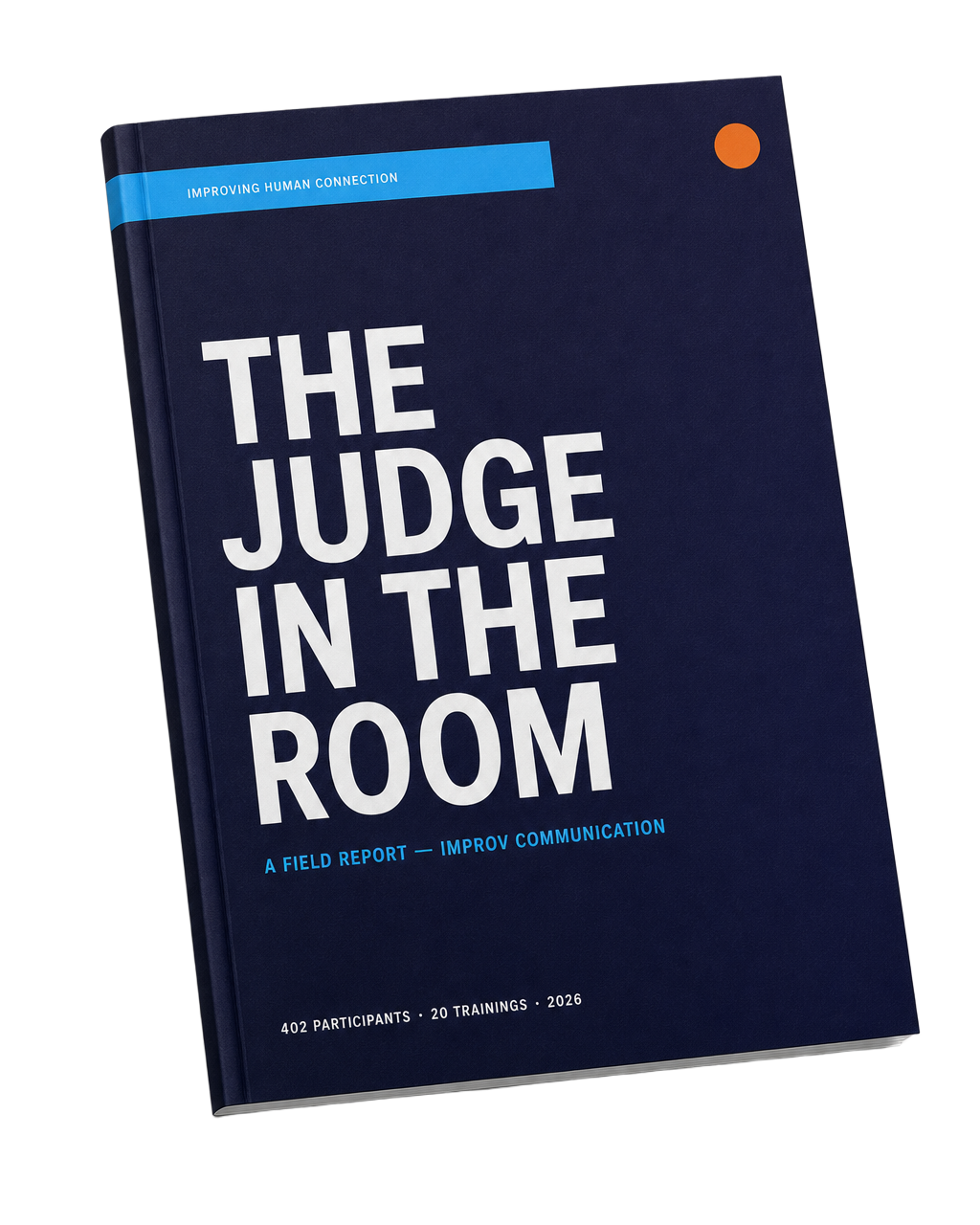
The Judge in the Room — what 402 people told us about psychological safety.
The five are Yes, And; Do Not Judge Yourself; Do Not Judge Others; Embrace Failure; and Make Each Other Look Good. Each one names a behaviour. Taken together, they describe the conditions a team needs to do its best thinking — where ideas get built on instead of shut down, where people speak before they have polished the thought, and where a mistake costs nothing.
What makes them work is that they reinforce one another. It is hard to say "Yes, And" to a colleague while you are busy judging them. It is hard to embrace failure while you are judging yourself for every wobble. Pull on one principle and the others come with it. That is why we treat them as a set rather than a menu.
1. Yes, And — how do you build on each other?
"Yes, And" is the most quoted principle, and the easiest place to start. "Yes" means you accept what your colleague has offered as real. "And" means you add to it. You take the idea forward instead of blocking it.
The opposite is what we call blocking — "no", "that won't work", "we tried that". Every block ends a line of thought. In a meeting, a single confident "no" from the most senior person in the room can quietly close down the next ten ideas nobody now dares to say.
Yes, And does not mean agreeing with everything. It means building before you critique. You can disagree later, in the editorial phase, once there is something to work with. First you let the idea breathe. Our Yes, and post goes deeper on how this one habit changes a team's creative output.
2. Do Not Judge Yourself
Most ideas die before they are spoken. They die in the half-second where someone thinks "that's probably stupid" and stays quiet. Do Not Judge Yourself is about quieting that inner critic long enough to let the contribution out.
This matters more for senior people than they often expect. The higher you rise, the more you feel you should already have the answer, and the harder it becomes to offer a half-formed thought. A team where everyone waits until they are certain is a slow team. A team where people can think out loud moves faster and finds better answers.
The principle is not about lowering your standards. It is about separating the creative phase, where you generate, from the editorial phase, where you refine. You cannot do both at once. Judge while you create and you create nothing.
3. Do Not Judge Others
The inner critic has a twin: the one pointed at everyone else. Do Not Judge Others asks you to receive a colleague's contribution with curiosity before you reach for a verdict.
When people sense they are being judged, they protect themselves. They share less, hedge more, and keep the bold idea in the drawer. When they sense the room is on their side, they offer the bold idea. This is the behavioural root of psychological safety — Amy Edmondson's research shows that teams perform better when people feel safe to take interpersonal risks, like admitting a mistake or floating an unfinished thought.
In practice, this principle is quieter than it sounds. It is the raised eyebrow you do not make, the "where could this go?" you ask instead of "that's wrong". Small signals, repeated, that tell people it is safe to keep talking.
4. Embrace Failure
Embrace Failure is the principle people resist most, and the one that changes the most. In Applied Improv you put people in situations where they cannot get it perfect, and you make the mistakes survivable — even enjoyable. After a few rounds, something shifts. People stop bracing against error and start moving through it.
That shift matters far beyond the room. Innovation, learning and honest feedback all depend on people being willing to be wrong in front of each other. A team that punishes every mistake teaches its people to hide them, and hidden mistakes are the expensive kind. A team that can fail well learns faster and recovers quicker.
There is a useful distinction here between failure that is careless, failure that is unavoidable, and failure that comes from intelligent risk. The third kind is the engine of progress, and it is the kind Applied Improv gives people a safe place to practise. We unpack this in the three types of failure.
5. Make Each Other Look Good
The last principle is the one that ties the rest together. Make Each Other Look Good moves your attention off your own performance and onto the success of the people around you. When everyone in a group is working to make their colleagues succeed, the whole thing lifts.
It sounds soft. In practice it is one of the most demanding shifts a team can make, because it runs against the instinct to protect your own standing. In many organisations people are quietly competing — for credit, for airtime, for the next role. Make Each Other Look Good asks them to do the opposite: to set a colleague up, to pass them the good line, to share the win.
When a team adopts this, meetings change. People finish each other's thinking instead of waiting for a turn. Credit gets shared. And the safety that the other four principles build becomes something you can feel in the room.
Which principle matters most?
People often ask which one to focus on. The honest answer is that they only work as a set — and the door in depends on the team. Yes, And is the easiest to teach and the quickest to show results. Embrace Failure and Make Each Other Look Good are usually where the deeper change lives, because they shape how safe people feel.
What we find again and again is that these are not ideas you can absorb from a slide. You can nod along to "embrace failure" in a presentation and still freeze the next time you get something wrong in front of your boss. The principles change behaviour when they are practised — when a team experiences what it feels like to build on each other and recover from a mistake together, and then carries that feeling back to their real work.
That is the whole of our approach. We make psychological safety something a team feels, in the room, through the five principles in action — and then we help them keep it once the training ends. If you want to see what that looks like for your team, explore our Applied Improv Training or start with the pillar guide to Applied Improv.
Free field report
The Judge in the Room
What 402 people told us about psychological safety — and what you can do with it on a Monday morning. Five findings, seven practices, participants’ own words.
Curious?
Is your team losing ideas to silence?
That's exactly what we help leaders see and shift. No pitch — just a proper conversation about your team.