
Case study · Culture · Lederne
The inner work behind better leadership — Lederne
90%
Would recommend to a colleague
6.5 / 7
Value of continuing this work
9 / 10
Opted into the 30-day sprint
Quick answer
IMPROV Communication delivered a session on psychological safety and emotional intelligence to the internal team at Lederne, Denmark's professional association for managers and leaders, anchored in the 5 Guiding Principles of Applied Improv. Of the ten who completed the feedback survey, 90% would recommend it and 90% opted into the 30-day follow-up. One result stood out: people left more willing to reach across team lines than to apply the methodology in general — a sign the day moved something real about how the organisation collaborates with itself.
At a glance
- Client: Lederne — Denmark's professional association for managers and leaders
- Engagement: Psychological Safety and Emotional Intelligence, built on the 5 Guiding Principles, delivered 21 May 2026, followed by a 30-day reinforcement sprint
- Scale: 16 participants from the internal team; 10 survey responses (62.5%)
- 90% would recommend the experience to a colleague (9 of 10)
- 6.5 / 7 belief that this kind of training is worth continuing
- 6.3 / 7 likelihood of reaching out to a colleague in another team — higher than general confidence to apply (6.0/7)
- 90% opted into the 30-day sprint (9 of 10)
Key takeaways
- The most credible leadership organisations do the inner work first — Lederne practised the conditions it advocates.
- Cross-team outreach (6.3/7) scored higher than general confidence to apply (6.0/7) — a sign quiet silos moved.
- Yes, And was both the most-named principle and the most-named commitment.
- Half the commitments came down to one muscle: listening, and asking one more question before reaching for an opinion.
- Delivered in Danish, followed by a four-week sprint to turn intention into habit.
Why Lederne asked us in
Lederne exists to help leaders across Denmark lead better. That external promise rests on something internal: a team that practises, with each other, the conditions it advocates for everyone else — psychological safety and emotional intelligence. The most credible leadership organisations do the inner work first.
So the brief was to build those conditions inside Lederne's own team, using the 5 Guiding Principles of Applied Improv as the vehicle. The aim was not a polished performance of safety for members to admire. It was a team that practises it for one another.
The themes that shaped the work:
- Inside-out credibility. A team that helps others lead is most convincing when it has done the work itself.
- Quiet silos. Like most organisations, Lederne wanted people reaching across team lines more readily than they tend to.
- Substance over surface. This is a group that knows leadership content well, so the session had to give them something they could feel, not another model to nod at.
What we delivered
An experiential session grounded in the 5 Guiding Principles of IMPROV, delivered in Danish, followed by a 30-day reinforcement sprint for those who opted in — a short prompt each Monday, a reflection each Friday, for four weeks. The session was hands-on throughout: people practise the behaviours, notice what happens in themselves, and commit to one specific change to carry back to their work. The sprint exists to turn that intention into habit in the weeks that follow.
What the participants told us
The numbers are warm and consistent. People rated the value of continuing this kind of work at 6.5/7, their likelihood of reaching across to a colleague in another team at 6.3/7, and their confidence to apply what they'd experienced at 6.0/7. Nine of the ten would recommend it, and nine of the ten opted into the sprint.
One gap is worth noticing. The cross-team outreach score (6.3) sat higher than the general confidence score (6.0). That is unusual, and telling: people left the day more willing to reach across departmental lines than they felt able to apply the methodology in the abstract. Where silos are a quiet feature of how an organisation works, that is the needle moving in the right direction.
Which principles resonated most. Asked which of the five spoke to them most, the room pointed clearly at one.
| Principle named as most resonant | Times named |
|---|---|
| Yes, And | 3 (and a 4th within "all five together") |
| Embrace Failure | 2 |
| All five, named as a set | 2 |
| Do Not Judge Yourself | 1 |
| Do Not Judge Others | 1 |
| Make Each Other Look Good | 1 |
Yes, And was both the most-named principle and the most-named commitment. In every team where it lands first, the message underneath is the same: people are tired of meetings where ideas get killed before they're explored. It's also concrete enough to put into a meeting practice straight away.
What people noticed about themselves is where the real change starts. The patterns were honest and specific: the distinction between reacting to the task and reacting to the relationship; the habit of raising three objections before a colleague has finished talking; how the response to a question is where psychological safety either deepens or contracts; and reflection experienced as a useful tool rather than a luxury squeezed out of the calendar.
In their own words
Trust myself. The difference between the task and the relationship. — Anonymous respondent, on what they noticed about themselves
I could benefit from being more curious about other people's ideas, and noticing whether someone is in the middle of three no's. — Anonymous respondent
I need to think more about how one responds to a colleague's question. — Anonymous respondent
Think about meeting questions and dialogues more with a "yes, and". — Anonymous respondent, on what they'll do differently
(The session was delivered in Danish; quotes are translated and lightly tidied.)
What they committed to doing differently
Each respondent named one specific behaviour to change back at work. Half pointed in the same direction.
- Ask more questions, and be more open and direct in meetings.
- Be more of a listener.
- Ask one more question before giving my own opinion.
- Bring "yes, and" into how I plan meetings and interactions.
Half of all the commitments came down to one muscle: listening, and asking one more question before reaching for an opinion. It's the most concrete theme in the survey, and the one the 30-day sprint is built around.
Bring this to your organisation
Any organisation that asks its people to collaborate well — and especially any that helps others lead — faces a recognisable version of Lederne's question: how to build psychological safety and emotional intelligence on the inside, where it's felt rather than performed. Our approach transfers directly: an experiential session built on the 5 Guiding Principles, a follow-up sprint that turns intention into habit, and a way of working that moves the quiet silos a little closer together.
Source: anonymous post-session survey, 21 May 2026. 10 of 16 participants responded — a healthy sample for a single cohort, and worth reading as the ten voices we heard rather than the whole group.
Trainings used in this engagement
Bring these to your team
Bring this to your organisation
Turn a shared moment into lasting change.
Whether it's a department day, a faculty seminar or an organisational offsite — let's talk about the team and the change you're after.
Free field report
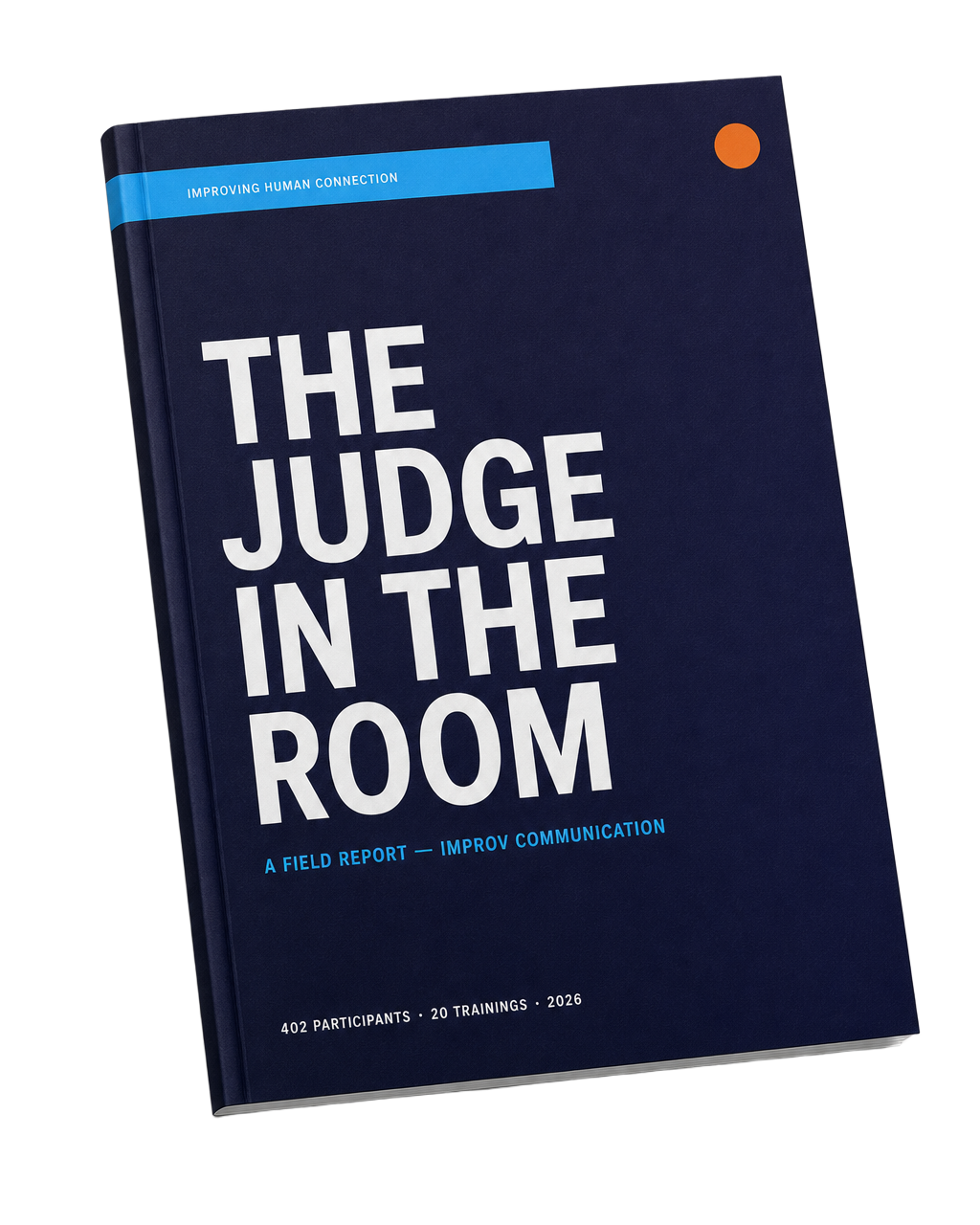
The Judge in the Room
What 402 people told us about psychological safety — and what you can do with it on a Monday morning. Five findings, seven practices, participants’ own words.