
Quick answer
Self-awareness is the ability to notice your own emotions, patterns and impact as they happen. It sits underneath every other part of emotional intelligence: you cannot manage a feeling you have not noticed, or read a room while blind to your own effect on it. It is the skill the other four capacities are built on, and it is learnable.
Key takeaways
- Self-awareness is knowing your emotions, values, patterns and impact on others as they happen. In Goleman's model it is the first of the five components of emotional intelligence, and the one the rest depend on.
- Tasha Eurich's research found that around 95% of people believe they are self-aware, while only 10 to 15% actually meet the criteria. Most of us have a wider blind spot than we think.
- There are two independent kinds: internal self-awareness (seeing yourself clearly) and external self-awareness (knowing how others experience you). Leaders need both, and the second is the harder half.
- Naming an emotion loosens its grip. UCLA research on affect labelling shows that putting a feeling into words lowers activity in the brain's threat-alarm, which buys a moment to choose your response.
- Self-awareness is a practised skill, not a fixed trait. Honest feedback, asking 'what' rather than 'why', and input from others build it faster than private reflection alone.
Most of us assume we know ourselves well. We can describe our strengths, name our values, and explain why we reacted the way we did in yesterday's meeting. The uncomfortable finding from the research is that this confidence is mostly misplaced. Self-awareness is rarer than it feels, and it is the quiet engine underneath everything else we call emotional intelligence.
What does self-awareness actually mean?
Self-awareness is the ability to see yourself clearly: your emotions as they rise, the patterns you repeat, the values that drive you, and the effect you have on the people around you. Daniel Goleman placed it first among the five components of emotional intelligence in his 1995 book, and he was deliberate about the order. Self-awareness comes first because the other four capacities have nowhere to stand without it.
Consider what the others ask of you. Self-regulation asks you to manage a feeling. Empathy asks you to read someone else's. Social skill asks you to steer a conversation. Each of these starts with noticing, and noticing yourself is where noticing begins. A leader who cannot feel their own irritation rising will let it leak into the room long before they choose to.
Why does self-awareness sit underneath the rest of emotional intelligence?
There is a simple test for how foundational a skill is: ask what falls apart without it. You cannot manage an emotion you have not registered. You cannot separate your own mood from your judgement of a colleague if you cannot see the mood at work. And you cannot understand how you land with your team while you are blind to your own tone, timing and habits.
This is why self-awareness earns its place at the base. It is the sense that makes the other four usable. When it grows, self-regulation and empathy grow with it, because the raw material they work on, an accurate read of what is actually happening inside you, becomes clearer.
Why do most of us overrate our own self-awareness?
One finding from the research should give every leader pause. Organisational psychologist Tasha Eurich and her team spent several years studying self-awareness across thousands of people. They found that around 95% of us believe we are self-aware, while only 10 to 15% actually meet the criteria. The gap between how well we think we know ourselves and how well we do is wide, and it tends to widen with seniority and experience, as fewer people feel able to tell us the truth.
The reasons are human. We run on autopilot for most of the day, acting from habit rather than observation. We are also gently biased towards the flattering version of ourselves, because it feels better to hold. None of this makes us dishonest. It makes us normal, and it means self-awareness is something to build on purpose rather than assume we already have.
What are the two kinds of self-awareness?
Eurich's research draws a distinction that matters a great deal at work. There are two types of self-awareness, and they are independent of each other.
Internal self-awareness is seeing yourself clearly from the inside: knowing your values, your triggers, your strengths and the things you find hard. External self-awareness is knowing how you come across to others: how your team actually experiences your feedback, your silences, your quick decisions.
Because the two are independent, you can be strong in one and weak in the other. A reflective leader with rich internal insight can still be surprised by how sharp they seem in a review. A warm, socially attuned leader can read every room and still struggle to name what they themselves value. The leaders people trust tend to work on both, and the second half, how you land, is the harder one, because you cannot see it without other people.
What happens in the brain when you name an emotion?
Self-awareness also works in the moment, and the neuroscience here is encouraging. Matthew Lieberman and colleagues at UCLA used brain imaging to study what they called affect labelling: the act of putting a feeling into words. When people named an emotion ("I am frustrated", "this is anxiety"), activity in the amygdala, the brain's threat-alarm, went down, and the more deliberate prefrontal regions became more active. Psychiatrist Dan Siegel later gave the effect a memorable handle: name it to tame it.
It is worth being honest about the size of this. Naming a feeling does not switch it off. The intensity drops; the feeling itself stays. What you gain is a small gap between the feeling and your reaction, a moment in which you can choose rather than simply respond. For a leader in a tense meeting, that gap is often the whole difference between a reply they respect and one they regret.
How do you actually become more self-aware?
Introspection alone is a weaker tool than it sounds. Eurich found that people who ask themselves "why", why do I feel this, why did I do that, often spiral into stories that feel true and are not. Asking "what" tends to work better: what am I feeling right now, what is this reminding me of, what do I want to do next. The shift from why to what keeps you close to observation rather than invention.
Beyond that, the reliable route runs through other people. External self-awareness only grows when you invite honest input and stay open when it arrives. A short, direct question to a trusted colleague, "what is one thing I do that gets in my own way?", will teach you more than an hour of private reflection. Regular pauses help too: a minute at the end of a meeting to notice how it went, a habit of naming the feeling before you send the tense email.
The catch is that reading about all this changes very little. Self-awareness is built by practising in situations that carry a little real pressure, with feedback close enough to the moment that you can feel the pattern rather than only hear about it. This is where experiential development does what a slide cannot. In our emotional intelligence trainings, much of the work is simply this: putting people in live situations, giving them immediate and kind feedback on the effect they are having, and letting them watch the distance between their intention and their impact close in real time. People leave knowing something about themselves they could not have read their way to.
If you want to build this in your own team, our emotional intelligence training is designed around exactly that kind of practice. And if you would rather start with the wider picture, our guide to what emotional intelligence is sets self-awareness in the context of the whole model, alongside Goleman's five components and the case for why emotional intelligence is a learnable skill.
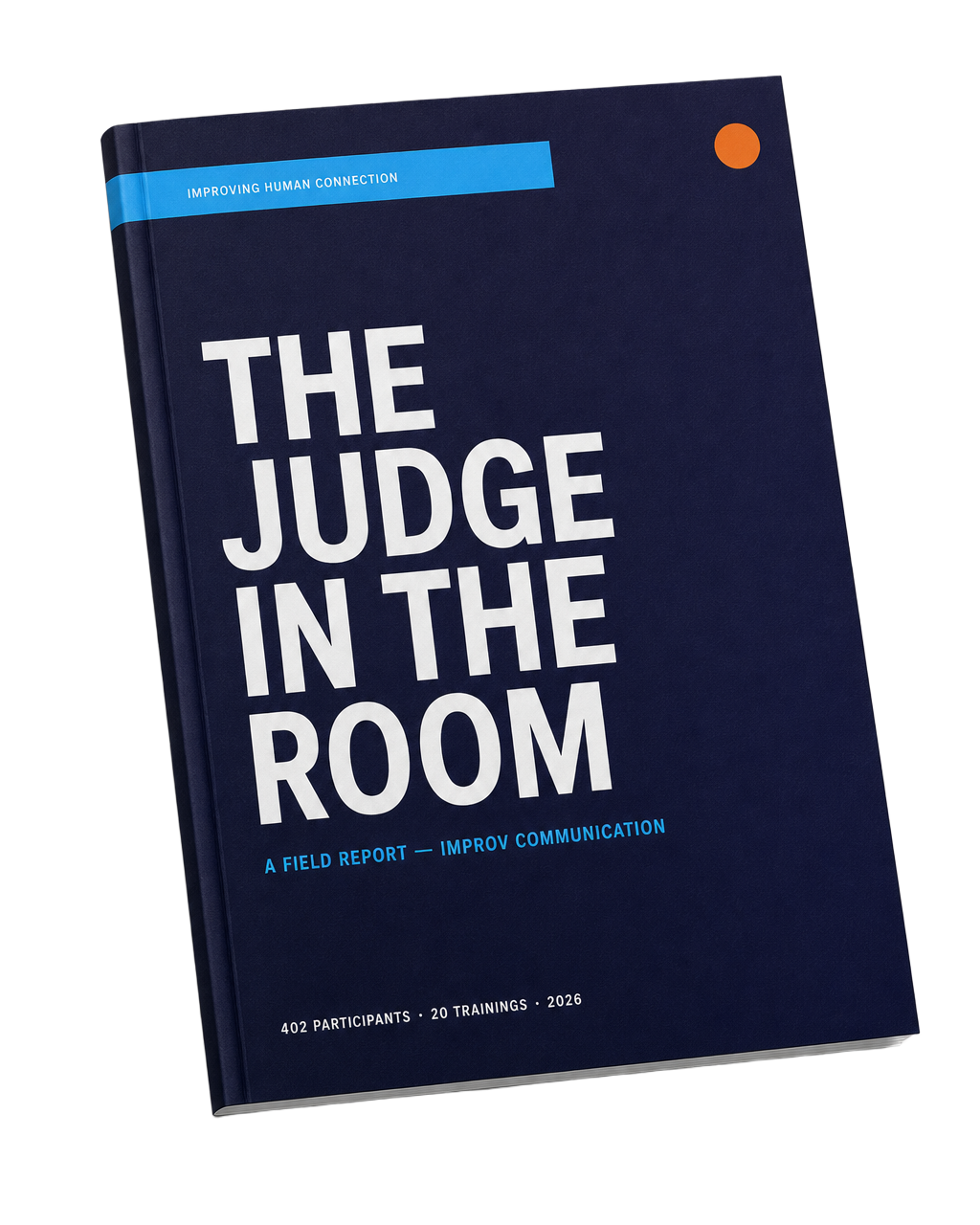
Free field report
The Judge in the Room
What 402 people told us about psychological safety — and what you can do with it on a Monday morning. Five findings, seven practices, participants’ own words.
Curious?
Is your team losing ideas to silence?
That's exactly what we help leaders see and shift. No pitch — just a proper conversation about your team.