
Quick answer
Applied improv turns a keynote, kick-off or company event into something people take part in rather than sit through. Short, well-designed exercises lift the energy in the room, get people connecting across teams, and help the day's message stay with them long after the event ends.
Key takeaways
- Most event content fades fast: without reinforcement people forget around half of new information within an hour and up to 90 percent within a month.
- Applied improv turns an event from something people watch into something they take part in — lifting energy, connecting people across teams, and helping the message stay.
- It involves no acting, no performing and no one put on the spot; everyone takes part at once in pairs and small groups, guided by facilitators.
- It flexes to the format — a keynote opener, a between-sessions energiser, a kick-off connector, or short bursts across a conference.
- Active, experiential sessions are backed by research showing people retain more from taking part than from listening.
Why do most events lose the room the moment it ends?
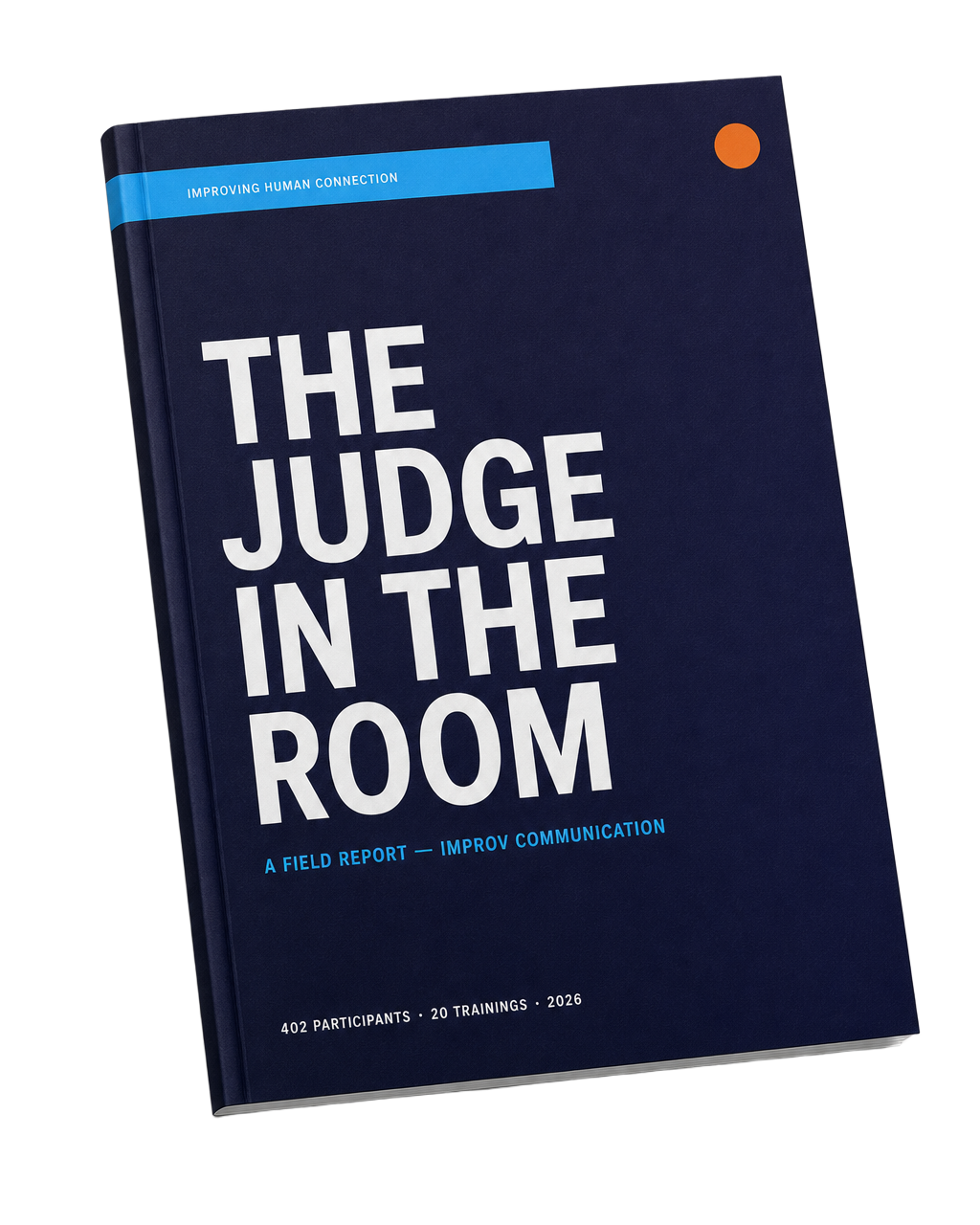
Free field report
The Judge in the Room — what 402 people told us about psychological safety.
Think about the last big kick-off or conference you attended. A strong speaker, good slides, a clear message. Then Monday arrives, the inbox fills up, and most of it is gone.
There is solid science behind that fade. Hermann Ebbinghaus mapped it more than a century ago: without any reinforcement, we forget roughly half of new information within an hour and about 70 percent within a day. A month later, as little as a tenth may remain. A room full of people listening quietly is, by design, one of the fastest ways to trigger that curve.
The message may have been right. The delivery may have been polished. The problem is that listening on its own asks very little of the people in the room, and the mind lets go of what it never had to use.
What does applied improv actually add to an event?
Applied improv is a leadership and team-development methodology built on the core skills of improvisation — listening closely, building on what others offer, thinking on your feet, and recovering quickly when something goes wrong. At an event, those skills become short, well-designed exercises that a whole room can do together.
Three things tend to happen.
The energy in the room lifts. People who arrived tired or distracted are suddenly talking, laughing and paying attention. That shift matters: a room that is awake takes far more from the rest of the day.
People connect across teams. Most events seat colleagues next to the people they already know. A well-run exercise gets near-strangers working together within minutes, which is often the quiet reason kick-offs exist in the first place.
And the message lands. When a session is designed around the theme of the day — collaboration, change, a new strategy — people spend a few minutes practising that idea with the colleagues beside them. That is what stays.
Where does it fit — a keynote, a kick-off, or an away day?
It flexes to the format.
As a keynote or opening, it wakes a room up and sets the tone, turning a passive audience into people who are ready to take part in whatever follows.
As an energiser between sessions, it clears the after-lunch fog and brings attention back before the next serious block of content.
At a kick-off or away day, it does the connecting work — getting a large, mixed group comfortable with each other early, so the conversations later in the day are more open and more honest.
And woven through a longer conference, short bursts keep energy and attention steady across a day that would otherwise sag.
The common thread is participation. Whatever the shape of the event, the room stops watching and starts doing.
Is this performance? Will people be put on the spot?
No. This is the question most people quietly worry about, so it is worth answering plainly.
Applied improv in an organisational setting involves no acting, no performing, and no one singled out in front of colleagues. There is no audience and no front of the room to be pushed towards. Everyone takes part at the same time, in pairs or small groups, working through experiential exercises designed to feel safe from the first minute.
Skilled facilitators run the room carefully. They read the group, pitch each exercise at the right level, and build things up gently, so that even the most reserved people find themselves joining in without quite noticing the moment they did. The aim is for people to feel at ease and included, never exposed. Much of that ease comes from the five guiding principles that shape how the room works — building on each other, and treating a stumble as part of the fun rather than a failure.
What makes an experiential session stick when a talk doesn't?
The difference is doing rather than watching, and the research on this is consistent.
A randomised trial with medical students found that people in interactive sessions scored meaningfully higher on later tests of learning than the same people in passive lectures — and, tellingly, the ones who had learned more often felt they had learned less. Active involvement works even when it does not feel like the more comfortable option. Broader reviews of active learning reach the same conclusion.
For an event, that has a practical meaning. A message delivered from a podium competes with the forgetting curve. A message people have just practised together has a far better chance of surviving the walk back to the car park.
Bringing it into your event
At IMPROV, this is much of what we are asked to do — open a conference, lift a kick-off, or give an away day a moment people still talk about weeks later. The exercises are chosen around your theme and your people, run by facilitators who have done it many times, and designed so a room of any size can take part together.
If you have an event coming up and you want it remembered for more than the catering, our improv trainings and event sessions are built for exactly that. The simplest next step is a short conversation about what your day needs.
Free field report
The Judge in the Room
What 402 people told us about psychological safety — and what you can do with it on a Monday morning. Five findings, seven practices, participants’ own words.
Curious?
Is your team losing ideas to silence?
That's exactly what we help leaders see and shift. No pitch — just a proper conversation about your team.