Quick answer
An applied improv session is a hands-on training where a team practises real communication skills through short, structured exercises — active listening, building on each other's ideas, thinking on your feet, and recovering from mistakes. There is no performance and no audience. People work in pairs and small groups, and each exercise is debriefed to connect it back to daily work.
Key takeaways
- An applied improv session is experiential — people learn by doing short exercises, rather than by listening to a talk.
- It is not acting or performance: there is no audience, and no prior experience is needed to take part.
- Exercises fall into a few families — warm-ups, listening and building ("Yes, and"), thinking on your feet, safe failure, and making each other look good.
- Each exercise is followed by a debrief that connects the skill back to real situations at work.
- The value comes from practising the behaviours a team relies on, at low stakes, before they matter under pressure.
Walk into an applied improv session and the first thing you notice is that everyone is standing up. There are no slides waiting on a screen, and no one is about to be put on the spot in front of the group. A facilitator gives the room a short, clear exercise, people try it in pairs, and then the group talks about what happened. That rhythm — try something, notice what it did, connect it to work — repeats for the length of the session.
The exercises look playful, and the skills underneath them are serious: listening properly, building on what a colleague just said, staying steady when you do not know what comes next, and carrying on after a mistake. These are the behaviours teams rely on every day and rarely get the chance to rehearse.
Is an applied improv session acting or performance?
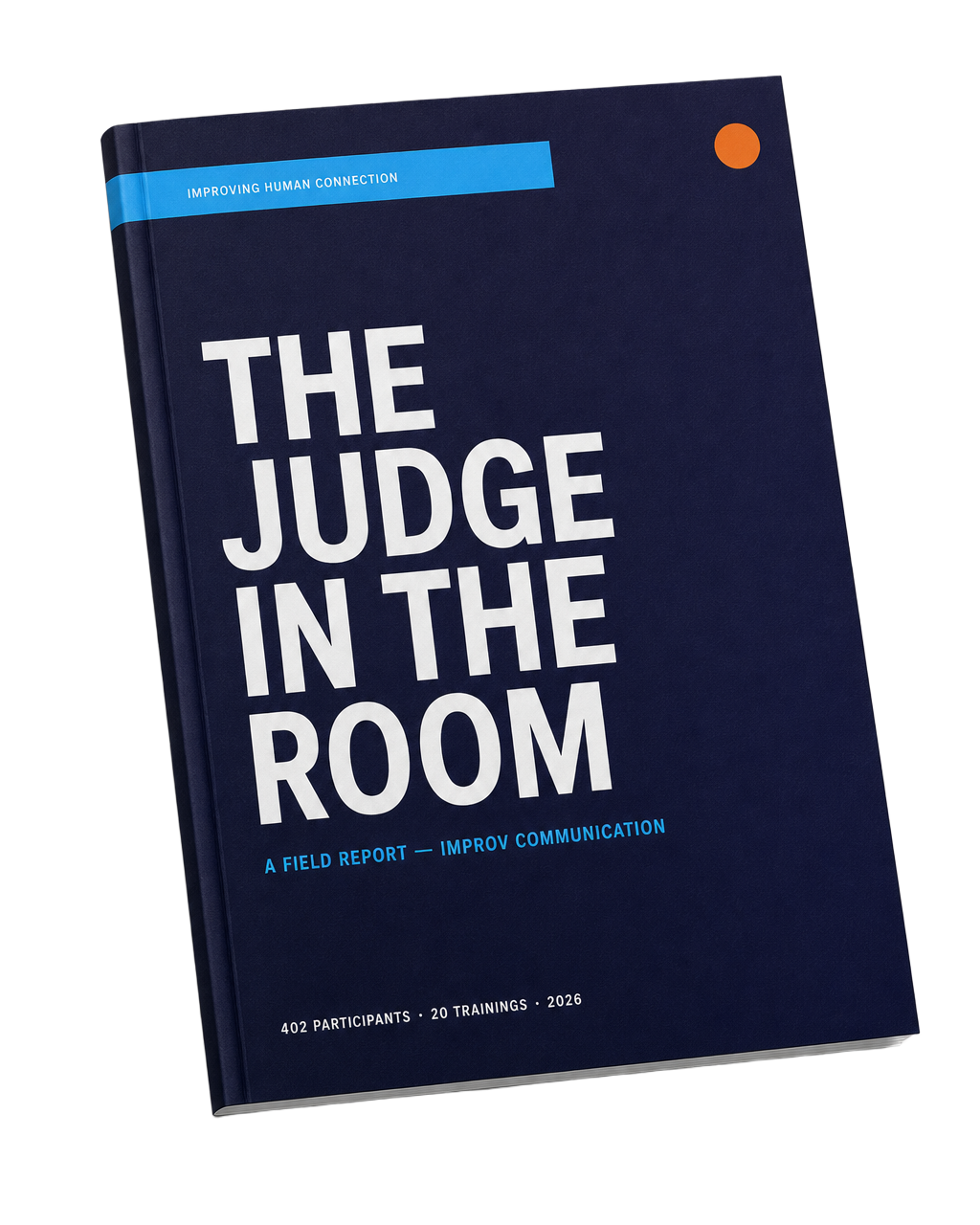
Free field report
The Judge in the Room — what 402 people told us about psychological safety.
No. This is the question people ask most often, and the honest answer settles most of the nerves. There is no audience, no script to memorise, and no moment where one person performs while the rest watch and judge. Everyone takes part at the same time, usually in pairs or small groups, so no one is left exposed.
Applied Improv in an organisational setting uses the core skills of improvisation — active listening, building on others, adapting in the moment, recovering from mistakes — as a way to develop leaders and teams. The exercises are simply the method for practising those skills together. Being funny or quick-witted has nothing to do with it.
What does a session actually feel like?
Most sessions open gently. The early exercises are light and low-stakes, designed to get people out of their heads and paying attention to each other. As the room warms up, the facilitator raises the challenge a little at a time, so the group is always working slightly outside its comfort zone and never thrown in too deep.
People move, talk, laugh and occasionally get things wrong in front of each other, and find that nothing bad happens when they do. That felt experience of safe, low-cost failure is a large part of why the method works. After each exercise the facilitator draws the group into a short debrief: what did you notice, where does this show up in your work, what would you do differently on Monday.
What types of exercises are used, and what does each build?
Every facilitator has their own repertoire, and the exercises tend to fall into a handful of families, each one training a specific capability.
Warm-ups reset attention. They ask people to drop whatever they walked in carrying and tune into the room and each other. What they build is presence — the plain skill of being here, now, with the person in front of you.
Listening-and-building exercises, the "Yes, and" family, sit at the heart of the method. One person offers something, the next accepts it and adds to it. What they build is active listening and the habit of building on a colleague's idea, rather than waiting for a turn to replace it with your own.
Thinking-on-your-feet exercises remove certainty on purpose. People respond to something they could not have prepared for. What they build is adaptability and composure under mild pressure — the calm that lets a leader stay useful when a plan falls apart.
Safe-failure exercises make mistakes cheap, and even something to celebrate. What they build is the confidence to try, to be wrong out loud, and to recover quickly rather than freeze.
Make-each-other-look-good exercises shift the goal from personal performance to shared success. What they build is the generosity that turns a group of capable individuals into a genuine team.
Read across those five families and you have IMPROV's five guiding principles in practice: treat others with a "Yes, and" mentality, hold back judgement of yourself and of others, drop the fear of failure, and make everyone else look good.
Why do these exercises change behaviour when a talk does not?
Most people already know they should listen more and interrupt less. Knowing it changes very little on a busy Tuesday. Behaviour is a skill, and skills are built by doing the thing, getting honest feedback, and doing it again.
An applied improv session is a rehearsal space for the behaviours a team needs, run at low stakes before those behaviours matter under real pressure. Practising active listening in an exercise, feeling the difference it makes, and then naming that in the debrief lands far more firmly than being told that listening is important. This is the same reason experiential training tends to stick when classroom sessions fade within a month.
Do you need any improv experience to take part?
None at all. Sessions are designed for people who have never done anything like it, and the exercises are built so that everyone can succeed from the first minute. Senior leaders take part on the same footing as everyone else, which is often where the value shows up, as hierarchy quietly softens when a whole team is learning together.
What does a facilitator do during a session?
A great deal of the quiet work sits with the facilitator. They choose the exercises to match the group and the goal, keep the room feeling safe, calibrate the challenge so it stretches without overwhelming, and lead the debriefs that connect each exercise back to the team's actual work. The exercises themselves are simple; the skill lies in the sequencing and the sense-making around them.
How long is a session, and can it fit a real agenda?
Applied improv is flexible in format. It works as a 90-minute energiser inside a larger event, as a half-day or full-day team session, and as a recurring thread across a longer leadership programme. A short session can lift energy and reset how a team is talking to each other; a longer one has room to go deeper into a specific challenge, whether that is communication, collaboration under pressure, or building psychological safety. The exercises stay the same in spirit, and how far each one is taken depends on the time and the goal.
Bringing it back to your team
What people carry out of the room is the felt memory of behaving differently — of really listening, of building on a half-formed idea, of recovering from a fumble without shame. That is why, at IMPROV, we treat a session as practice for the everyday moments where communication and trust are made or lost, and why every exercise is chosen to build a specific skill your team can use the next morning.
If you are curious what this could look like for your people, our Applied Improv Training is built around exactly these kinds of exercises, and you are warmly welcome to explore it or start a conversation with us.
Free field report
The Judge in the Room
What 402 people told us about psychological safety — and what you can do with it on a Monday morning. Five findings, seven practices, participants’ own words.
Curious?
Is your team losing ideas to silence?
That's exactly what we help leaders see and shift. No pitch — just a proper conversation about your team.