
Quick answer
Yes — when it is designed well. The evidence on training transfer and on experiential learning is consistent: information alone rarely changes behaviour, while practised, multi-method learning that is reinforced afterwards does. Applied improv works by rehearsing real behaviours — listening, adapting, recovering — so people can use them under pressure, not only describe them.
Key takeaways
- Most training fades because knowing something and doing it under pressure are two different skills — what Pfeffer and Sutton called the knowing-doing gap.
- Research on training transfer shows that motivation, practice, reinforcement and follow-up are what turn learning into changed behaviour.
- Hodzic and colleagues' 2018 meta-analysis of emotional-intelligence training found a moderate improvement that held at follow-up — strongest for active, experiential methods.
- Applied improv works because it is practised, not explained: people rehearse listening, adapting and recovering in real time.
- Impact is measurable — through behaviour change and what participants report and recommend, not satisfaction scores alone.
Why are people right to be sceptical about training?
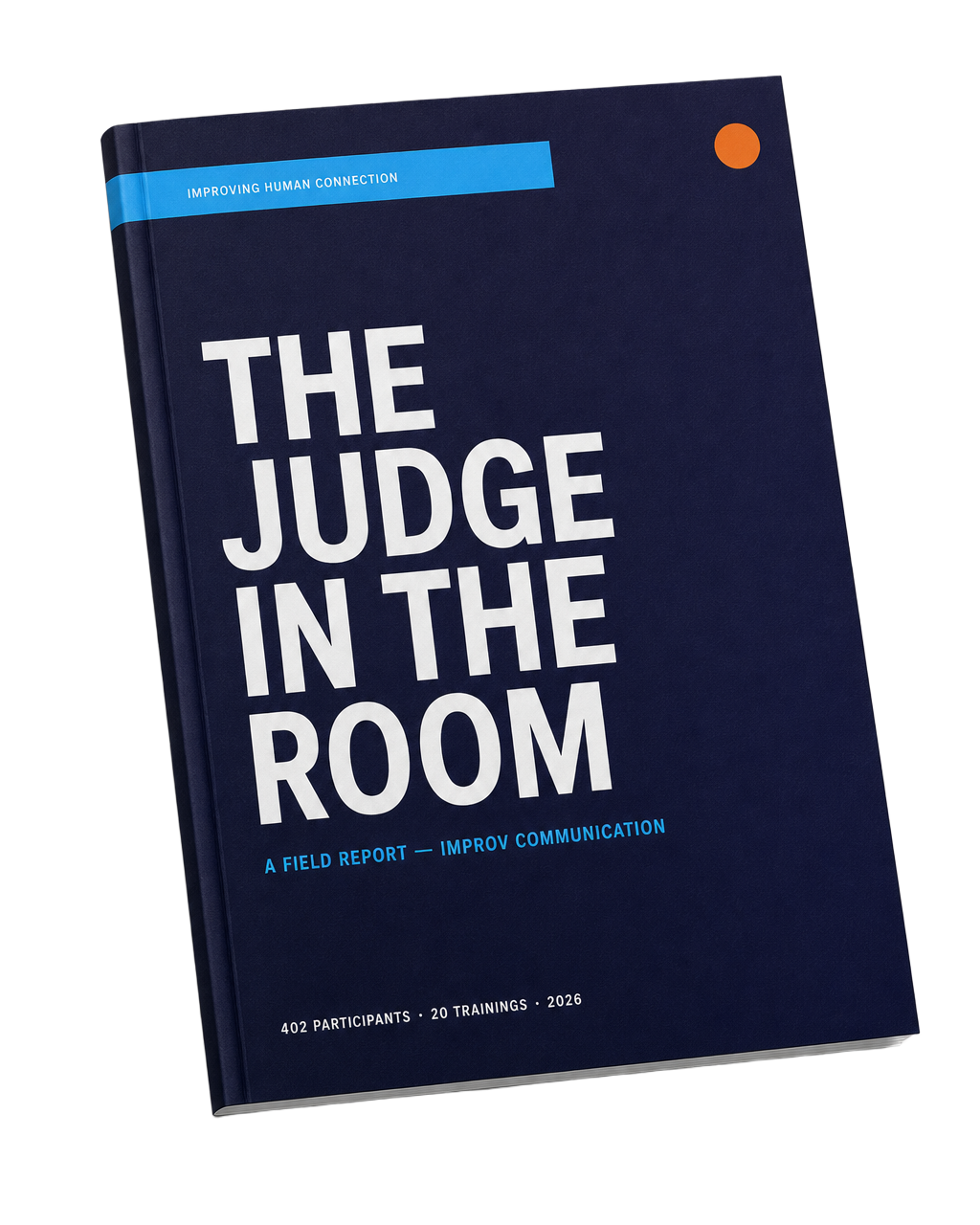
Free field report
The Judge in the Room — what 402 people told us about psychological safety.
Because most of it does not change much. Plenty of leaders have sat through an engaging day that felt valuable in the moment and left no trace a month later. Jeffrey Pfeffer and Robert Sutton named this the knowing-doing gap: the distance between what an organisation knows it should do and what it actually does. Knowing about active listening and doing it in a tense conversation are two different skills. One lives in your notes. The other has to be available to you when your heart rate is up and someone disagrees with you in front of the team.
So the real question is not whether a training day is enjoyable. It is whether anything is different on the Monday afterwards. That is the bar the evidence cares about too.
What does the research on training transfer say?
"Transfer of training" is the field that studies exactly this — how much of what people learn in a programme shows up later in how they work. The consistent finding is that transfer is not automatic. A well-run day, on its own, tends to fade. What protects it is a small set of conditions: learners who are motivated and can see the relevance, practice rather than passive listening, and reinforcement and follow-up after the event.
Follow-up matters more than most buyers expect. Studies show that people who take part in follow-up contact with facilitators and peers after a programme are far more likely to keep using what they learned, and that feedback from a skilled observer on the job strengthens it further. The day is the start of the change, and the weeks around it decide whether it holds.
This is why a one-off, talk-only session rarely earns its cost. The design has to carry the learning into real work.
Is there evidence that experiential learning works specifically?
Yes, and it is more than anecdote. In 2018, Sabina Hodzic and colleagues published a meta-analysis in Emotion Review pulling together 24 studies on emotional-intelligence training. They found a moderate, statistically significant improvement from before to after — and, importantly, the effect held at follow-up rather than evaporating. The gains were strongest for programmes built on ability models and on active, practised methods.
That last point is the one that matters here. The interventions that produced the gains were experiential — people practising the skill, getting feedback, and trying again, rather than sitting through lectures about emotion. Applied improv sits squarely in that category. It is a method built on doing.
What does changing behaviour actually require?
Pfeffer and Sutton put it plainly: learning is best done by trying many things, seeing what works, reflecting, and trying again. Behaviour is a performance skill. You build it the way you build any performance skill — through repetition under conditions close enough to the real thing that the new behaviour is available when it counts.
Applied improv is a low-stakes place to get those repetitions. People practise listening properly, building on a colleague's idea instead of waiting to talk, staying composed when a situation shifts, and recovering quickly when something goes wrong. Each of these is a leadership behaviour. Rehearsing them in the room, with mild pressure and quick feedback, is what makes them usable later in a meeting that actually matters.
The design around the practice is what makes it hold: clear relevance before the day, real rehearsal during it, and reinforcement afterwards so the new habit survives contact with a busy week.
What do teams report after applied improv training?
This is where the evidence gets specific to a provider, and it is fair to ask for it. At IMPROV we measure every programme — what shifted in behaviour, what participants intend to do differently, and whether they would recommend the experience to a colleague. We treat those numbers as the real test of the work, and we share them openly in our case studies.
The pattern we see repeatedly is the one the research predicts. People leave able to do things they could previously only describe — speak up sooner, listen without rushing to judge, hold a difficult moment without tensing up. The teams that pair the day with follow-up see the largest and most lasting change, which is why our programmes are built in phases rather than as a single event.
What the evidence adds up to
Does applied improv training work? When it is designed as experiential practice with reinforcement around it, the evidence on both training transfer and experiential learning says yes. When it is a one-off talk, no method saves it. The difference comes down to one thing: whether people leave having practised the behaviour or merely heard about it.
That is the reason our work is felt in the room rather than delivered from a slide. If you want to see how we measure the change — and whether it would hold for your team — explore our Applied Improv Training, or read how it builds the human side of leadership in applied improv for leadership development.
Free field report
The Judge in the Room
What 402 people told us about psychological safety — and what you can do with it on a Monday morning. Five findings, seven practices, participants’ own words.
Curious?
Is your team losing ideas to silence?
That's exactly what we help leaders see and shift. No pitch — just a proper conversation about your team.