
Quick answer
Emotional intelligence is measured with validated assessments of two kinds: ability tests such as the MSCEIT, which score how well you solve emotional problems, and self-report questionnaires such as the EQ-i 2.0, which capture how you see yourself. Each has known limits, so the strongest picture combines a score with observed behaviour over time.
Key takeaways
- EQ assessments fall into two families: ability tests, which score your answers against a standard, and self-report questionnaires, which capture your view of yourself.
- The MSCEIT is the best-known ability measure — 141 items and eight tasks built on the four-branch model of perceiving, using, understanding and managing emotion.
- The EQ-i 2.0 is the most widely used self-report tool in organisations, measuring fifteen competencies across five composites, with subscale reliabilities of roughly 0.77 to 0.91.
- The TEIQue takes a third position, treating emotional intelligence as a personality trait rather than a cognitive ability.
- Every tool has known limits: consensus scoring may reward conformity, and self-report measures the very self-perception that low EQ tends to distort.
- Read a score as a hypothesis to explore, never as a verdict on character or as a hiring filter.
- Hodzic et al. (2018) found EI training produces a moderate improvement that holds at follow-up, with ability-based models performing strongest.
Emotional intelligence gets talked about as though it were a mood or a personality quirk, and it was defined from the start as something more precise: a set of abilities for processing emotional information. Peter Salovey and John Mayer set out that definition in 1990, and an ability that can be defined can, in principle, be assessed. Three decades of psychometric work have gone into doing exactly that.
The tools that came out of that work fall into distinct families, and the family matters more than the brand name. Knowing which kind of instrument you are holding tells you what its score can carry.
What is the difference between ability tests and self-report questionnaires?
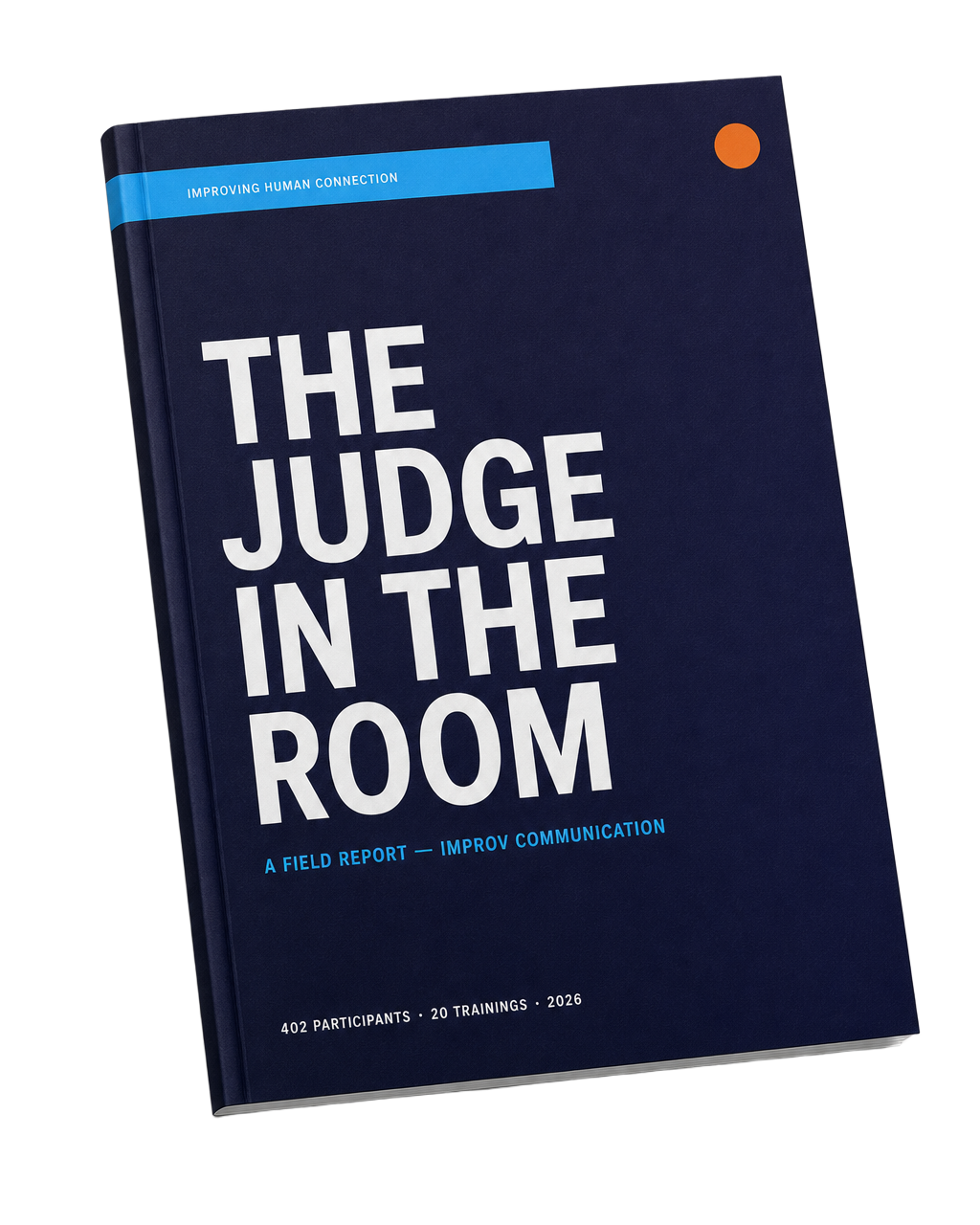
Free field report
The Judge in the Room — what 402 people told us about psychological safety.
An ability test asks you to solve emotional problems and scores your answers against a standard. You look at a face and identify the emotion. You read a situation and choose the response most likely to help. There are better and worse answers, and your score reflects how close you land.
A self-report questionnaire asks you to rate yourself. You read statements about how you handle frustration or read a room, and you say how well each one describes you. The score reflects your view of your own emotional functioning.
The distinction matters because the two families answer different questions. An ability test estimates what you can do. A self-report estimates how you see yourself doing it. Those two things drift apart in ways that are well documented in the research, which is why a serious assessment process often uses both.
What is the MSCEIT and what does it measure?
The Mayer–Salovey–Caruso Emotional Intelligence Test is the best-known ability-based measure. Developed by John Mayer, Peter Salovey and David Caruso, it is a 141-item performance assessment built directly on their four-branch model of emotional intelligence: perceiving emotion, using emotion to help thinking, understanding emotion, and managing emotion. Eight tasks in total, two for each branch.
It reports an overall score, four branch scores, and two area scores — experiential EI (perceiving and using emotion, the fast in-the-moment processing) and strategic EI (understanding and managing emotion, the slower deliberate work).
The design goal was to get away from self-perception. Ask people to rate their own empathy and you collect their self-image along with everything else. Ask them to solve an emotional problem and you get closer to a capability.
What is the EQ-i 2.0?
The Emotional Quotient Inventory 2.0, published by Multi-Health Systems in 2011, is the most widely used self-report tool in organisational settings. It descends from the model Reuven Bar-On developed through his dissertation work and clinical practice, and takes around twenty minutes to complete.
It measures fifteen competencies grouped into five composites: Self-Perception, Self-Expression, Interpersonal, Decision Making and Stress Management. It produces a total EI score, the five composite scores and a well-being indicator. Subscale reliabilities run from roughly 0.77 to 0.91, which is respectable for an instrument of this kind.
Its popularity in leadership development comes down to what it gives you afterwards. The report is readable, the fifteen competencies map onto things a leader can actually work on, and it pairs with a 360 version that adds how colleagues see you. Putting your self-rating next to other people's ratings is often where the useful conversation starts.
What about trait measures like the TEIQue?
The Trait Emotional Intelligence Questionnaire, developed by K. V. Petrides at the London Psychometric Laboratory, takes a third position: it treats emotional intelligence as a personality trait rather than a cognitive ability. Released in 2001, it comes in a 153-item full form measuring fifteen facets across four dimensions — Emotionality, Self-control, Sociability and Well-being — and a 30-item short form.
Trait EI predicts well-being and mental health, and it correlates negatively with stress, anxiety and depression. Whether it measures the same underlying construct as the MSCEIT remains a live argument in the field. Treat it as measuring something adjacent and worth knowing.
How accurate are EQ tests?
The limits here deserve as much attention as the capabilities.
The MSCEIT has taken real criticism. Its scoring rests on consensus — an answer counts as correct when enough people, or enough experts, agree that it is. Critics point out that this may reward conformity as much as competence. Reviewers have also flagged low discriminant validity, questionable incremental validity, mixed support for the four-factor structure said to underlie it, and items that are too easy to separate people at the higher end. Its correlations with real-world outcomes are modest.
Self-report tools carry a different problem. They measure self-perception, and self-perception is precisely what low emotional intelligence tends to distort. Someone with poor self-awareness will rate their own self-awareness. Social desirability pushes scores up. The person who most needs the feedback is the person least equipped to give it about themselves.
The tools remain useful, with known error bars. A validated EQ assessment gives you a structured, defensible starting point — better than an impression formed over coffee, and weaker than a year of watching someone work.
What does an EQ score actually tell you?
A score is a snapshot of a profile. The shape it shows carries more than the number on top.
The total score is the least interesting part. The pattern underneath is where the value sits: high empathy with low stress management is a different person to develop than the reverse, even where the totals match. The gap between an ability score and a self-report score on the same person tells you something as well — someone who tests well and rates themselves poorly has a confidence issue, and the opposite pattern points to a blind spot.
Read as a hypothesis, a score does good work. Read as a verdict on someone's character, it does harm. And an EQ score should not be used as a hiring filter — the validity evidence does not support that weight, and several publishers say as much themselves.
How should you use measurement in a development programme?
Measure before, measure after, and be clear about what you expect to move.
Emotional intelligence responds to development. Hodzic and colleagues' 2018 meta-analysis in Emotion Review pooled 24 studies of emotional intelligence training among healthy adults and found a moderate improvement from before to after, holding steady at follow-up. Programmes built on ability models produced stronger effects than those built on mixed models.
A workable approach:
- Baseline before you start, so improvement has something to be measured against.
- Use the profile to shape the work, rather than to rank the participants.
- Re-measure some months later, instead of on the day the training ends — a score taken that afternoon is measuring enthusiasm.
- Watch behaviour alongside the instrument. Are people naming what they feel? Do they recover faster after a difficult conversation? Does the quiet person speak up now? Colleagues notice this long before any questionnaire does.
That last point is where measurement earns its keep. The instrument gives you the language and the baseline. The behaviour in the room tells you whether anything changed.
Where measurement meets practice
A score describes a capability, and capability grows through use.
This is the part we care about at IMPROV. An assessment can tell a leader their stress management sits low, and reading that sentence has never yet steadied anyone in a difficult meeting. The skill develops in the repetition — reading a room, handling a moment that goes sideways, recovering, going again — with a facilitator to name what happened as it happens. Our trainings are built for those reps, and we work with clients who measure before and after so the change has evidence behind it.
If you are considering an emotional intelligence programme and want measurement built into it properly, have a look at our Emotional Intelligence Training or get in touch for an exploration call.
Free field report
The Judge in the Room
What 402 people told us about psychological safety — and what you can do with it on a Monday morning. Five findings, seven practices, participants’ own words.
Curious?
Is your team losing ideas to silence?
That's exactly what we help leaders see and shift. No pitch — just a proper conversation about your team.