
Quick answer
Applied Improv builds the conditions innovation depends on. It trains people to defer judgement, build on half-formed ideas, and stay comfortable with uncertainty. Research shows even twenty minutes of improvisation raises divergent thinking. By practising these habits together, teams generate more ideas and make it safe to voice the unfinished ones.
Key takeaways
- Innovation stalls when ideas are judged the moment they appear; the core rule of idea generation is to separate creating from evaluating.
- Applied Improv trains three innovation behaviours: deferring judgement, building on others' ideas, and staying comfortable with uncertainty.
- Research by Lewis and Lovatt (2013) found that twenty minutes of improvisation significantly raised divergent thinking — fluency, flexibility and originality.
- "Yes, and" replaces the reflex that cancels ideas, so more of them survive and get built into something stronger.
- Psychological safety sits underneath it all: people only offer unproven ideas when speaking up feels safe.
Innovation rarely fails for lack of clever people. It fails earlier, in the small moments where an idea forms and then dies quietly because someone decides it is not worth saying. Most teams are full of these unspoken half-ideas. The work of building a more creative team is largely the work of getting those ideas into the room.
Applied Improv addresses this directly. As a leadership and organisational-development methodology, it trains the behaviours that idea generation depends on — deferring judgement, building on what a colleague offers, and staying steady when the path ahead is unclear. These are practised habits, and a team can get measurably better at them.
Why does innovation stall in most teams?
Free field report
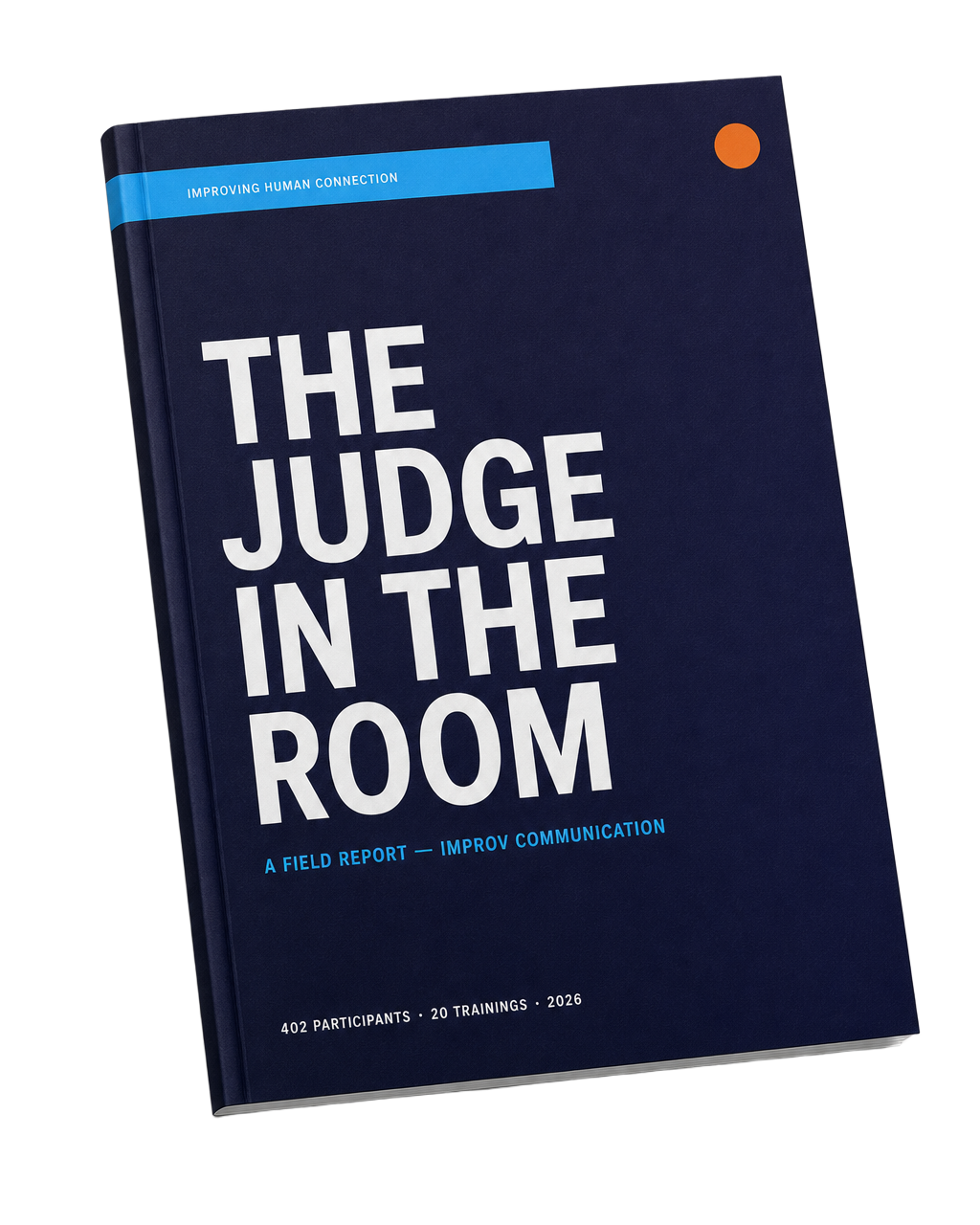
The Judge in the Room — what 402 people told us about psychological safety.
The usual account blames a shortage of creative talent. The more accurate account is that good ideas are killed early by evaluation. People think of a possibility and, almost in the same breath, find the flaw in it. The idea never reaches the table.
Research on divergent thinking has understood this for decades. The core rule of idea generation is to separate creating from judging: generate first, evaluate later. When the two happen at once, quantity collapses, and with fewer ideas comes a smaller chance of a strong one. Alex Osborn, who developed brainstorming, and later researchers at the Creative Education Foundation named deferring judgement as the first principle of the process.
The difficulty is that most workplaces reward the opposite. Meetings move quickly to critique, seniority shapes whose ideas get air, and the person with the unfinished thought reads the room and stays quiet. The mechanics of innovation are well known; the behaviours that carry them out are the part that needs practice.
What does applied improv train for innovation?
Applied Improv gives a team a low-stakes place to practise the exact behaviours creativity asks for. Three matter most.
The first is deferring judgement. In an improvisation exercise there is no time to pre-vet a contribution, so people learn to offer the half-formed thought and trust the group to develop it. That habit carries back into a planning session, where the instinct to critique softens and more ideas survive their first few seconds.
The second is building on others. The principle at the heart of improvisation — "Yes, and" — asks you to accept a colleague's offer and add to it rather than replace it with your own. Innovation is rarely one person's finished idea; it is a rough idea that three other people improve. Teams that practise building on each other produce combinations no single person would have reached alone.
The third is comfort with uncertainty. Creative work means acting before you know the answer. Improvisation is practice at exactly that — moving forward with incomplete information and staying composed while the shape of the thing emerges. That tolerance for not-yet-knowing is what keeps a team exploring instead of retreating to the safe, familiar option.
What does the research say about improv and creativity?
The link is measurable. In a 2013 study published in Thinking Skills and Creativity, Carine Lewis and Peter Lovatt found that twenty minutes of improvisation significantly raised participants' divergent thinking — measured by the Alternative Uses Test, where people generate as many uses as they can for an everyday object. Scores for fluency, flexibility and originality all rose after improvising, and did not rise in a matched control group.
Later work points the same way. A 2020 study by Peter Felsman and colleagues found that a short improv experience promoted divergent thinking and tolerance of uncertainty, alongside improvements in well-being. The pattern across studies is consistent: practising improvisation, even briefly, moves people towards the kind of thinking innovation relies on.
This is what makes the method more than a pleasant away-day. The behaviours it rehearses are the same behaviours the creativity research has spent decades pointing to.
How does "Yes, and" change how a team generates ideas?
"Yes, and" is a small phrase with an outsized effect. "Yes" means you accept what your colleague has offered as something real to work with. "And" means you add to it. Together they replace the reflex that quietly ends most ideas — the "yes, but" that accepts a thought and cancels it in the same breath.
In practice this changes the texture of a meeting. An idea arrives half-formed and, instead of being tested against every objection, it gets a second contribution, then a third. By the fourth build it is a different and stronger idea than the one that started. People also speak up more readily once they trust their contribution will be developed rather than dismissed, so the raw material of innovation — the number of ideas offered — grows.
Why does psychological safety sit underneath all of this?
None of these behaviours survive in a team where speaking up feels risky. Amy Edmondson's research at Harvard has shown that psychological safety — the shared belief that you can take an interpersonal risk without being punished or humiliated — is what lets people voice the tentative, unproven idea in the first place. Without it, deferring judgement and building on others stay fine in theory and absent in practice.
This is why creativity and safety are so closely tied. A team that has practised failing well together, and recovering quickly, treats a weak idea as a step towards a better one rather than a mark against the person who offered it. The safety makes the ideas possible; the ideas are where innovation starts.
The IMPROV view
Innovation is a set of behaviours before it is an outcome, and behaviours are built by practising them together. This is why our Innovation Training puts teams into the practice itself — deferring judgement, building on each other, and staying comfortable in the unknown — so the habits are felt in the room and carried into the next real conversation. A team leaves having produced ideas together, and knowing how they did it.
If you want your team to generate more and braver ideas, our Innovation Training is built around exactly these behaviours. It is the most direct way we know to make a team more creative together.
Free field report
The Judge in the Room
What 402 people told us about psychological safety — and what you can do with it on a Monday morning. Five findings, seven practices, participants’ own words.
Curious?
Is your team losing ideas to silence?
That's exactly what we help leaders see and shift. No pitch — just a proper conversation about your team.