
Quick answer
Applied Improv improves communication by turning it into something you practise. Through hands-on exercises it builds active listening, building on others' ideas, clarity under pressure and the confidence to recover from a fumble. Because these skills are rehearsed in real time, they hold up in real meetings, not just in the room.
Key takeaways
- Communication is a behaviour built through practice, feedback and repetition, which is why information alone rarely changes how people talk.
- Applied improv builds five everyday communication skills: active listening, building on others, clarity under pressure, reading the room and recovering well.
- The "Yes, and" habit gives an idea room to grow before it is judged, which changes how conversations move through a team.
- Rehearsing communication in real time is what lets it hold up under the pressure of an actual meeting.
- Applied improv is a leadership and team-development method, with no performing and no acting required.
We have all sat through communication training. A model on a slide, an acronym to memorise, a quick role-play before lunch. A month later the model has faded and the meetings sound the way they always did. This is one of the most consistent findings in learning science: knowing what good communication looks like and doing it under pressure are two separate capabilities. Communication is a behaviour, and behaviours are built through repetition, feedback and practice in realistic situations — the conditions a slide deck cannot create.
Applied improv closes that gap by making communication something people practise in real time, together, with immediate feedback from the person in front of them.
Why does communication training so often fail to change how people talk?
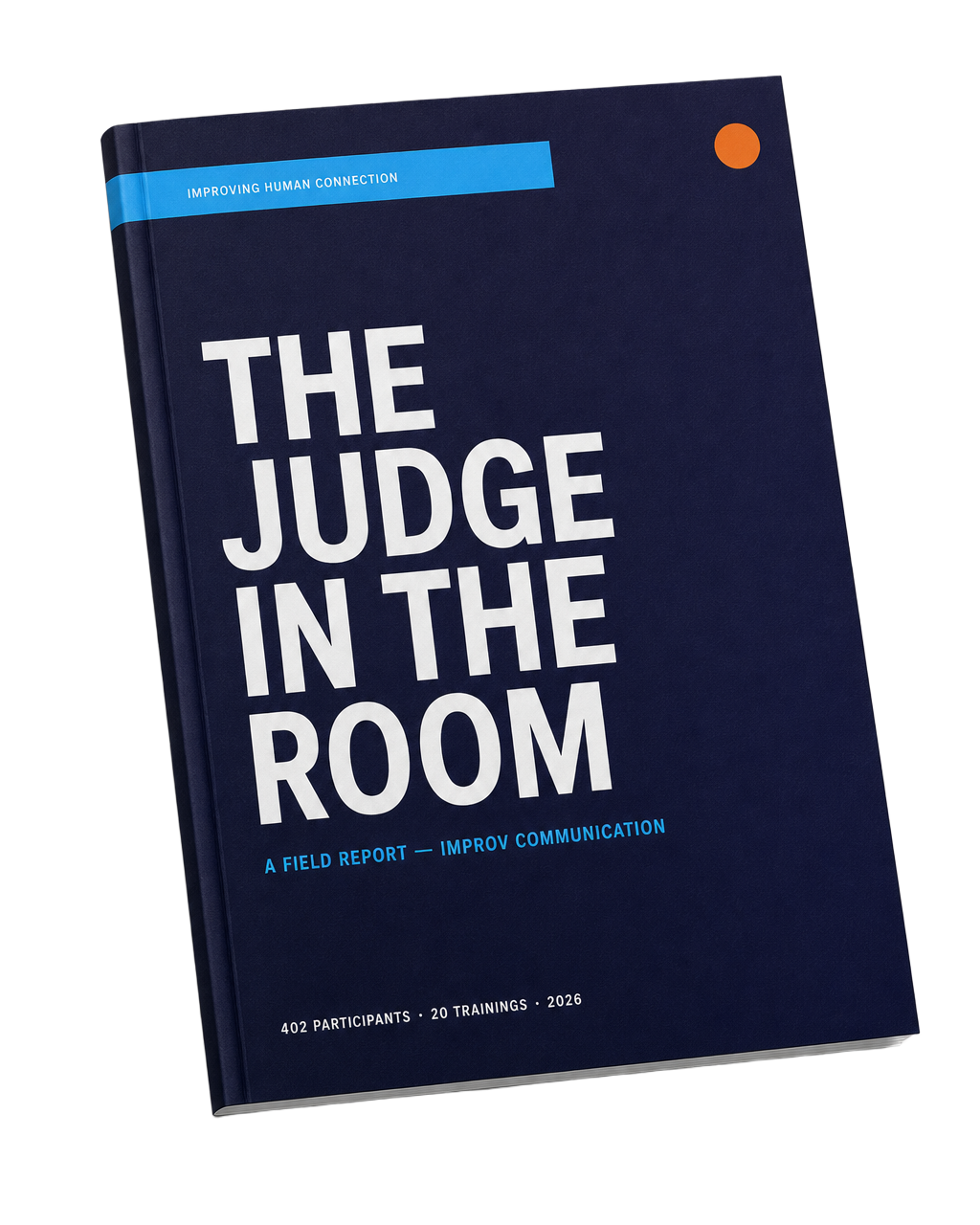
Free field report
The Judge in the Room — what 402 people told us about psychological safety.
The research on training transfer is clear and a little uncomfortable. Most communication courses lift awareness for a while and leave day-to-day behaviour untouched. People can describe active listening perfectly and still interrupt the next colleague who pauses for breath. The skill was understood, and never rehearsed enough to become automatic.
What actually shifts behaviour is repeated practice in situations close to the real thing, with feedback in the moment and reinforcement afterwards. Communication habits form the same way any other habit does: through many small repetitions rather than one big explanation. That is the design principle underneath applied improv, and it is why the learning holds up once people are back at their desks.
What communication skills does applied improv build?
Applied improv works on the moment-to-moment skills that decide whether a conversation lands.
Active listening. Hearing what a colleague actually said, rather than half-listening while loading your own reply. The exercises make it impossible to move an interaction forward until you have taken in the other person's offer, so listening becomes a reflex instead of a good intention.
Building on others. Adding to an idea before you pick it apart, so a half-formed thought has room to grow. This is the "Yes, and" habit, and it quietly changes how ideas travel through a team.
Clarity under pressure. Saying something useful when you have had no time to prepare. Most real communication happens without a script, and applied improv trains people to stay clear and grounded when the conversation keeps moving.
Reading the room. Noticing tone, pace and what is going unsaid, then adjusting how you respond. Attunement is a learnable skill, and practising it live sharpens it fast.
Recovering well. Carrying on with grace after a fumble or a misread, so one awkward moment does not sink the whole exchange. Leaders who recover well give everyone around them permission to take a communication risk.
How does "Yes, and" change a conversation?
"Yes, and" is the first of IMPROV's five guiding principles, and it is the one people feel most quickly. The idea is simple: accept what your colleague has offered, then add to it. In practice it interrupts the reflex most teams have of meeting a new idea with the reasons it will not work.
When a team builds on each other's contributions before evaluating them, more ideas reach the point where they can be judged on merit. Quieter voices contribute, because they can see their thought will be received rather than shot down. The tone of the whole conversation softens, and the thinking gets better. Building on an idea is different from agreeing with it. The point is to give a thought enough oxygen to become useful before anyone decides whether it holds up. Our post on Yes, and goes deeper into how this one habit reshapes team communication.
Is applied improv the same as acting or public speaking?
No. Applied improv is a leadership and organisational-development method built on the core skills of improvisation — listening, building on others, adapting and recovering. There is no performing, no script and no audience. Participants work through experiential exercises in small groups, and the attention stays on how they listen, respond and collaborate with each other. The communication people practise in the room is the same communication they need in a meeting, a difficult conversation or a client call.
Why does practising communication work better than being told how?
Because communication happens in real time, under a little pressure, with another human reacting to you. Applied improv recreates those exact conditions in a low-stakes setting, so people can try, misjudge, adjust and try again with nothing real at risk. Each repetition wires the behaviour a little deeper, until the skill shows up on its own when it matters.
This is also why the effects last. When a skill has been lived rather than only heard about, it stays available under pressure, and communication is almost always needed under pressure. For more on this, see why experiential training sticks.
At IMPROV, communication is never handled as theory. People practise the listening, the building and the recovering until those become the way they naturally show up with each other, and that is what a team carries back to work. If you are curious about what that looks like for your people, our Applied Improv training is a good place to start, and you can always explore the wider blog first.
Free field report
The Judge in the Room
What 402 people told us about psychological safety — and what you can do with it on a Monday morning. Five findings, seven practices, participants’ own words.
Curious?
Is your team losing ideas to silence?
That's exactly what we help leaders see and shift. No pitch — just a proper conversation about your team.