Case study · Case Study · Psychological Safety · a European marketing and communications team at a global logistics company
Disagree, then commit — a European marketing team at a global logistics company
9 of 9
would recommend
6.7 / 7
value to continue
5.9 / 7
confidence to apply
5.9 / 7
reaching across teams
Quick answer
At a global logistics company, IMPROV Communication delivered a half-day training for a ten-person European marketing and communications team working across three countries. The aim was to help the team raise concerns while they are still small and keep moving when the direction is not yet settled. In anonymous feedback, all nine respondents would recommend the experience, and they rated its value to continue at 6.7 out of 7.
Key takeaways
- Build safety step by step: pairs and trios before anything goes to the full room.
- Small, observable commitments about disagreement are easier to follow up than mindset goals.
- A follow-up structure matters most for teams that only meet in person twice a year.
Quick answer
At a global logistics company, IMPROV Communication delivered a half-day training for a ten-person European marketing and communications team working across three countries. The aim was to help the team raise concerns while they are still small and keep moving when the direction is not yet settled. In anonymous feedback, all nine respondents would recommend the experience, and they rated its value to continue at 6.7 out of 7.
At a glance
- Client: a European marketing and communications team at a global logistics company
- Engagement: a half-day training on speaking up and working through ambiguity, October 2026
- Scale: 10 participants from three countries, one four-hour session in person
- 9 of 9 respondents would recommend the experience to a colleague
- 6.7 / 7 believe the training is valuable to continue with
- 5.9 / 7 confidence that they can apply what they experienced in their daily work
- 5.9 / 7 likelihood of reaching out to a colleague in another team to collaborate
Source: anonymous survey completed at the close of the session by 9 of the 10 participants. A small sample, so read it as the voice of one team.
Why the team asked us in
The team runs marketing, communications and customer insights for internal stakeholders across a large global business. Its members sit in three countries, and several of them work as individual contributors inside other teams. The whole group meets in person twice a year.
The team's ambassadors wrote the brief themselves, and they were precise about it. They had already been through change management training. They wanted no slides, no generic models and no post-its. What they asked for was a morning that would help them speak up, keep moving when not everything is decided, and leave with commitments that last until the next time they meet.
The challenges that shaped our design:
- Raising concerns early. The team wanted problems to reach the table while they were still small and cheap to solve.
- Moving on incomplete information. After a year of organisational change, roles and decisions were still settling, and some of them sat outside the team's control.
- Follow-through between meetings. With two team meetings a year, commitments need owners and a way of being checked in between.
What we delivered
One four-hour morning, built as a progressive sequence: low-risk, high-energy exercises first, with the heavier conversations later, once the room felt safe enough to hold them. Pairs and trios came before anything went to the full group, and people chose what they shared.
The training followed the three-phase architecture at the heart of our methodology:
- Pre-training activation. An ambassador call and a management call shaped the design. Each participant was asked to bring one reflection: a recent moment when they felt uncomfortable because things were not fully clear.
- The session itself. Experiential exercises grounded in research on psychological safety and the amygdala response, and in the 5 Guiding Principles of IMPROV. Tasks with missing information and shifting direction let the team see how each of them behaves under ambiguity. Participants do, then reflect, then commit, and the morning closed with each person naming one behaviour, the situation they will use it in and who will notice.
- Post-training reinforcement. A 30-day sprint for the whole team built from their own survey answers, an ambassador check-in two weeks in, and two online reflection sessions at three and six weeks.
What the participants told us
The survey was anonymous and completed in the room in the final minutes of the session, with one late response the same afternoon. It asks about behaviour and intention rather than satisfaction.
| Question (1 = low, 7 = high) | Score |
|---|---|
| I believe this training is valuable to continue with | 6.7 |
| How confident do I feel that I can apply what I experienced in my daily work? | 5.9 |
| How likely am I to reach out to a colleague from another team to collaborate? | 5.9 |
Note: scores are means of 9 responses, rounded to one decimal place. Full data available on request.
Three patterns stood out.
Judgement was the theme of the morning. Asked which of the 5 Guiding Principles spoke to them most, five of the nine respondents named Do Not Judge Yourself or Do Not Judge Others. Their reasons were practical: you rarely see a colleague's whole week, so the generous explanation is usually the more accurate one.
The commitments were about how disagreement happens. A third of them described disagreeing well, asking the question or keeping conflict about the task. These are small, observable behaviours, which makes them easy to follow up in the weeks after.
The appetite to continue was the strongest signal. Every respondent scored the value of continuing at 6 or 7, and confidence clustered on 6 with nobody below 5. That reads as realistic from experienced people who know the harder test comes back at their desks. Nobody chose Make Each Other Look Good, the principle most closely tied to keeping promises to colleagues, and that is where the follow-up sessions will pick up.
In their own words
"Yes and mentality as I tend to be yes but…" — Participant, European marketing team
"No judgment of others because it can be such a default and we don't always know how their bigger picture looks. We shouldn't assume a negative!" — Participant, European marketing team
"I tried to correct people doing something 'wrong' in the exercises, when I also struggled to coordinate myself." — Participant, European marketing team
"It's really reassuring when you acknowledge that others also go through some of the same challenges and fears and it makes it easier to be more empathetic with others and yourself." — Participant, European marketing team
"It was an eye opener to see how we all deal differently with same challenges." — Participant, European marketing team
What they committed to on Monday
- "Disagree and commit more, instead of just disagree."
- "I will ask more questions without the fear of thinking they are stupid questions."
- "Focus more on being task conflict oriented and disconnect the human side of the conflict."
- "Really listen to others rather than judge or worry about mistakes."
- "Prepare better before meetings. Don't just show up without giving it thought beforehand."
Bring this to your team
Many teams know this situation: people who like each other and deliver on deadlines, working through a period of change where not everything is decided, and finding that the honest comment arrives too late or not at all. What carries across is a morning designed around the team's own situations, the three phases that turn a single session into a habit, and exercises people feel in the room instead of sitting through.
[Primary button: Book an exploration call] [Secondary button: Request a quote]
Bring this to your organisation
Turn a shared moment into lasting change.
Whether it's a department day, a faculty seminar or an organisational offsite — let's talk about the team and the change you're after.
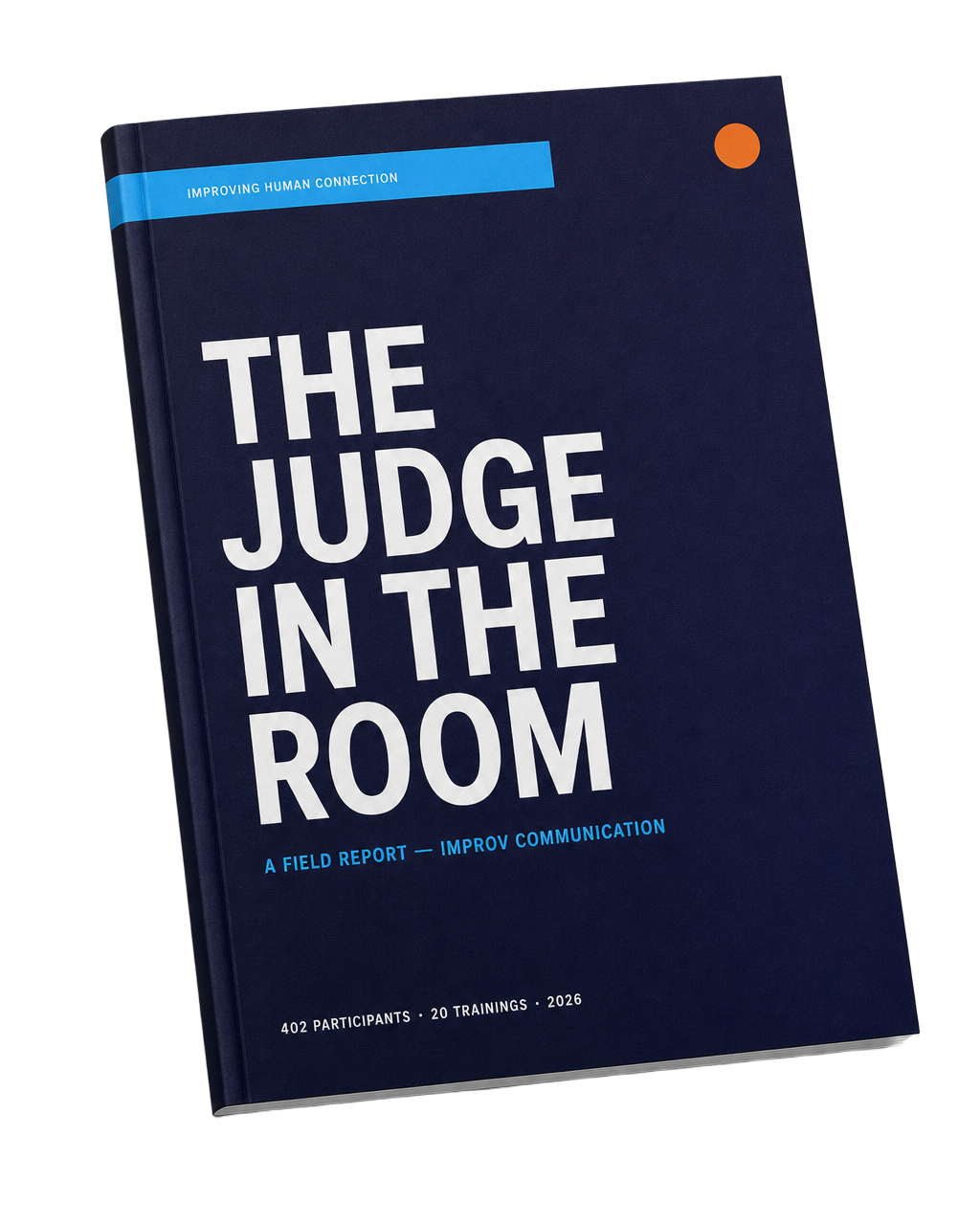
Free field report
The Judge in the Room
What 402 people told us about psychological safety — and what you can do with it on a Monday morning. Five findings, seven practices, participants’ own words.