Case study · Cross-cultural collaboration · A cross-functional digital team inside a global testing, inspection and certification company
Warming up a cross-border digital team — a global testing and certification company
98%
Would recommend
5.5 / 7
Likelihood to reach across teams
67%
Opted into the 30-day sprint
Quick answer
A cross-functional digital team of around 55 people inside a global testing, inspection and certification company asked IMPROV Communication to warm up collaboration that had grown cold and siloed across six countries. In a single three-hour experiential session built on our five Guiding Principles, 98% of respondents would recommend the experience, and two in three opted into a 30-day follow-up sprint.
At a glance
- Client: A cross-functional digital team inside a global testing, inspection and certification company
- Engagement: Cross-cultural communication and collaboration training — July 2026
- Scale: ≈55 participants, one three-hour experiential session, two facilitators
- 98% would recommend the experience to a colleague (41 of 42 respondents)
- 5.5 / 7 likelihood to reach across teams after the session
- 67% opted in to the voluntary 30-day behavioural sprint (28 of 42)
Key takeaways
- A single experiential session people feel rather than sit through can shift how a cross-border team talks to itself
- The three-phase architecture turns one day into behaviour that lasts past the thirty-day mark
- Follow-up built from the team's own words carries more weight than generic content
- An honest gap between belief and confidence is exactly what reinforcement is designed to close
Quick answer
A cross-functional digital team of around 55 people inside a global testing, inspection and certification company asked IMPROV Communication to warm up collaboration that had grown cold and siloed across six countries. In a single three-hour experiential session built on our five Guiding Principles, 98% of respondents would recommend the experience, and two in three opted into a 30-day follow-up sprint.
At a glance
Client: A cross-functional digital team inside a global testing, inspection and certification company
Engagement: Cross-cultural communication and collaboration training — July 2026
Scale: ≈55 participants, one three-hour experiential session, two facilitators
98% would recommend the experience to a colleague (41 of 42 respondents)
5.5 / 7 likelihood to reach across teams after the session
67% opted in to the voluntary 30-day behavioural sprint (28 of 42)
Source: anonymous post-session survey completed by 42 of the ≈55 participants (76%), on the day of the training.
Why they asked us in
The team sits inside a hundred-year-old, safety-first organisation, and it is one of the most mature and organised parts of the business — other groups copy its ways of working. Its people are cross-functional through and through: developers and technical specialists alongside marketing and process people, spread across Germany, Spain, Croatia, Hungary, Italy and Canada, working in English that is a first language for almost none of them.
The sponsor brought us in after experiencing our work elsewhere. The concern was simple and human. Collaboration across regions had gone cold and transactional — everything running through process, little through relationship. They wanted a foundation for ongoing development, not a one-off event.
The challenges that shaped our design:
Cold, transactional communication across regions. When most contact is a written message from another time zone, the easy thing is to fill the gaps with a harsh reading.
Siloing between teams. A drift toward "this is mine, this is yours", away from an earlier sense of being one team.
Problems created in writing, solved in speech. Issues that a five-minute conversation would settle instead dragging between streams for weeks.
What we delivered
One three-hour experiential session for the whole team, led by two experienced IMPROV facilitators. Less presentation, more doing — people were on their feet, working with the real friction of how their team actually talks to itself.
The engagement followed the three-phase architecture at the heart of our methodology:
Pre-training activation. Stakeholder and ambassador conversations to surface the real challenges, and a reflection prompt sent to every participant before the day.
The session itself. Experiential exercises grounded in the research on psychological safety and emotional intelligence, and our five Guiding Principles — Yes And, No Judgement of Yourself, No Judgement of Others, Embrace Mistakes, and Make Each Other Look Good. Participants do, then reflect, then commit.
Post-training reinforcement. A voluntary 30-day sprint of short Monday and Friday prompts built from the team's own takeaways, an ambassador coaching call, a manager reinforcement guide, and the EPIC Leadership e-book for every participant.
What the participants told us
Feedback was gathered anonymously in the room, in the final minutes of the session. Forty-two of the roughly 55 participants responded — a little over three-quarters.
Three patterns stood out.
They valued the day, and they want more of it. Ninety-eight per cent would recommend the experience to a colleague, and two in three chose to opt into the 30-day sprint. For a technically-minded room that started sceptical, that is a strong signal — the appetite to continue, not just a pleasant afternoon.
The principles that landed speak straight to the challenge. No Judgement of Others was the most-named principle, followed closely by No Judgement of Yourself — precisely the capacities a cross-cultural team needs to read a written message generously and to speak up earlier.
Confidence sat a step below belief. People rated the likelihood of reaching across teams at 5.5 out of 7, and their confidence to apply it under daily pressure a touch lower, at 5.1. That honest gap is the one follow-up exists to close, and it is why the sprint and manager reinforcement matter.
In their own words
I'm just like everyone else. A lot of us have the same behaviours and patterns. I feel more free to be myself. — Participant, July 2026 session
Most of the time we know how to fix or improve things, and we don't do it. — Participant, July 2026 session
Even an affirmative-meant laugh can really make an individual feel excluded. — Participant, July 2026 session
What they committed to on Monday
Before responding to a question or giving an opinion, take a second, and look for one point that contradicts the first thought.
Stop making negative assumptions before reaching out to others.
Reach out to other teams for help without fear, and work on the "yes, and" more often.
Create an environment in which people feel safe to bring up ideas.
Bring this to your team
If you lead a team spread across countries and time zones, you will recognise the pattern — collaboration that slowly cools until everything runs through process and nothing through relationship. What transfers is the shape of the work: a single session people feel rather than sit through, the three phases that turn one day into behaviour that lasts past the thirty-day mark, and follow-up built from the team's own words.
[Book an exploration call] · [Request a quote]
Bring this to your organisation
Turn a shared moment into lasting change.
Whether it's a department day, a faculty seminar or an organisational offsite — let's talk about the team and the change you're after.
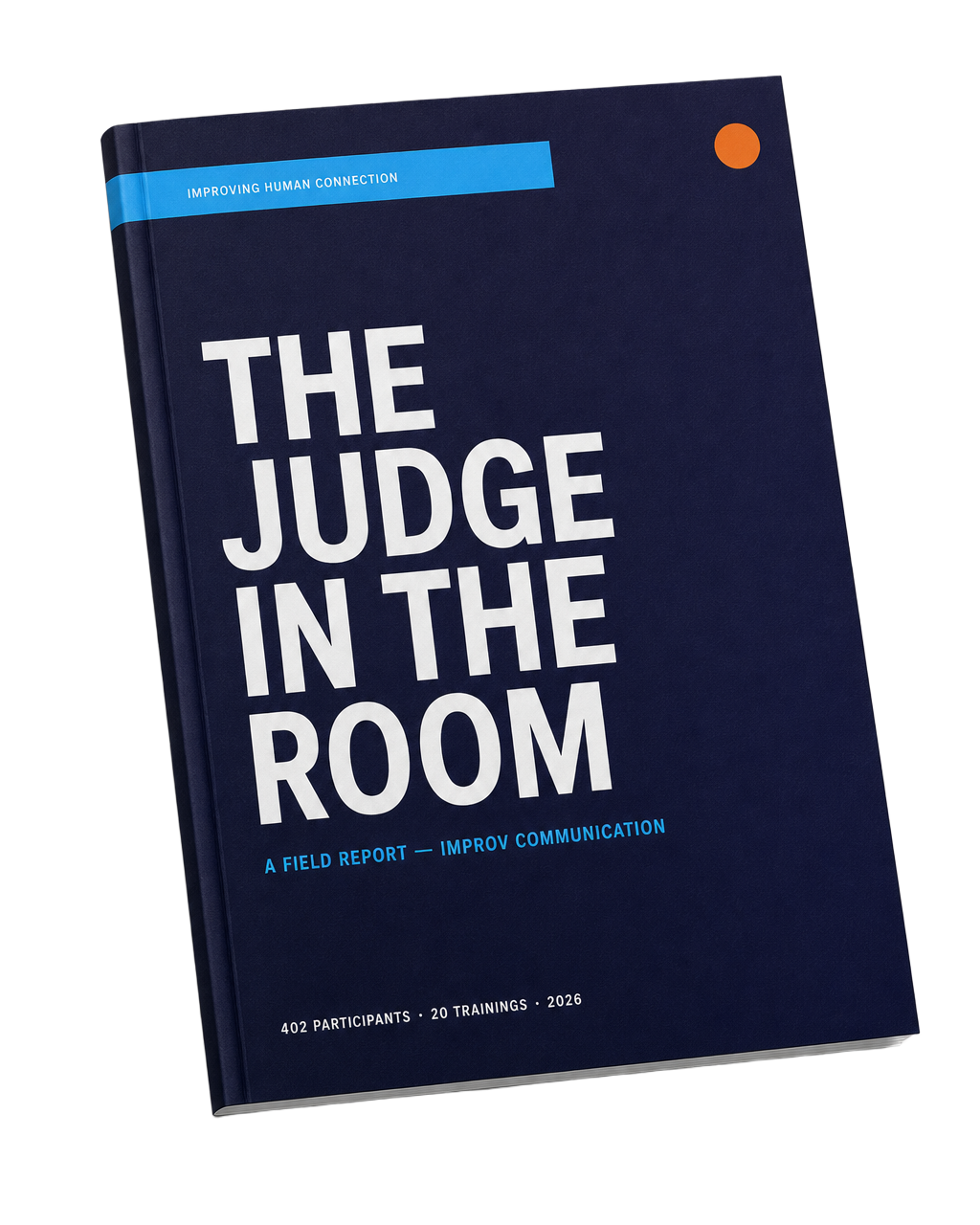
Free field report
The Judge in the Room
What 402 people told us about psychological safety — and what you can do with it on a Monday morning. Five findings, seven practices, participants’ own words.