
Quick answer
Thinking on your feet is a trainable skill, less about being clever and more about listening closely, staying calm under pressure, and building on what you hear. Applied Improv develops it through repeated practice in low-stakes situations, so the considered response becomes a habit rather than a scramble for the perfect words.
Key takeaways
- Thinking on your feet is mostly listening. When you are busy rehearsing your reply, you stop hearing the room, and the response lands flat.
- Pressure narrows attention. Learning to settle yourself keeps more of your thinking available when it matters most.
- Building on what you hear beats hunting for the perfect line. A quick next step keeps the conversation moving and buys you time.
- It is a practised skill, not a personality trait. Research shows improvisation practice improves divergent thinking and comfort with uncertainty.
- Preparation still helps. Knowing your material frees your attention for the moment in front of you.
Most of us have walked out of a meeting replaying the thing we wish we had said. The clever point arrived ten minutes too late. It can feel as though some people are simply wired for quick thinking, and the rest of us are left catching up.
The reassuring part is that thinking on your feet is a skill, and skills can be built. It rewards a handful of habits far more than raw intelligence, and every one of those habits can be practised.
Why does thinking on your feet feel so hard?
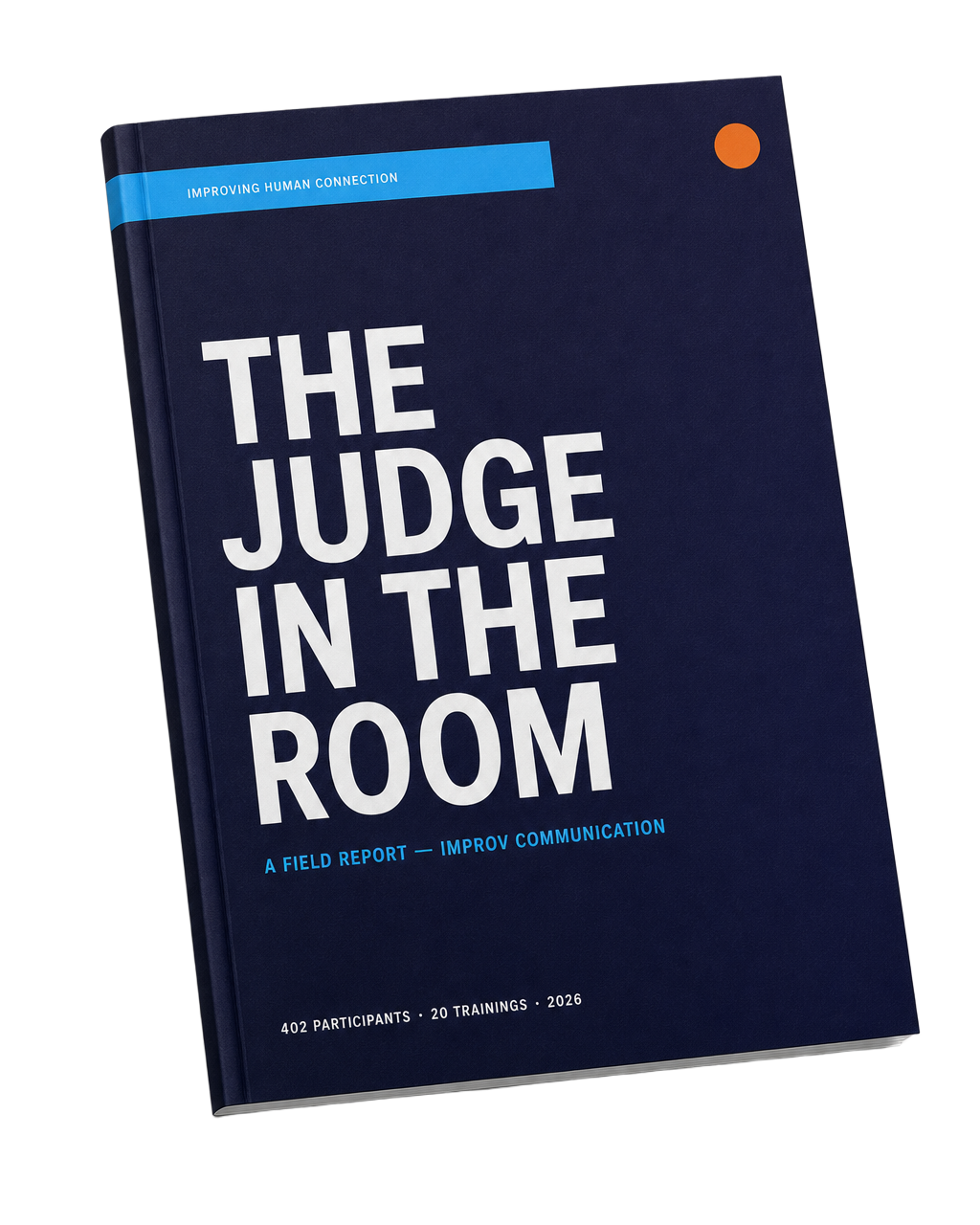
Free field report
The Judge in the Room — what 402 people told us about psychological safety.
The usual culprit is a crowded mind, not a slow one.
When someone puts you on the spot, your attention splits. Part of you listens to what is being said. Another part scrambles to draft a reply, judges how it will sound, and worries about looking unprepared. Working memory has limited room, and the moment you fill it with rehearsal and self-monitoring, there is less left for the conversation actually happening in front of you.
That is why the perfect line so often arrives afterwards. Once the pressure lifts, your attention frees up and the thought lands. In the room, it was crowded out.
Pressure makes this worse. Under stress, attention narrows and the brain leans towards familiar, safe responses rather than fresh ones. So the harder you strain to be impressive, the more likely you are to reach for something flat.
Is quick thinking a talent or a skill you can build?
It is a skill, and there is research to back that up.
Peter Felsman, Colleen Seifert and colleagues ran a series of experiments, published in Thinking Skills and Creativity in 2020, comparing people who did improvisation exercises with a control group who followed scripted social tasks. The improvisation group improved more in divergent thinking — the ability to generate several possible responses to an open situation — and reported greater comfort with uncertainty. The scripted group did not see the same gains.
That last point matters most. Comfort with uncertainty is the quiet engine behind thinking on your feet. Much of what stops us is not a shortage of ideas; it is the discomfort of not yet knowing what we are going to say. Practice that eases that discomfort makes the whole thing easier.
Which means quick thinking sits closer to fitness than to eye colour. You can train it.
What actually makes someone quicker in conversation?
A few habits do most of the work.
Listen before you plan. The people who respond well in the moment are usually listening more closely, not thinking faster. When you give the other person your full attention rather than half of it, you have more to work with when your turn comes, and your reply connects to what was said rather than to the speech you were quietly drafting.
Build on what you hear. You rarely need a brilliant original point; a solid next step is usually enough. Taking the last thing that was said and adding to it — a version of the improviser's "yes, and" — keeps a conversation moving and buys you thinking time while you speak.
Steady your body first. A slow breath before you answer does more than buy a second. It takes the edge off the stress response that narrows attention, so more of your thinking stays available. Leaders who look unflappable under questioning are rarely calmer by nature; they have practised settling themselves in the half-second before they speak.
Let a small pause be fine. Two seconds of silence feels like an age to the person talking and passes almost unnoticed by everyone else. A short pause reads as considered. Rushing to fill every gap is what makes answers tumble out half-formed.
Lower the stakes in your own head. Most exchanges do not call for the definitive answer. "Here is my first thought, and I might refine it" is an honest, useful thing to say, and it takes the pressure off finding the flawless word.
How do you practise thinking on your feet?
Reading about these habits changes very little on its own. Thinking on your feet is a performance skill, and performance skills are built by doing them, ideally somewhere the cost of fumbling is low.
This is the ground Applied Improv works on. In a session, people take turns responding to situations they cannot plan for, with no script and no single right answer to reach for. The exercises are built so that missteps are expected and quickly recovered from, which is exactly the condition the Felsman research points to: repeated, low-stakes practice at responding to the unplanned. Do enough of it and the calm, listen-first response starts to feel normal, so it holds up when the situation is real and the room is watching.
It helps that the practice is shared. When a whole team grows more comfortable building on each other and less anxious about the perfect contribution, meetings change. Ideas get picked up rather than dropped, and people speak sooner because a half-formed thought is welcome.
If your instinct is to prepare harder for every possible question, keep it. Knowing your material well frees your attention for the moment in front of you. The aim is to prepare thoroughly and then trust yourself to respond to what is actually said.
At IMPROV, this is the heart of what our facilitators help people build — the composure to listen, the willingness to offer a first thought, and the habit of building on others rather than waiting for the flawless line. It is one of the most practical changes a leader or a team can make, and it tends to show up in the very next conversation.
If you would like to see how that practice works, our improv training is built around exactly this, and you can explore more of the thinking on our blog.
Free field report
The Judge in the Room
What 402 people told us about psychological safety — and what you can do with it on a Monday morning. Five findings, seven practices, participants’ own words.
Curious?
Is your team losing ideas to silence?
That's exactly what we help leaders see and shift. No pitch — just a proper conversation about your team.