
Quick answer
Psychological safety in remote and hybrid teams is built the same way as in the office — through consistent leader behaviour — and it needs more deliberate attention. Distance removes the informal cues that build trust, so leaders replace them on purpose: they go first with their own uncertainty, invite every voice by name, and respond warmly when someone raises a concern.
Key takeaways
- Psychological safety is a group-level climate, not a perk — Amy Edmondson defined it as the shared belief that a team is safe for interpersonal risk-taking.
- Distance strips away the informal signals that build trust, so remote and hybrid teams need safety built on purpose rather than left to chance.
- Proximity bias — favouring the people a leader physically sees — quietly tells remote colleagues their input matters less.
- The leader moves that work in the room work online too: go first, name your own uncertainty, and reward the person who speaks up.
- Hybrid meetings need deliberate design so the people on a screen are heard as clearly as the people sharing a room.
Why psychological safety matters more when the team is spread out
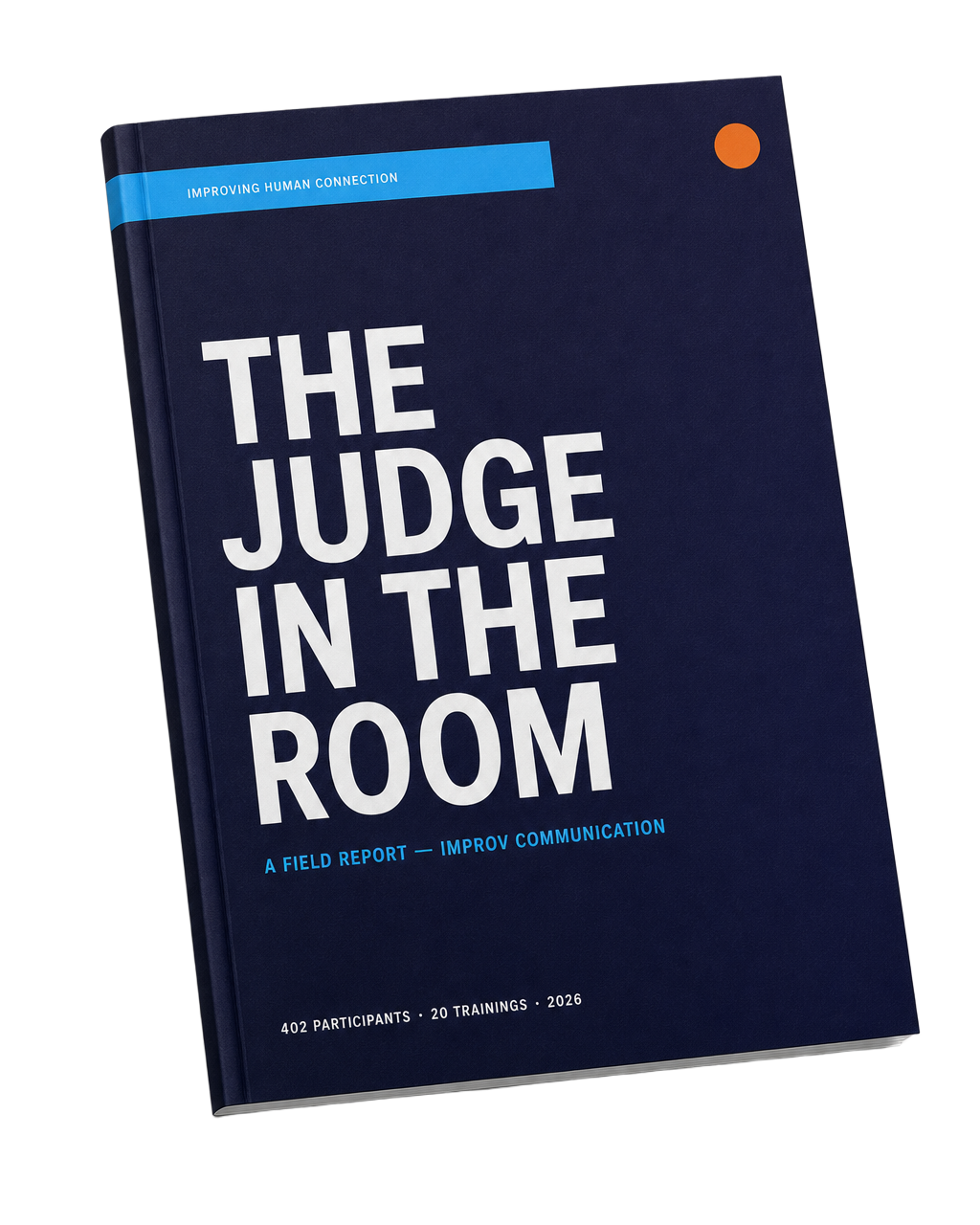
Free field report
The Judge in the Room — what 402 people told us about psychological safety.
Amy Edmondson, the Harvard professor who introduced the term in 1999, described psychological safety as the shared belief that a team is safe for interpersonal risk-taking — the sense that you can ask a question, admit a mistake or float a half-formed idea without fear of looking foolish. It is a group-level climate rather than a feeling between two people, and it is one of the strongest predictors of how well a team learns and performs. Google's Project Aristotle reached the same conclusion when it studied its own teams: the highest-performing ones shared this quality above any other.
When a team sits in the same room, a good deal of that safety is built without anyone naming it. A colleague's expression tells you your idea landed. A quiet word after the meeting repairs a misread comment. The small talk before the call reminds everyone there is a person on the other side. Distance removes most of those signals. What was carried by presence now has to be carried on purpose.
Why is psychological safety harder in remote and hybrid teams?
Remote and hybrid teams face a few pressures at once. People read silence as judgement more easily when they cannot see a face. A delayed reply can feel like disapproval. Someone unsure whether their point is welcome will often keep it to themselves rather than unmute and interrupt. Over time, a team can grow quieter without anyone deciding it should.
Hybrid adds another layer. When some people share a room and others join from a screen, the two groups rarely have an equal experience. The people in the room hear the side conversations, catch the glances and speak first. The people on the screen wait for a gap that never quite opens. None of this is anyone's intention, and it shapes who feels able to contribute.
What is proximity bias, and why does it matter?
Proximity bias is the tendency to favour the people a leader sees most often. In a hybrid setup that usually means the colleagues who come into the office. They get the informal check-ins, the corridor updates and the first thought when an opportunity comes up. The remote members receive less of all three — not through any deliberate choice, and the effect is real. Over months, remote colleagues can start to feel less seen, and a person who feels overlooked rarely takes the risk of speaking up.
Left unaddressed, proximity bias reads as a message: your input matters less. That message wears away the shared belief Edmondson described, and it does so quietly, which is what makes it worth naming out loud.
How do you build psychological safety in a distributed team?
The leader behaviours that create safety in the room create it online too. They simply need more deliberate use, because the environment gives you less for free.
Go first with your own fallibility. When a leader says "I'm not sure I've got this right — tell me what I'm missing," it gives everyone else permission to be uncertain in public. On a call, where people are more guarded, that permission matters even more.
Invite every voice by name. Rather than asking "any thoughts?" into a grid of muted squares, ask a specific person what they make of it. Done warmly and spread around the team, being named feels like a welcome.
Reward the person who speaks up, especially when the news is difficult. The response to the first piece of bad news teaches the whole team whether honesty is welcome. A warm "thank you for raising that" does more for safety than any policy.
Separate the moment for generating ideas from the moment for judging them. Distributed teams lose the loose, exploratory conversation most easily, so protect it. Make it clear when you are collecting possibilities and nothing is being weighed yet.
Write things down and share them widely. Decisions made in a room have a habit of staying in that room. Putting the context and the reasoning in a shared place gives remote colleagues the same footing as the people who were present.
How do you keep hybrid meetings fair?
Hybrid meetings need design rather than good intentions. A few habits go a long way.
Give the remote participants the floor first, before the room warms up and fills the space. Ask one of the people on the screen to open, so the meeting starts on their terms.
Consider having everyone join the call from their own device, even those in the building, so every face is the same size and every voice comes through the same channel. It levels the experience more than any reminder to include the remote colleagues.
Use a written channel alongside the talking. A chat window lets the person who needs a moment to phrase a thought contribute without having to fight for a gap in the audio.
Close the loop afterwards. A short written summary of what was decided, and why, keeps everyone on the same page and gives the quieter members a way back in with a follow-up.
Can you measure psychological safety in a remote team?
Yes. Edmondson's seven-item survey works regardless of where people sit, and it is worth running more than once so you can see the trend. Alongside the survey, watch the behavioural signals: who speaks in meetings and who never does, whether difficult news reaches you early or late, whether remote colleagues raise concerns or only ever agree. A drop in questions is often the first sign that a distributed team has quietly stopped feeling safe.
Building it, not just believing in it
Reading about these behaviours takes a minute. Doing them under the small pressures of a real meeting — when someone has just challenged your plan on a call in front of the team — is the harder thing. This is why psychological safety tends to grow through practice rather than through a briefing.
Our psychological safety trainings put leaders and teams into live situations where they practise these moves and feel the difference between a group that has safety and one that does not. When a distributed team has rehearsed speaking up and responding well, the habits hold when the pressure is on and a camera is the only thing connecting you. If you would like to explore what that could look like for your team, we would be glad to talk it through.
Free field report
The Judge in the Room
What 402 people told us about psychological safety — and what you can do with it on a Monday morning. Five findings, seven practices, participants’ own words.
Curious?
Is your team losing ideas to silence?
That's exactly what we help leaders see and shift. No pitch — just a proper conversation about your team.