
Quick answer
Psychological safety at work is the shared belief that it is safe to speak up, ask questions, challenge ideas and admit mistakes without being punished or humiliated. Harvard's Amy Edmondson identified it, and Google's Project Aristotle found it was the single strongest predictor of team performance — ahead of talent, seniority or experience. It is not about being nice, and it does not mean lowering standards. It is built through leader behaviour in the small, high-stakes moments: how a challenge is received, how a mistake is met, how a half-formed idea is welcomed. The fastest way to build it is to give teams the felt experience of it, then anchor it in a shared framework — for us, the 5 Guiding Principles of IMPROV.
Key takeaways
- Psychological safety at work is not comfort or niceness — it is the confidence that speaking up will not be punished.
- It is the strongest predictor of team performance (Google Project Aristotle, Amy Edmondson, BCG 2024).
- High safety plus high standards is where the best teams live; safety without standards is complacency.
- Leaders build or break safety in the small moments, not in the values statement.
- The 5 Guiding Principles of IMPROV — Yes And, Do Not Judge Yourself, Do Not Judge Others, Embrace Failure, Make Each Other Look Good — give teams a shared, teachable behaviour set.
- You cannot lecture safety into a team. It has to be felt, practised, and reinforced week after week.
What psychological safety at work actually means
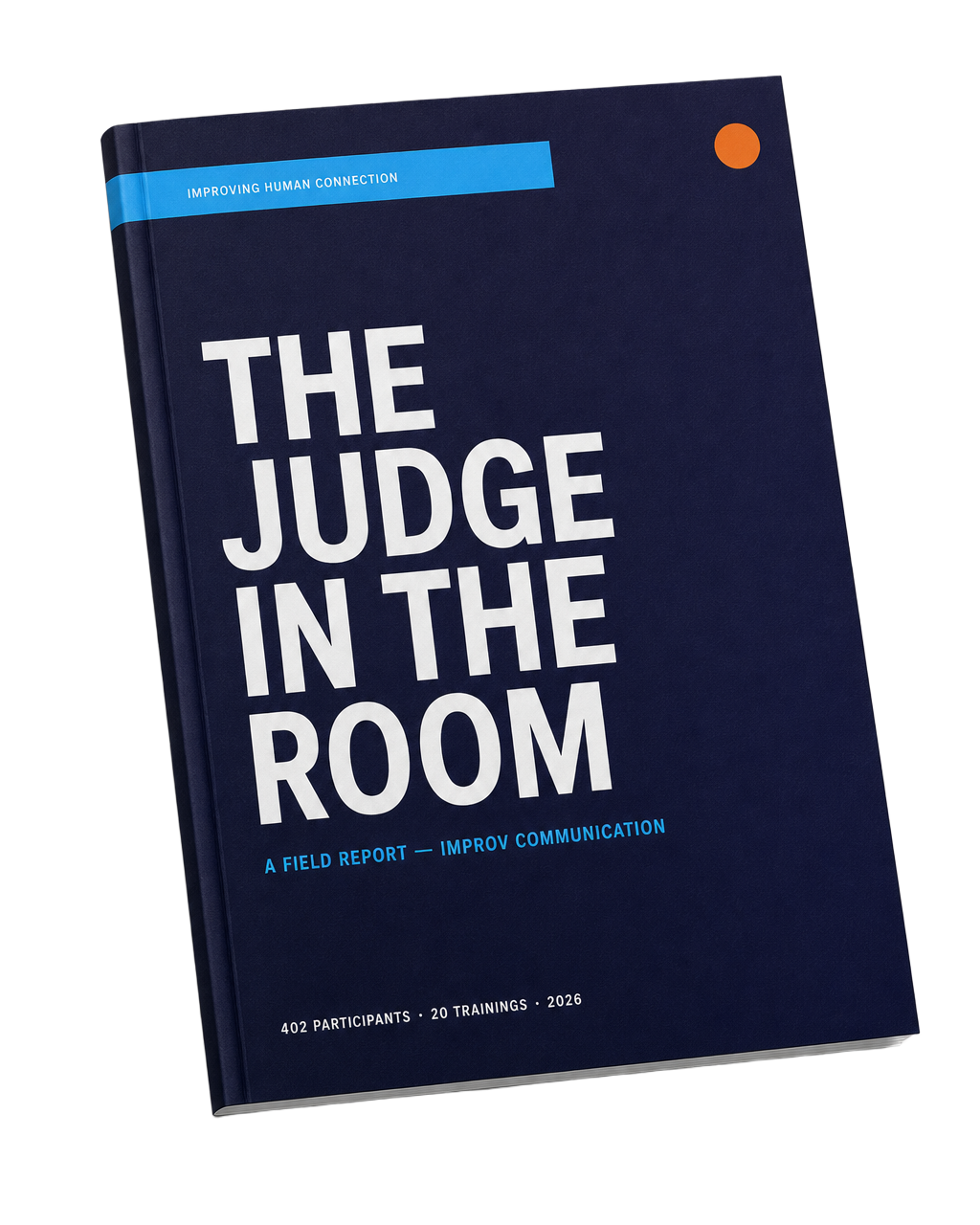
Free field report
The Judge in the Room — what 402 people told us about psychological safety.
Psychological safety at work is a simple idea that people often get wrong. It is the shared belief in a team that you can speak up, take an interpersonal risk, ask a question, disagree with the person in charge, or admit you got something wrong — and not be punished, embarrassed or quietly written off for it.
It is not the same as being comfortable. It is not niceness, and it is not the absence of tension. Amy Edmondson, the Harvard professor who coined the term, is emphatic on this: the best teams pair high psychological safety with high standards. Safety is what makes the honesty possible; standards are what make the honesty useful.
If your team is polite in meetings and candid only in the corridor afterwards, you do not have psychological safety at work. You have a workaround.
Why it matters more than almost anything else
For years, psychological safety could be dismissed as a soft topic. The evidence has closed that argument.
When Google set out to understand what made some teams outperform others, it studied 180 teams over two years in a project called Aristotle. The expectation was that the best teams would have the most talented people, the deepest experience, the most impressive credentials. They did not. The single strongest predictor of team performance was psychological safety.
Amy Edmondson's research points the same way: teams where people feel safe to speak up learn faster and perform better than teams where people self-censor. A 2024 global study by BCG found the same, and added that psychological safety was a significant buffer against burnout and attrition.
Put plainly: the organisations that hear their own best thinking outperform the ones that do not. In a period where value comes from how quickly people adapt, a workforce that holds back compounds a cost week after week.
Why smart people stay silent
From the outside, silence in meetings looks like a lack of ideas or nerve. Usually it is neither. Most of the time, people are running fast, sensible maths.
Speaking up carries an immediate, certain risk: you might look uninformed, irritate someone senior, or be wrong in public. The reward is delayed and uncertain: maybe the idea lands, maybe it changes nothing. Faced with a certain risk and an uncertain reward, the safe move is to say nothing. So people say nothing.
There is biology underneath this. When we sense social threat — the risk of being judged, excluded or diminished — the brain's amygdala responds much as it would to physical danger. The part of the brain we need for creative, generous contribution goes quiet. People are not choosing to disengage; their nervous system is choosing for them.
In research by James Detert and Amy Edmondson, 85% of professionals reported at least one occasion when they felt unable to raise a concern with their boss, even though they believed it was important. Not a fringe minority. The overwhelming majority, holding back something that mattered.
The four stages of psychological safety
It helps to think of psychological safety at work in four widening circles, adapted from Timothy Clark's model. Each one has to hold before the next becomes possible.
Inclusion safety — the sense that you belong here, as you are. Without it, everything else is theatre.
Learner safety — the sense that it is safe to ask questions, admit you do not know, and try things that might not work.
Contributor safety — the sense that your ideas and work are welcome, and that you can use your skills without asking permission for every move.
Challenger safety — the sense that you can question the status quo, disagree with more senior people, and push back on decisions without being punished for it.
Most organisations achieve the first two reasonably well and quietly stall on the last two. That is where the expensive silence lives.
What leaders actually do to build it
The good news is that psychological safety at work is behaviour, and behaviour is learnable. A few moves matter more than any statement of values.
Go first with your own uncertainty. The fastest way to make it safe for others to be uncertain is to be uncertain yourself, out loud. When a leader says "I got this wrong" or "I do not know — what am I missing?", the cost of honesty drops for everyone watching. People match the candour they see at the top.
Reward the messenger, especially when it stings. The moment that defines a team is the inconvenient warning, the dissent, the question that exposes a gap. How you respond to it teaches the room far more than any policy. Thank the person who raised it, even — perhaps especially — when you would rather not have heard it.
Separate creating from judging. Most teams kill ideas in the cradle by evaluating them the instant they are spoken. Generation and judgement are different jobs, and doing both at once means people only ever offer the safe, finished thought. Make space to gather ideas before anyone critiques them.
Meet the half-formed idea with "Yes, and". When someone offers a rough, unpolished thought, the instinct to correct or improve it shuts the next person down. Building on it instead — taking what is useful and adding to it — signals that contribution is welcome before it is perfect. Small habit, large effect.
Watch the small moments. Safety is decided in micro-signals: the eye-roll when someone speaks, the interruption of the quieter voice, the meeting that ends without asking the people who did not speak. Leaders who take those seconds seriously build safety faster than leaders who write memos about it.
Grounding it in the 5 Guiding Principles of IMPROV
Behavioural advice on its own is fragile. Under pressure, most of it evaporates. Teams need a shared, practised framework — a small set of principles they can point to when a meeting starts to slip.
We use the 5 Guiding Principles of IMPROV, drawn from applied improvisation and now taught to more than 20,000 professionals across Europe.
Yes, And — build on what your colleagues offer instead of blocking or redirecting. It is the foundation of every generative conversation.
Do Not Judge Yourself — the inner critic is the biggest obstacle to speaking up. Teams learn to notice it and move anyway.
Do Not Judge Others — the moment we judge a colleague's contribution, we shut down the conversation. Removing judgement changes what people are willing to say.
Embrace Failure — treat mistakes as material rather than as problems. Curiosity replaces blame.
Make Each Other Look Good — the simplest definition of a great team. When people stop competing for airtime and start actively supporting each other, everything else follows.
Each principle is a specific, visible behaviour. Together they give a team a common vocabulary — "that felt like a yes-and moment", or "I think we are judging rather than listening". That language sticks, and it shows up in real meetings the week after.
Why "just be more open" does not work
Once leaders see this, they often reach for the obvious fix. They tell people the door is always open. They say "there are no stupid questions". They ask, at the end of the meeting, whether anyone has any concerns.
It rarely changes anything, and the reason is simple. People do not calibrate their honesty to what leaders say. They calibrate it to what leaders do — especially in the small, high-stakes moments. The first time someone raises a real concern and is met with a flicker of irritation, a correction, or a "we have already been through this", the whole room recalculates. The door may be open. The lesson is to stay out of it.
Safety is an experience people have, again and again, until they believe it — not a policy you can announce. Which means it cannot be taught from a slide. It has to be felt.
How to start this quarter
You do not need a culture programme to begin. Three things move the needle in weeks, not years.
Change how meetings end. Before the last five minutes, ask: "What have we not said yet?" Then wait. Silence is normal; hold it. The first two times will feel awkward, and the third time someone will say the thing everyone was thinking.
Respond visibly to the hard message. The next time a colleague raises something inconvenient, name it: "That is exactly the kind of thing I want to hear more of — thank you." Do it in front of the group. That single moment does more than a values workshop.
Give the team a shared vocabulary. Introduce the 5 Guiding Principles — or your own equivalent — and make them referenceable in real meetings. The point is not the poster on the wall. It is that anyone in the room can name what is happening and shift it.
Everyone talks about psychological safety at work. The work is making people feel it. Do that, and the ideas you have been losing to silence start showing up in the room, where they can finally do some good.
Free field report
The Judge in the Room
What 402 people told us about psychological safety — and what you can do with it on a Monday morning. Five findings, seven practices, participants’ own words.
Curious?
Is your team losing ideas to silence?
That's exactly what we help leaders see and shift. No pitch — just a proper conversation about your team.