
Quick answer
You rebuild psychological safety after layoffs by naming the reality plainly, restoring certainty where you can, and modelling honesty yourself. Redundancies threaten status, certainty and fairness, which pushes the people who remain to go quiet. Safety returns through consistent leader behaviour over months — steady, repeated signals that speaking up still carries no penalty.
Key takeaways
- Layoffs threaten status, certainty and fairness at once, which the brain treats as danger — so survivors take fewer interpersonal risks and go quiet.
- David Noer named the aftermath 'layoff survivor sickness' in 1993: guilt, anxiety, anger and eroded trust in the people who stay.
- Silence, spin and pretending nothing happened are the three leader responses that do the most damage.
- Rebuilding is behavioural: name the reality, restore what certainty you can, go first with your own honesty, and reward whoever raises the first risk.
- Trust and engagement recover over months of consistent behaviour — one honest all-hands is only the start.
A round of layoffs does not end when the last conversation is over. For the people who remain, the questions are only starting: am I next, can I trust what I am told, is it still safe to raise a problem. Left unanswered, those questions quietly change how a team behaves. People stop speaking up, hold information close, and keep their heads down at the exact moment the organisation needs them thinking out loud.
For any leader carrying a team through redundancies, a restructure or a merger, this is the real work that starts once the announcements are done: rebuilding the safety to speak.
Why do layoffs damage psychological safety?
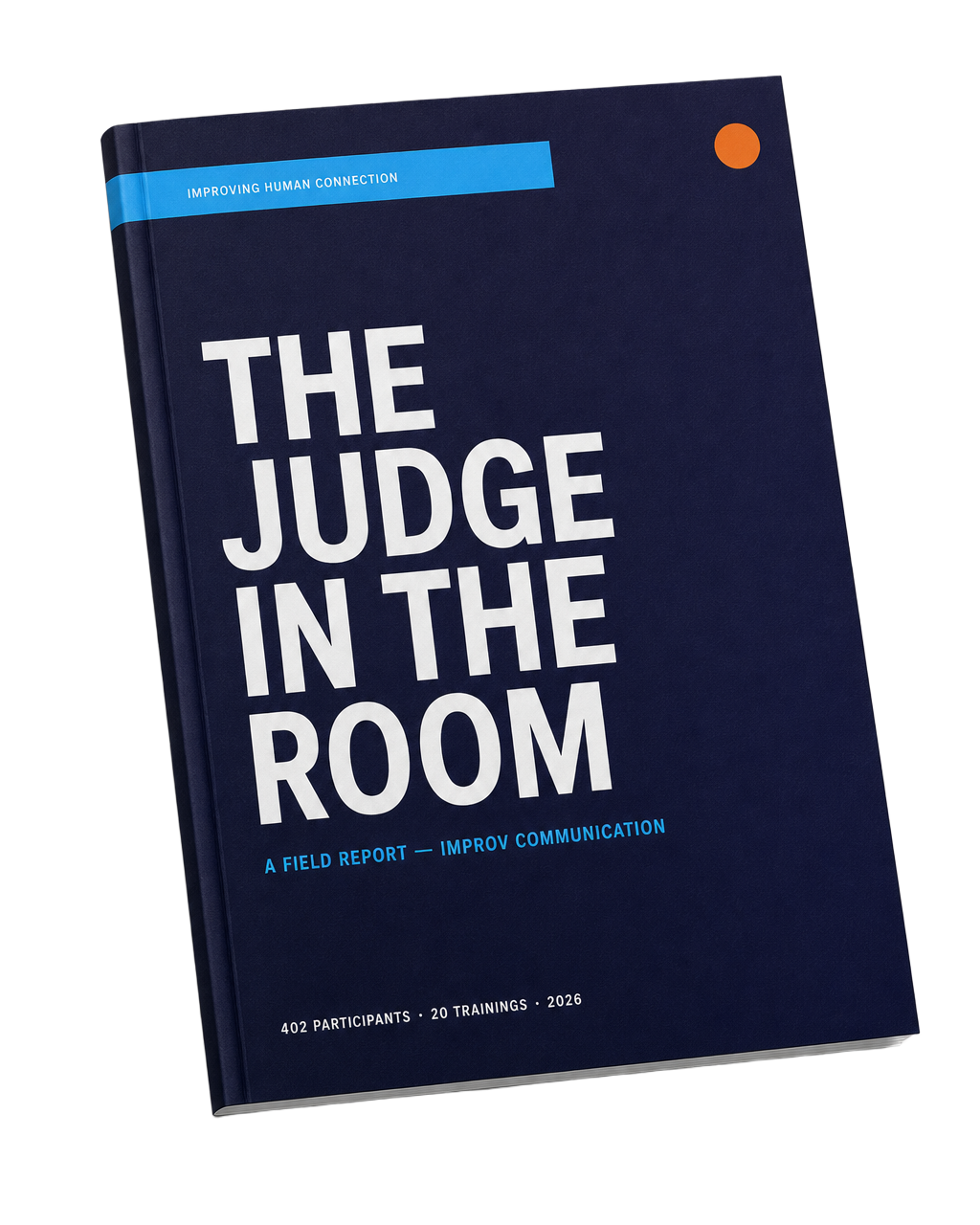
Free field report
The Judge in the Room — what 402 people told us about psychological safety.
Psychological safety is the shared belief that a team is safe for interpersonal risk-taking — that you can ask a question, admit a mistake or challenge a decision without fear of embarrassment or punishment. Amy Edmondson introduced the term in her 1999 research, and the studies since have tied it to learning, innovation and performance.
A layoff attacks that belief head-on. The evidence that people can be removed — sometimes good people, sometimes with little warning — teaches everyone still there a lesson about risk. David Rock's SCARF model, published in 2008, helps explain why the reaction runs so deep. Rock identified five social drivers the brain treats as survival matters: status, certainty, autonomy, relatedness and fairness. A redundancy round threatens almost all five at once. Status feels fragile. Certainty collapses. People lose colleagues they were close to, and many quietly judge the process as unfair. When those drivers are under threat, the brain responds much as it would to physical danger — it narrows attention, avoids risk and goes quiet.
What is layoff survivor syndrome?
In 1993, David Noer named what he had seen in organisation after organisation: layoff survivor sickness. The people who keep their jobs carry a heavy, largely unspoken load — guilt about colleagues who left, anxiety about the next round, anger at how it was handled, and eroded trust in leadership. Noer's observation, still accurate three decades on, is that companies pour support into those who leave and offer almost none to those who stay. The survivors are expected to be grateful and to absorb the extra work in silence.
Grateful and quiet is the opposite of what psychological safety needs. A team running on survivor syndrome can look calm from the outside while it has stopped taking the small interpersonal risks — the awkward question, the early warning, the half-formed idea — that keep an organisation honest.
What do leaders get wrong after layoffs?
Three patterns do the most damage.
The first is silence. Leaders, uncomfortable and short of answers, say as little as possible and hope the mood settles. The team reads the silence as evasion, and fills the gap with rumour.
The second is spin. A carefully worded message about being "leaner and more focused" lands badly on people who have just watched friends clear their desks. When the words and the felt reality do not match, trust drops further.
The third is pretending nothing happened. Business as usual, straight back to targets, no acknowledgement of loss. That asks people to suppress what they feel, and suppression is costly — it leaves less attention for the work itself.
How do you rebuild psychological safety after layoffs?
Rebuilding is slow, and it is mostly behavioural. A handful of leader moves matter more than any announcement.
Name the reality plainly. Say what happened, why, and what you know and do not yet know about the future. People handle hard truth far better than they handle a vacuum. Naming the loss also gives them permission to feel it rather than hide it.
Restore certainty wherever you honestly can. You will not have every answer. You can still be specific about what is now stable — this team, this quarter's priorities, this way of working — so people have something solid to hold onto. Rock's model shows how much even small, reliable certainty helps a threatened brain settle.
Go first. A leader who admits their own doubt, or their own part in how something was handled, signals that honesty is safe here. Edmondson calls this modelling fallibility, and in the weeks after a layoff it carries far more weight than any reassuring email.
Make it safe to say the fear out loud. Ask directly how people are doing, then listen without correcting or defending. The moment a leader argues with someone's worry, the room learns to keep worries private.
Deal with the workload openly. When headcount falls the work does not, and it usually lands on the survivors without discussion. Renegotiating what gets dropped is one of the clearest signals that leadership sees the strain and takes it seriously.
Reward the messenger. In the anxious period after a cut, the first person to raise a risk or own a slip is testing whether it is still safe to do so. How you respond in that moment teaches the whole team more than any values poster.
How long does it take to recover?
Longer than most leaders hope. Trust and engagement tend to return over many months, not weeks, and only when the behaviour above stays consistent. One honest all-hands does not undo the felt experience of watching colleagues leave. What rebuilds safety is the accumulation of small, repeated signals that speaking up still carries no penalty. Consistency is the whole game — a leader who is open one week and defensive the next resets the clock.
Practising the behaviour, not just knowing it
This is where the gap between knowing and doing shows up. Most leaders can recite what they should do after a layoff. Under the strain of the real situation — a tense room, a hard question, their own uncertainty — the old habits take over. That gap is what our trainings work on. We give leaders and teams a low-stakes place to practise the exact behaviours safety depends on: saying the difficult thing, staying open when someone challenges them, recovering quickly from a stumble. People build the habit in the room, so it holds when the pressure is real.
If your organisation is carrying a team through change and you want to rebuild the safety to speak up, our Psychological Safety Training is a good place to start. Our exploration call is a proper conversation about your team, with no pitch.
Free field report
The Judge in the Room
What 402 people told us about psychological safety — and what you can do with it on a Monday morning. Five findings, seven practices, participants’ own words.
Curious?
Is your team losing ideas to silence?
That's exactly what we help leaders see and shift. No pitch — just a proper conversation about your team.