
Quick answer
As AI takes over more analytical and routine cognitive work, the skills that stay human — reading emotions, staying steady under pressure, connecting with people and judging what matters — become more valuable, not less. Emotional intelligence is the part AI cannot replicate, and the World Economic Forum now ranks these human skills among the most important for the coming decade.
Key takeaways
- As AI handles more analytical and routine work, human skills like empathy, self-awareness and emotional regulation rise in value.
- The World Economic Forum's Future of Jobs Report 2025 ranks resilience, leadership and social influence, and self-awareness among the core skills employers most need.
- Emotional intelligence — introduced by Salovey and Mayer, popularised by Goleman — is learnable; a 2018 meta-analysis found emotional-intelligence training has a moderate, lasting effect.
- AI can imitate the language of empathy; it cannot feel, take responsibility, or read a room the way a person can.
- The people who work best alongside AI bring judgment, steady nerves and real attention to others — human skills built through practice.
Why does AI make emotional intelligence more valuable?
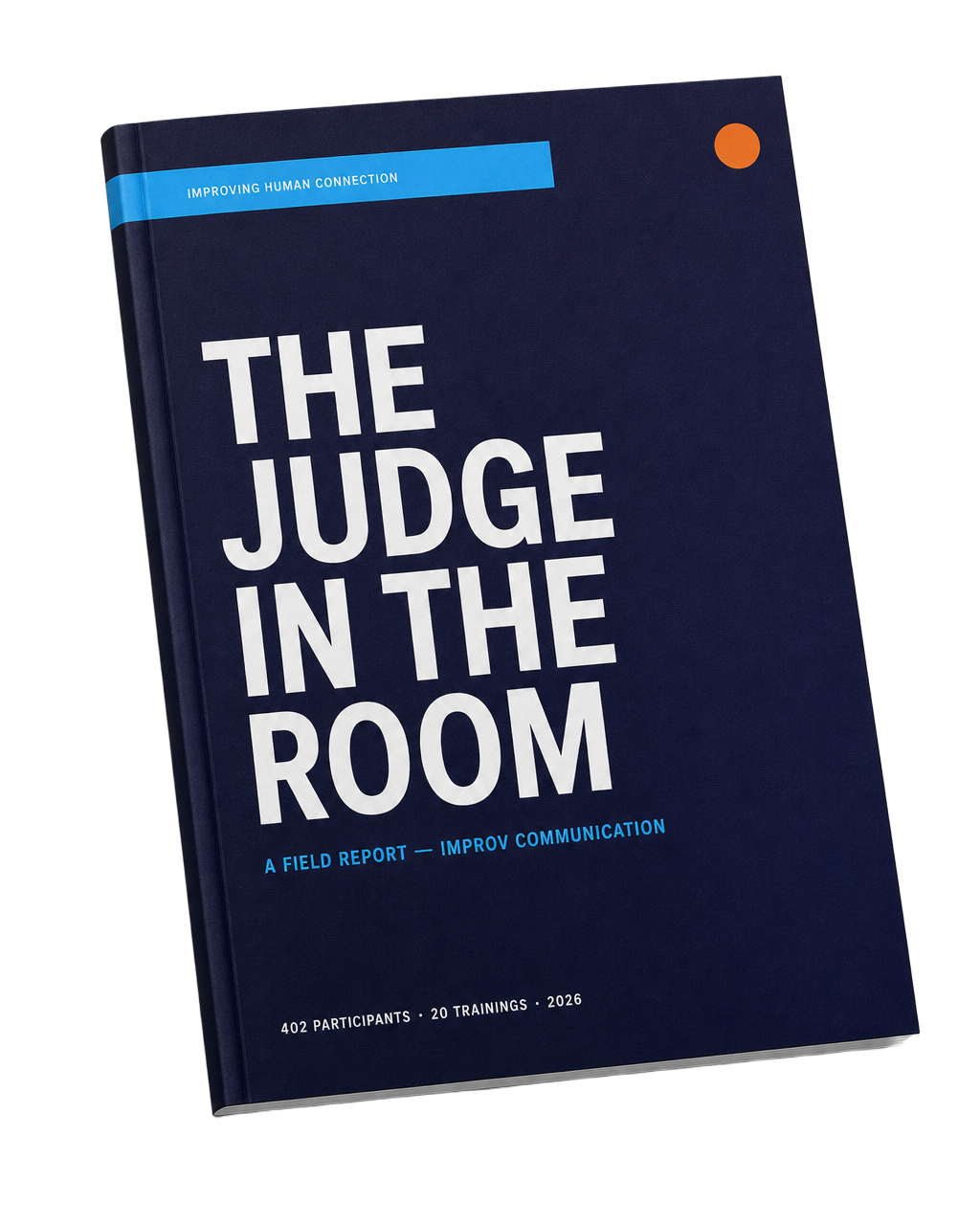
Free field report
The Judge in the Room — what 402 people told us about psychological safety.
For most of the last decade, the advice to young professionals was to learn to code, work with data, become technical. That advice still holds. At the same time, something has shifted. As AI systems take on more of the analytical, routine and even creative cognitive work, the skills that stay stubbornly human are the ones rising in value.
Machines are now good at the tasks we once called intelligent — summarising, drafting, analysing, predicting. What they cannot do is care whether a decision is fair, sense that a colleague is holding something back, or take responsibility when a call goes wrong. Those are the acts of emotional intelligence, and they are becoming the clearest marker of what a person adds that a model does not.
What does the research say about the skills employers now need?
The World Economic Forum's Future of Jobs Report 2025 makes the pattern concrete. Alongside AI and big-data skills, the report places human skills at the centre of the coming decade. Resilience, flexibility and agility, leadership and social influence, and self-awareness all sit among the core skills employers rank most highly, and creative thinking and resilience are among the fastest rising. Analytical thinking still leads the list, and the human, interpersonal skills sit right beside it.
The signal is worth sitting with. In a report about automation and AI, the skills employers say they need most are the ones a machine cannot supply. When the technical work is increasingly shared with software, the human contribution — reading people, staying steady, bringing others with you — is what stays scarce.
Can AI actually replicate emotional intelligence?
AI can produce the language of empathy. Ask a model to respond kindly to an upset customer and it will write something warm and well-judged. That is useful, and it is worth being clear about what it is: pattern-matching on how empathy sounds.
Feeling is a different thing from imitating feeling. A model has no stake in the outcome, no relationship to protect, no discomfort when it delivers hard news. It cannot notice that the quiet person in the meeting has gone quiet for a reason, or decide that this is the moment to slow down and check in rather than push ahead. Emotional intelligence lives in that judgment — reading a real situation, in real time, with something at stake — and that is the part the technology does not reach.
So the human skill becomes more distinctive as the technology improves. The gap between sounding caring and actually reading and responding to people grows wider the more fluent the machines become.
Which human skills matter most in an AI workplace?
It helps to be specific about what emotional intelligence actually contains. Daniel Goleman's widely used model breaks it into five parts, and each one maps onto something AI leaves untouched.
Self-awareness — knowing what you feel and how it colours your judgment — is what lets a person question their own first reaction to a machine's recommendation rather than accept or reject it on impulse. Self-regulation is staying composed when the pace picks up and the tools multiply. Motivation is the internal drive that decides what is worth doing in the first place, a question no model answers for you. Empathy is sensing what colleagues and clients actually need, often before they say it. And social skill is the work of building trust and moving a group forward together.
None of these is downstream of raw processing power. They are the human operating system that decides how, and whether, all that processing gets used well.
What does this mean for leaders?
For leaders, the shift is sharper still. A team working with AI carries new anxieties — about relevance, about being replaced, about keeping up. Managing that emotional weather is squarely a leadership job, and it is one no tool can do for you. Leaders set the emotional climate of a team, a point Goleman's work established years ago, and it matters more when people feel the ground moving under them.
The leaders who will do well are the ones who can hold two things at once: real fluency with what AI makes possible, and the human presence to keep their people steady, honest and willing to speak up while everything changes around them. The first can be learned quickly. The second takes practice.
Is emotional intelligence something you can build?
Encouragingly, yes. Peter Salovey and John Mayer, who introduced the concept in 1990, framed emotional intelligence as a set of abilities — and abilities can be trained. A 2018 meta-analysis by Hodzic and colleagues, published in Emotion Review, pulled together the available studies and found that emotional-intelligence training produces a moderate improvement that holds at follow-up. It is a skill, and it responds to practice like any other.
That last point matters for anyone weighing how to prepare for an AI-heavy workplace. Reading about empathy, or asking a model to explain it, does little for how you actually show up under pressure. Emotional intelligence grows through reps — through practising the moment of noticing, naming and choosing a response, again and again, until it becomes how you operate rather than something you have to think about.
Working well alongside AI
This is where the human skills and the technology meet. The people who work best with AI tend to bring good judgment, steady nerves and real attention to other people to the work the tools make possible. Knowing the tools matters; knowing how to read a situation and carry a group matters more. The technology handles the analysis; the person decides what matters, holds the room, and owns the outcome.
That is the ground our Human Side of AI training works on — helping teams build the human skills that make them more valuable as the machines take on more, through experiential practice rather than theory. Because emotional intelligence is a practised skill, the fastest way to build it is to use it: in the room, with other people, in situations that ask something real of you. If you would like to explore what that looks like for your team, our emotional intelligence training is a good place to start, and the blog has more on how these skills are built.
Free field report
The Judge in the Room
What 402 people told us about psychological safety — and what you can do with it on a Monday morning. Five findings, seven practices, participants’ own words.
Curious?
Is your team losing ideas to silence?
That's exactly what we help leaders see and shift. No pitch — just a proper conversation about your team.