
Quick answer
Applied improv develops a team by giving it repeated, low-stakes practice at the behaviours real collaboration depends on — listening closely, building on each other's ideas, and recovering from mistakes together. Rather than a one-off game, it is structured team development that moves a group through the stages of becoming a genuine team.
Key takeaways
- Team development is a process, not a single event — applied improv gives a group repeated practice at collaborating well, so the new habits hold once the training ends.
- The behaviours it builds — active listening, building on others, recovering from mistakes — are the same ones that move a team through Tuckman's forming, storming, norming and performing stages.
- It builds psychological safety in the room, which Google's Project Aristotle found to be the strongest predictor of team effectiveness.
- A meta-analysis by Salas and colleagues (2008), covering 2,650 teams, shows structured team training improves how teams think, feel, coordinate and perform.
- A one-off improv game lifts energy for an afternoon; team development changes how a group works together for months.
What is the difference between team building and team development?
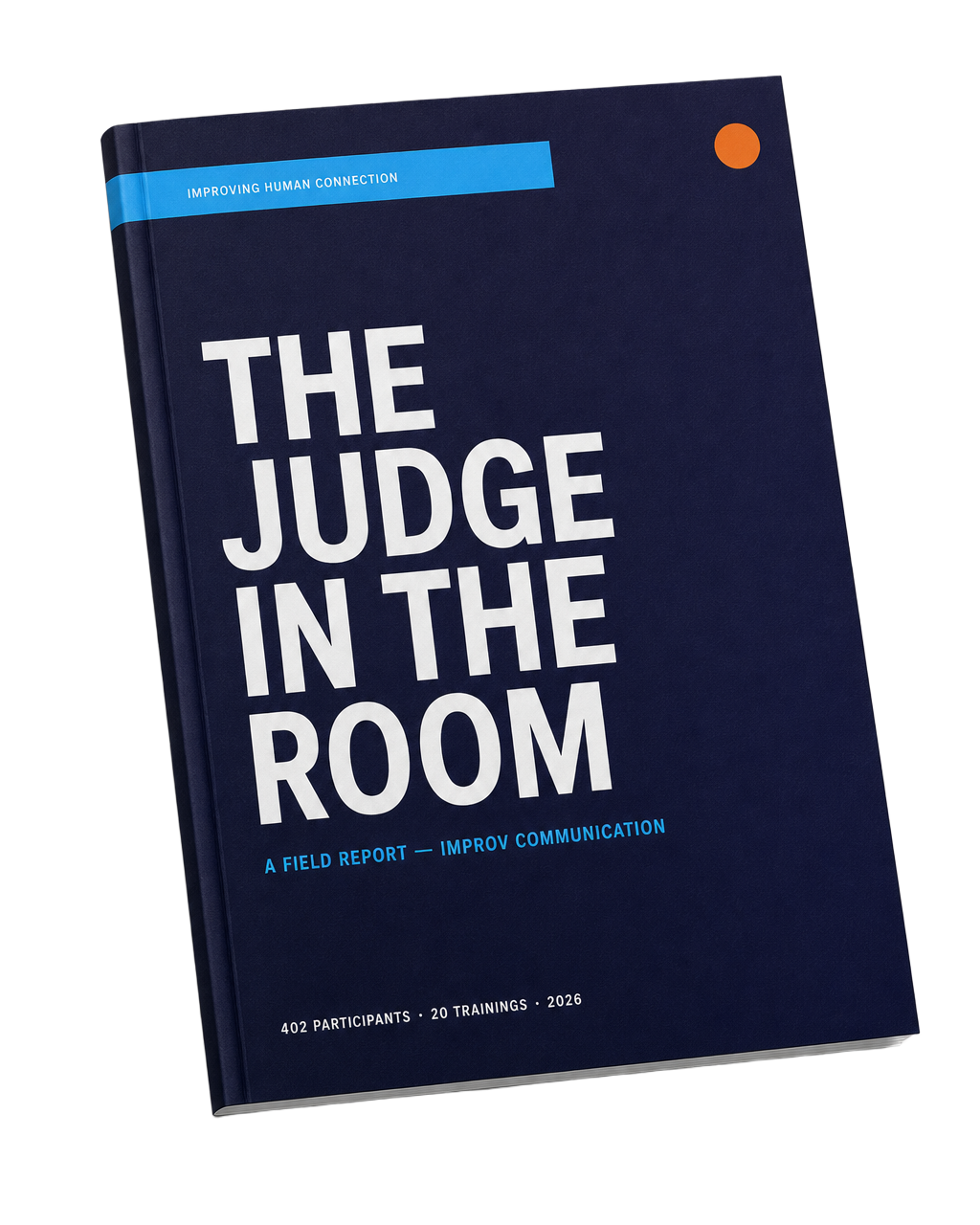
Free field report
The Judge in the Room — what 402 people told us about psychological safety.
Team building and team development are often used interchangeably, and they describe very different things. Team building tends to mean a single event — an afternoon of activities designed to lift the mood and get people talking. It has its place. The energy it creates rarely outlasts the week.
Team development is the longer work of helping a group become a genuine team: people who listen to each other, disagree well, build on each other's thinking and trust each other enough to take risks. That change happens through repeated practice over time.
Applied improv sits firmly in the second camp. It is a leadership and organisational-development methodology built on the core skills of improvisation — active listening, building on others' ideas, thinking on your feet and recovering from mistakes. Used as team development, it gives a group repeated practice at the exact behaviours collaboration depends on.
What does applied improv actually change in a team?
Three shifts show up again and again when a team practises together this way.
The first is listening. Most groups talk more than they listen; people wait for a gap to insert their own point. Applied improv exercises make listening the only way to succeed — you cannot build on a colleague's idea if you did not take it in. Teams leave paying closer attention to each other.
The second is building on each other. The principle of "Yes, and" asks people to accept what a colleague offers and add to it, rather than blocking or competing. Practised repeatedly, it changes how a group handles ideas in real meetings: fewer ideas killed on arrival, more carried into something workable.
The third is recovering from mistakes. In applied improv, small errors happen constantly and the group learns to move past them lightly. That lowers the fear of getting things wrong — the same fear that keeps people quiet in meetings.
How does it move a team through the stages of development?
Bruce Tuckman's well-known model describes teams moving through four stages — forming, storming, norming and performing (he later added adjourning). Most groups get stuck somewhere in the middle. They stay polite and cautious in forming, or they hit the friction of storming and never work through it.
Applied improv gives a team a safe place to practise the skills each stage asks for. Forming needs people to get comfortable with each other quickly, and shared, playful practice does that in an afternoon. Storming needs a group to disagree openly and recover, which improv rehearses at low stakes. Norming and performing need trust and fluent collaboration, which grow every time a team succeeds together in the room. The training gives a group repeated practice at the behaviours that carry a team through the stages.
Why does it work faster than a talk about teamwork?
You can explain good teamwork on a slide. Knowing what good collaboration looks like and doing it under pressure are two different things, and the gap between them is where most training is lost.
Applied improv closes that gap by having people practise the behaviour itself, together, with mild pressure and immediate feedback from the group. What a team practises together it tends to repeat. Habits formed in the room travel back to the meeting far better than ideas absorbed from a deck.
Is there evidence that team training works?
Yes. A meta-analysis by Eduardo Salas and colleagues (2008), covering 2,650 teams, found that structured team training has a moderate, positive effect on how teams think, feel, coordinate and perform. The strongest results come from training that is well designed for the team and reinforced over time.
There is a second, related finding. Google's Project Aristotle studied what makes teams effective and found psychological safety — the shared sense that it is safe to speak up, disagree and admit mistakes — to be the strongest predictor. Applied improv builds that safety directly, because embracing failure and making each other look good are practised in every exercise.
How IMPROV approaches team development
At IMPROV, we treat team development as a process. A session gives a team shared practice; the change shows when people carry the new habits — listening, building on each other, recovering well — back into their everyday work. Our team-development work is experiential and hands-on, grounded in five guiding principles.
If you are weighing up how to help a team work better together, our team-building and team-development training is a good place to start. You are also welcome to book an exploration call, and we will talk through what your team needs.
Free field report
The Judge in the Room
What 402 people told us about psychological safety — and what you can do with it on a Monday morning. Five findings, seven practices, participants’ own words.
Curious?
Is your team losing ideas to silence?
That's exactly what we help leaders see and shift. No pitch — just a proper conversation about your team.